L-Sit
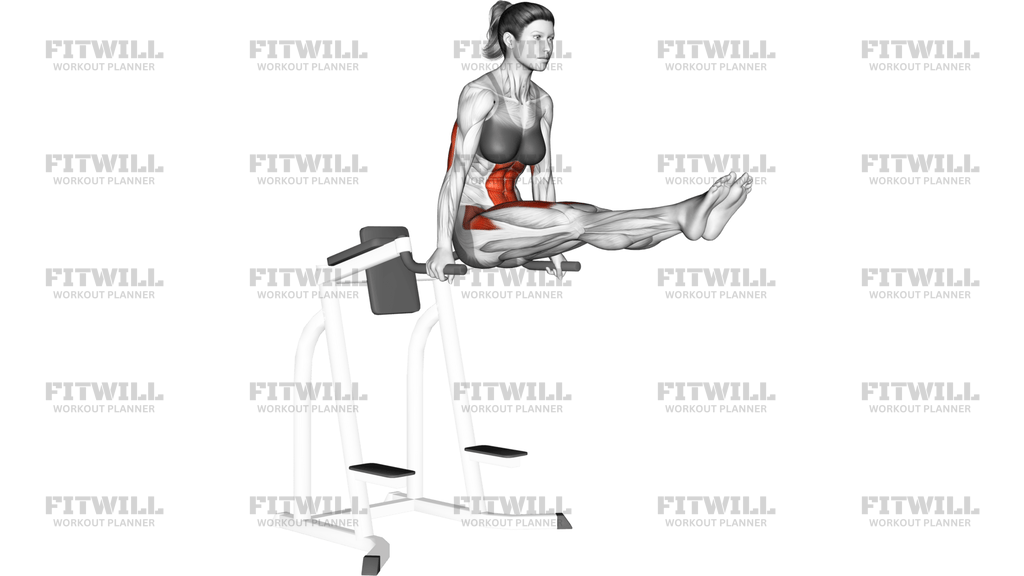
The L-Sit is a strict bodyweight core hold performed on parallel bars or a captain's chair. You support yourself on straight arms, lift the legs in front of the body, and hold the hips so the torso and feet form a clean L shape. The exercise looks simple, but it is demanding because the abs, hip flexors, and shoulder stabilizers all have to work at the same time while the body stays still.
The main job of the trunk is to keep the pelvis tucked and the ribs stacked over the hips. That is why the L-Sit is more than just a leg lift: rectus abdominis and the deep core hold the spine steady, the iliopsoas and other hip flexors create the leg raise, and the shoulders, triceps, and lower traps keep the body lifted off the bars. If the shoulders shrug or the low back arches, the hold gets much harder and the target tension is lost.
Setup matters more here than on most core drills. Place the hands firmly on the bars, lock the elbows, press the shoulders down away from the ears, and keep the chest tall without leaning back. The higher and cleaner the support, the easier it is to create space for the legs. If the full version is too demanding, a tuck L-Sit, one-leg L-Sit, or brief sets with bent knees lets you build the same pattern without breaking position.
During the hold, think about pushing the bars down while pulling the thighs up toward the ribs. Keep the feet together, toes pointed or ankles tight, and hold the legs level with the floor instead of chasing extra height. Small errors show up fast: bent elbows, shrugged shoulders, a flared rib cage, or swinging the legs to reach the position. A short, perfectly aligned hold is more useful than a long hold that turns into a rest.
The L-Sit is useful for gymnastics, calisthenics, and general core training because it builds compression strength, shoulder support, and midline control in one position. It also exposes side-to-side differences quickly, which makes it a good test and a good training tool. Use it in skill work or accessory blocks, and stop the set when the legs start to drift, the shoulders lose height, or the low back begins to arch.
Fitwill
Log Workouts, Track Progress & Build Strength.
Achieve more with Fitwill: explore over 9600 exercises with images and videos, access built-in and custom workouts, perfect for both gym and home sessions, and see real results.
Start your journey. Download today!




Instructions
- Grip the parallel bars or captain's chair handles and sit between the supports with your torso upright and your hands beside your hips.
- Lock your elbows, press the shoulders down away from your ears, and push firmly through the bars until your body is supported by straight arms.
- Lift your hips clear of the seat or pads so your weight is fully on the hands and shoulders.
- Extend both legs straight in front of you until they are level with the floor and your body makes an L shape.
- Keep the thighs together, the knees straight, and the toes pointed or feet tight so the legs do not drift apart.
- Hold the position while keeping the ribs down and the pelvis slightly tucked so the lower back does not arch.
- Breathe in short controlled breaths without losing the shoulder depression or straight-arm support.
- Lower the legs with control, briefly reset the support if needed, and repeat for the planned hold time or repetitions.
Tips & Tricks
- Set the bars or handles close enough to your hips that you can press straight down without leaning back to find the support.
- Think about pushing the floor away through the bars; that shoulder depression is what keeps the hold from collapsing into a shrug.
- If the full L-sit is too hard, bend the knees slightly or alternate one straight leg at a time before trying both legs together.
- Keep the ribs stacked over the pelvis; if the chest opens and the low back arches, the hold becomes a hip-flexor swing instead of a true L-sit.
- A shorter, cleaner hold beats a longer one with bent elbows or drifting feet.
- Use pointed toes or tight ankles to keep the line of the legs crisp and to reduce the urge to wobble.
- Short exhalations can help you maintain a tucked pelvis without losing tension in the shoulders.
- Stop the set the moment the shoulders rise toward the ears or the legs start dropping below parallel.
Frequently Asked Questions
What muscles does the L-Sit work?
It mainly trains the abs and hip flexors, with strong support from the shoulders, triceps, and deep core muscles.
Can beginners do the L-Sit on dip bars or a captain's chair?
Yes, but most beginners should start with bent knees, short holds, or one-leg variations before trying the full straight-leg position.
How should my hands and shoulders be set on the bars?
Grip the handles beside your hips, lock the elbows, and keep the shoulders pressed down so you are supporting your body instead of hanging in the joints.
How high should the legs be in an L-Sit?
The goal is to hold the legs parallel to the floor so the body forms a clear L shape from the hips to the heels.
Why do my shoulders burn before my abs?
The straight-arm support is demanding; if the shoulders shrug or the elbows unlock, the upper body takes over and the hold feels much harder.
Is it okay to bend my knees during the hold?
Yes. A tucked or bent-knee version is a good regression and lets you keep the same shoulder and core position while building strength.
What usually causes the L-Sit to fail first?
Most people lose position through the hips: the legs drop, the pelvis tips forward, or the lower back arches before the abs give out completely.
How can I make the L-Sit harder without adding weight?
Increase the hold time, straighten the knees harder, point the toes, or move from a tuck to one-leg and then to the full straight-leg version.