Barbell Squat To Shoulder Press
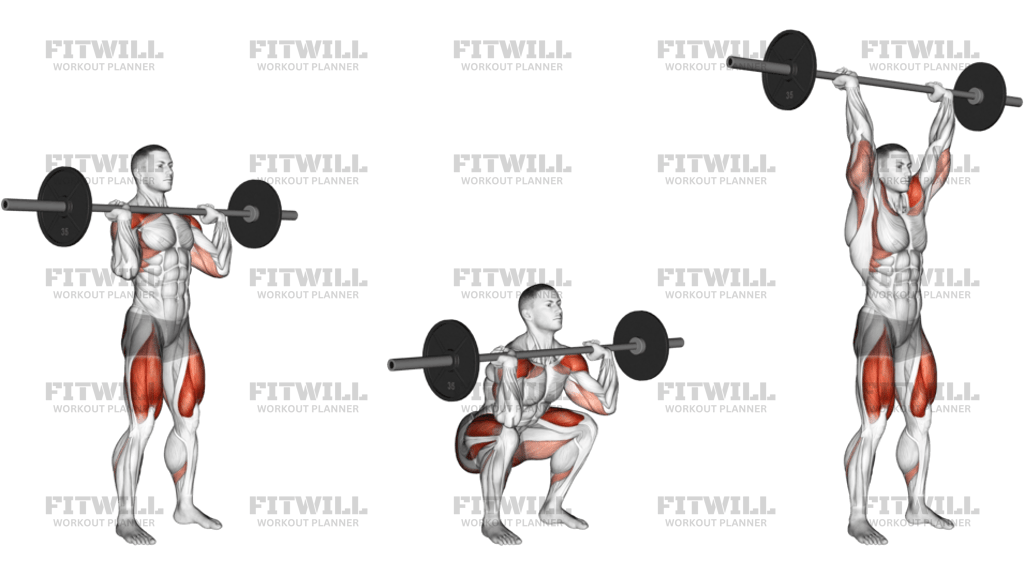
Barbell Squat To Shoulder Press is a barbell compound movement that links a front-rack squat with an overhead press. It is commonly used as a thruster-style exercise because the lower-body drive from the squat helps launch the bar into the pressing phase. The exercise asks the legs, trunk, shoulders, and arms to work together, but the main visual anchor is the barbell held at the shoulders before each descent and the straight overhead finish at the top.
The main training value comes from combining knee-dominant leg work with a strong vertical press in one continuous rep. In the metadata, the thighs are the primary emphasis and the quads are the main target, while the image shows the front rack, the deep squat position, and the locked-out overhead finish. That means setup matters: if the bar is not balanced on the front of the shoulders, the squat becomes unstable and the press turns into a low-back compensation pattern instead of a clean lift.
A good repetition starts with the bar resting across the front delts and upper chest, elbows slightly forward, feet planted, and the torso braced. From there, the lifter sits down into the squat with the heels grounded and the knees tracking over the toes. The press should begin as the body drives up from the squat, not as a separate shrug or backbend. At the top, the bar finishes over the midfoot with the arms straight and the ribs controlled, so the line from shoulders to wrists stays stacked instead of drifting behind the head.
This movement is useful for strength circuits, athletic conditioning, and full-body sessions because it trains force transfer from the legs into the upper body. It also exposes weak links quickly: limited ankle mobility, a soft front rack, poor brace control, or pressing early with the arms can all break the rep pattern. The safest version is the one you can repeat with a smooth squat, a balanced drive upward, and a press that finishes without a painful shoulder shrug or lumbar arch.
Because the exercise asks a lot from the front rack and overhead position, load choice should stay conservative enough to preserve timing and posture. Heavier sets are only worthwhile when the squat depth, bar path, and lockout remain crisp. For most users, the goal is not just standing up from the squat or just pressing overhead; it is moving through both phases with one coordinated, controlled rep.
Fitwill
Log Workouts, Track Progress & Build Strength.
Achieve more with Fitwill: explore over 9600 exercises with images and videos, access built-in and custom workouts, perfect for both gym and home sessions, and see real results.
Start your journey. Download today!




Instructions
- Hold the barbell in a front-rack position across the front of your shoulders, with your elbows slightly forward and your hands just outside shoulder width.
- Stand with your feet about shoulder-width apart, chest tall, and your weight balanced through the whole foot.
- Brace your core and keep your ribs down before you begin the squat.
- Lower into a controlled front squat by sending your hips down and back while letting your knees track over your toes.
- Keep the bar resting on your shoulders as you reach the bottom position; do not let it roll forward onto your hands.
- Drive through your heels and midfoot to stand up, then use that upward drive to press the bar overhead in one smooth rep.
- Finish with your arms straight overhead, biceps near your ears, and your head moving slightly forward under the bar.
- Lower the bar back to the shoulders under control and reset your stance before the next repetition.
Tips & Tricks
- Keep the bar in the front rack on the shoulders; if it drifts into the hands, the wrists and elbows will take over.
- Let the squat drive the press. If you press early, the rep turns into a sloppy push press with extra low-back stress.
- Keep your heels down through the squat so the bar can rise from a stable base instead of pitching forward.
- Use a grip width that lets the elbows stay slightly forward without forcing painful wrist extension.
- Exhale as you stand and press, then re-brace before the next descent so the torso does not relax between phases.
- Stop the squat at the depth you can own without the lower back rounding or the chest collapsing.
- Keep the bar path close and finish directly over the midfoot instead of drifting it in front of your face.
- Choose a weight that lets the last rep look like the first rep; this movement degrades fast when it gets too heavy.
Frequently Asked Questions
What does the Barbell Squat To Shoulder Press work most?
It mainly targets the quads, with strong help from the glutes, shoulders, triceps, and core.
Is this the same as a thruster?
Yes. The image shows the same front-squat-to-overhead-press pattern commonly called a thruster.
Where should the bar sit before I squat?
It should rest across the front of your shoulders in the front rack, not in your hands or out in front of your chest.
When do I start pressing the bar overhead?
Start the press as you finish standing up from the squat so the leg drive and shoulder press connect into one smooth rep.
How deep should the squat be?
Go as deep as you can while keeping the heels down, the chest up, and the lower back controlled.
Can beginners do this with a barbell?
Yes, but only with a light load and a clean front rack. Beginners often need to master the squat and overhead press separately first.
What if my wrists or shoulders feel uncomfortable in the front rack?
Adjust your grip width, keep the elbows a little higher, and lower the load. If pain stays sharp, use a safer variation.
What is a safer substitute if I cannot front-rack a barbell well?
A pair of dumbbells or kettlebells can be easier on the wrists while you learn the same squat-to-press pattern.