Barbell Stiff Leg Deadlift On Bench
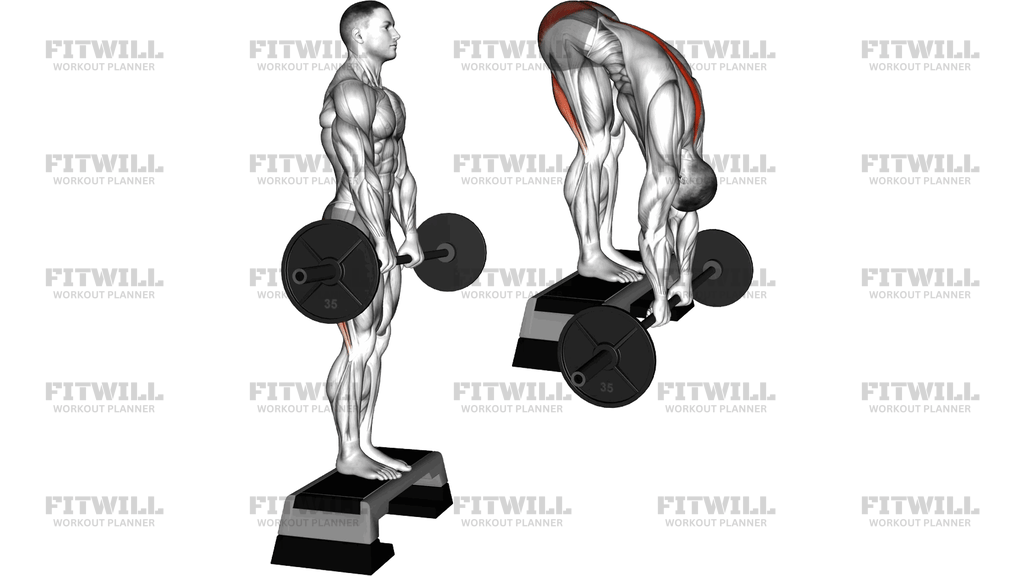
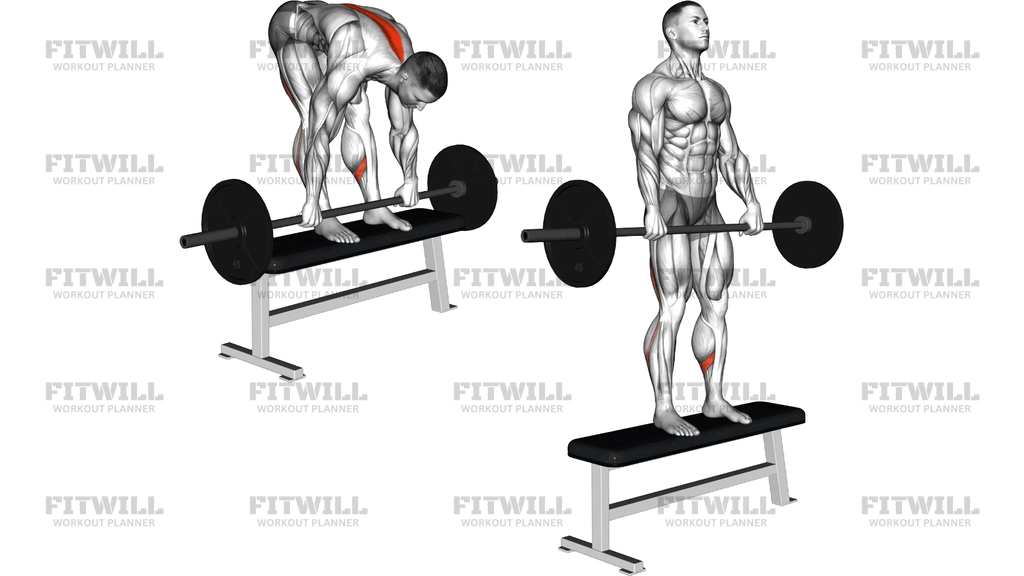
Barbell Stiff Leg Deadlift On Bench is a bench-elevated hip hinge that lets the bar travel farther below you while your feet stay fixed on a flat bench. That extra range makes the movement more demanding on balance, hamstring length, and trunk control, so the setup matters as much as the lift itself. It is best thought of as a strict posterior-chain accessory, not a heavy pull.
The exercise loads the hamstrings and glutes hard while the core, upper back, and grip keep the bar and torso organized. Because you are standing on a bench, every rep asks you to manage your foot pressure and keep your weight centered instead of drifting toward the toes or heels. That makes it useful for developing controlled strength through a longer hinge pattern.
A good rep starts with a stable bench, a hip-width stance, and a barbell held close to the thighs. The knees stay softly unlocked, but the movement should come from the hips shifting backward rather than from a squat. As you hinge down, the bar should skim the legs and the spine should stay long and neutral while the hamstrings lengthen.
The return phase is just as important: drive the hips forward, stand tall, and finish by squeezing the glutes without leaning back or bouncing through the top. Use a controlled tempo and stop the set if balance, grip, or spinal position starts to slip. This variation suits lifters who want more hamstring tension than a standard floor hinge, as long as the bench is secure and the load stays conservative.
Fitwill
Log Workouts, Track Progress & Build Strength.
Achieve more with Fitwill: explore over 9600 exercises with images and videos, access built-in and custom workouts, perfect for both gym and home sessions, and see real results.
Start your journey. Download today!




Instructions
- Place a flat, stable bench on a non-slip surface and stand on top of it with your feet about hip-width apart and fully planted.
- Hold the barbell in front of your thighs with an overhand grip, shoulders set down, chest long, and knees softly unlocked.
- Brace your midsection, keep your weight centered over the middle of each foot, and get balanced before the first rep.
- Push your hips straight back and let the bar slide down the front of your thighs and shins.
- Keep your shins nearly vertical and fold until you feel a strong hamstring stretch without rounding your lower back.
- Reverse the motion by driving your hips forward and pulling the bar back up along the same close path.
- Finish tall with the glutes squeezed, ribs stacked over the pelvis, and the bar back against the thighs.
- Reset your balance at the top, breathe, and repeat for the planned reps.
Tips & Tricks
- Start much lighter than your floor deadlift because the bench adds range and makes balance less forgiving.
- Keep the bar brushing your thighs and shins so it does not drift forward and turn the rep into a back raise.
- Keep the knees softly bent, but do not keep bending them as you lower; the hinge should stay hip-led.
- Stop the descent when your hamstrings are stretched and your pelvis starts to tuck under.
- Lower under control for two to four seconds so the eccentric tension stays on the hamstrings instead of the lower back.
- Keep your feet fully on the bench and avoid shifting toward the front edge where balance becomes unstable.
- If your grip fails before your hamstrings do, use straps or reduce the load instead of shortening the range.
- Exhale as you drive the hips forward and stand tall, then reset before the next rep instead of bouncing.
- Keep your neck neutral and look slightly ahead of the bench rather than cranking your chin up.
Frequently Asked Questions
What muscles does Barbell Stiff Leg Deadlift On Bench train?
It mainly trains the hamstrings and glutes, with the core, upper back, and grip working to keep the bar and torso stable.
Why stand on a bench for this deadlift variation?
Standing on the bench raises your feet and increases the range of motion, which creates a stronger hamstring stretch and more balance demand.
How far should the bar travel on the way down?
Lower only as far as you can keep a neutral spine and a clear hamstring stretch; do not chase depth by rounding your back.
Should my knees stay straight the whole time?
Keep them softly unlocked, but do not turn the movement into a squat. The hinge should come from the hips shifting back.
Can beginners do Barbell Stiff Leg Deadlift On Bench?
Yes, but only with a light load and a very stable bench. A floor-based Romanian deadlift is usually easier to learn first.
What is the most common form mistake?
Letting the bar drift away from the legs or rounding the lower back when the hamstrings get tight.
What if the bench feels unstable while I am standing on it?
Stop and switch to a more secure setup. If the bench shifts, the exercise is no longer safe enough for a loaded hinge.
What should I do if my grip gives out first?
Use straps or reduce the load so the set stays limited by hamstring tension instead of grip fatigue.