Dumbbell Split Jump
Dumbbell Split Jump is a plyometric lower-body exercise built around explosive leg drive, fast leg switching, and soft landings in a staggered stance. The dumbbells are held at your sides while you jump between split-squat positions, so the exercise trains power, coordination, and landing control at the same time.
This movement is not about loading heavy. The external resistance is there to challenge posture, grip, and trunk control while the legs produce the jump. Because the exercise is quick and reactive, the quality of each landing matters more than the height of the jump. If the torso collapses, the knees cave, or the feet land too close together, the set stops being a power drill and turns into sloppy impact work.
The starting position should look like a controlled split squat: one foot forward, the other back, front foot flat, back heel lifted, dumbbells hanging straight down beside the thighs, and ribs stacked over the pelvis. From that split stance, dip just enough to load the legs, then drive through both feet and switch legs in the air so the opposite foot lands forward. Absorb the landing quietly, keep the dumbbells steady, and reset immediately into the next rep.
Because this exercise uses repeated impact, the safest and most useful reps are the ones you can land cleanly. A shorter jump with balanced mechanics is better than forcing range or speed you cannot control. Keep the front knee tracking over the toes, keep the rear leg active, and let the hips and ankles soften the landing instead of snapping into a rigid position.
Dumbbell Split Jump is useful for athletes and lifters who want explosive single-leg transfer, better deceleration, and stronger split-stance control. It fits best in a power block or lower-body athletic session, usually for low-to-moderate repetitions with full recovery between sets. If the dumbbells pull you off balance or your landings get loud, reduce the load or switch to bodyweight until the jump pattern is crisp again.
[ Workout Log & Planner ]
Put your next workout in Fitwill
Keep your plan and training log ready when you are.


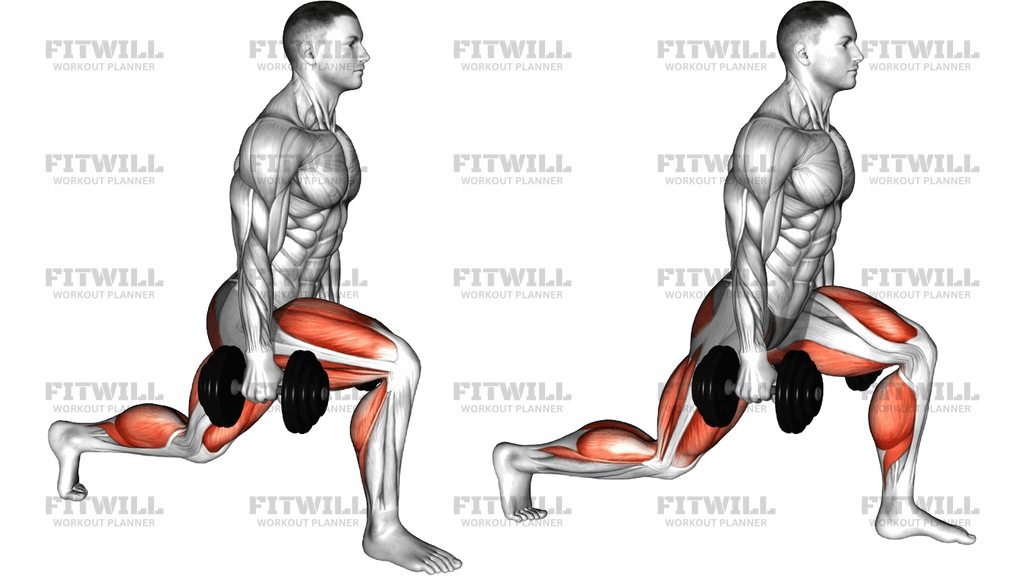
Instructions
- Stand in a split stance with one foot forward and the other back, holding a dumbbell in each hand at your sides.
- Set the front foot flat, keep the rear heel lifted, and stack your ribs over your hips before you start the first rep.
- Lower into a short split-squat dip to load both legs without collapsing the torso or drifting onto the back toe.
- Drive hard through the front heel and back toe, then jump upward and switch the legs in the air.
- Land softly in the opposite split stance with the knees bent and the feet set under control.
- Absorb the landing quietly, then immediately re-center your balance before the next jump.
- Keep the dumbbells hanging straight down and avoid swinging them to create momentum.
- Exhale as you drive off the floor and reset your breath on the landing.
- Finish the set when you can no longer land in a stable split stance.
Tips & Tricks
- Use lighter dumbbells than you would for a split squat, because the jump and landing make the exercise much more demanding.
- Keep the dumbbells still at your sides; if they swing forward, the rep is being driven by momentum instead of leg power.
- Land in the same split position every rep, with the front knee tracking over the middle toes rather than collapsing inward.
- Think of the jump as a quick exchange, not a long leap. Higher jumps usually make the landing noisier and less stable.
- Stay tall through the chest so the torso does not fold over the front thigh when you dip and switch.
- Use a short knee bend to load the legs before takeoff; sinking too deep turns the movement into a slow lunge.
- Reset your balance after every landing instead of bouncing blindly into the next rep if the stance feels off.
- If the rear foot keeps searching for the floor, reduce speed and focus on controlling the switch in midair.
- Stop the set when the landing starts getting heavy, loud, or uneven on one side.
Frequently Asked Questions
What does Dumbbell Split Jump train most?
It primarily trains explosive leg power, split-stance coordination, and landing control.
Can beginners perform this exercise?
Yes, but beginners should start with bodyweight or very light dumbbells and keep the jump short and controlled.
How heavy should the dumbbells be?
Choose a load that lets you jump and land cleanly without the weights pulling your shoulders forward or upsetting your balance.
What is the biggest form mistake?
Landing too narrow, letting the front knee cave inward, or swinging the dumbbells to create extra momentum.
Should my front foot stay flat on landing?
Yes, the front foot should land flat or nearly flat so you can absorb force through the whole leg instead of dropping onto the toes.
Do I need to jump very high?
No. A quick, controlled switch with clean mechanics is better than a big jump that makes the landing unstable.
What should I do if the dumbbells feel awkward?
Reduce the load or drop to bodyweight until you can keep the torso tall and the arms quiet throughout the set.
Where does this fit in a workout?
It works best early in a lower-body or athletic session, after warm-up and before heavy strength work.
What should I feel working most?
You should feel the quads, glutes, calves, and hips working together while the core keeps the torso steady.