Standing Knee To Chest Stretch
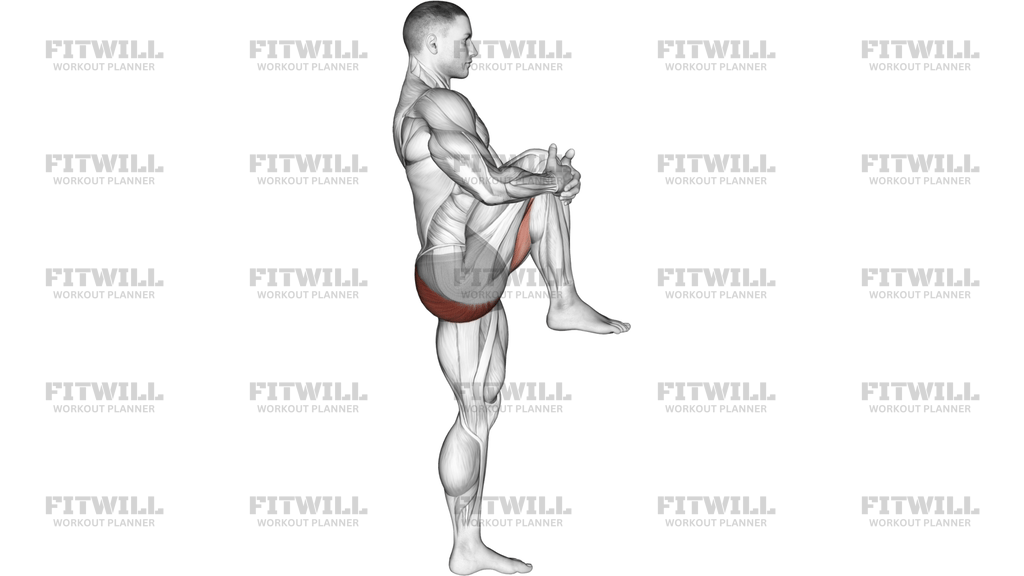
Standing Knee To Chest Stretch is a standing single-leg mobility drill that brings one knee toward the chest while the opposite leg supports your body. It is commonly used to loosen the hip and glute on the lifted side, challenge balance, and gently organize the pelvis and trunk before more demanding training. The picture matters here: this is not a kneeling stretch or a floor-based hamstring move, but an upright hold where the standing leg, ankle, and foot have to stay stable while the other hip flexes.
The main benefit comes from combining mobility with control. As you pull the thigh in, the lifted hip goes into flexion while the standing side has to keep the pelvis level and the ribs stacked over the hips. That makes the exercise useful in warm-ups, recovery sessions, and any routine where you want a controlled stretch instead of a passive flop into position. A clean rep should feel organized, not forced, and the upper body should stay tall instead of curling backward to steal range.
Setup is important because the movement is easy to cheat. If you lean back, twist the pelvis, or let the standing knee lock hard, the stretch shifts away from the target hip and into the low back or the standing leg. Hold the shin or around the front of the knee, draw the leg in until you feel a strong but comfortable pull, and keep the standing foot planted. If balance is limiting the stretch, use a wall lightly rather than collapsing through the torso.
Use a slow inhale to reset and a controlled exhale to bring the knee closer, then pause long enough to feel the hip settle before lowering again. For dynamic warm-ups, the hold may be brief and repeated in a smooth rhythm. For a static mobility hold, stay in position for longer without bouncing. Either way, the goal is the same: a repeatable, pain-free stretch that improves control of hip motion while keeping the rest of the body quiet.
[ Workout Log & Planner ]
Put your next workout in Fitwill
Keep your plan and training log ready when you are.


Instructions
- Stand tall with your feet about hip-width apart and shift your weight onto one leg.
- Lift the opposite knee and clasp the shin or the front of the knee with both hands.
- Keep the standing foot planted and the standing knee softly bent so you can balance without locking out.
- Pull the lifted thigh toward your chest until you feel a clear stretch in the hip and glute.
- Keep your ribs stacked over your pelvis instead of leaning backward to fake more range.
- Breathe out as you draw the knee in, then take a calm breath while holding the top position.
- Pause without bouncing, letting the lifted side relax into the stretch while the standing leg stays steady.
- Lower the leg under control, reset your posture, and repeat on the other side for the same number of reps or hold time.
Tips & Tricks
- Keep your chest tall; if your upper body drifts backward, the stretch shifts out of the hip and into the low back.
- Hold the shin or around the knee with enough grip to guide the leg, but do not crank on the joint.
- Think about pulling the thigh straight toward the torso instead of letting the knee fall across the body.
- A slight bend in the standing knee usually makes balance easier and keeps the pelvis from tilting.
- Use a wall or rack lightly if the standing foot is wobbling, then work toward doing the stretch unsupported.
- Keep the standing foot tripod-shaped with pressure through the heel, base of the big toe, and base of the little toe.
- If the front of the hip feels pinchy, reduce the height of the knee and avoid forcing the thigh higher.
- For warm-ups, use shorter holds and smooth reps; for recovery work, stay longer without bouncing.
- Exhale gently as the knee comes up so you do not arch through the lower back.
Frequently Asked Questions
What does Standing Knee To Chest Stretch target?
It mainly targets the lifted-side hip and glute while also challenging balance and trunk control.
Is this more of a dynamic warm-up or a static stretch?
It can be either. Use short, controlled reps before training or longer holds when you want more mobility work.
Should I hold the shin or the knee?
Either works, but holding the shin or around the front of the knee gives you better control than yanking on the leg from the side.
Why do I feel this in my balance leg so much?
All of your bodyweight is on one leg, so the standing foot, ankle, and hip have to stabilize while the other knee comes up.
Can I do this against a wall if I have poor balance?
Yes. A light fingertip contact on a wall is a good way to keep the torso upright while you learn the position.
What is a common mistake with this stretch?
The most common mistake is leaning backward or rounding the upper back instead of keeping the torso stacked over the hips.
Should the standing knee stay straight?
No. A soft knee usually works better because it helps you balance and keeps the pelvis from shifting around.
When should I stop the stretch?
Stop if you feel sharp pain, pinching in the front of the hip, or a tug in the knee joint instead of a clean hip stretch.