Neck Flexor And Rotational Stretch
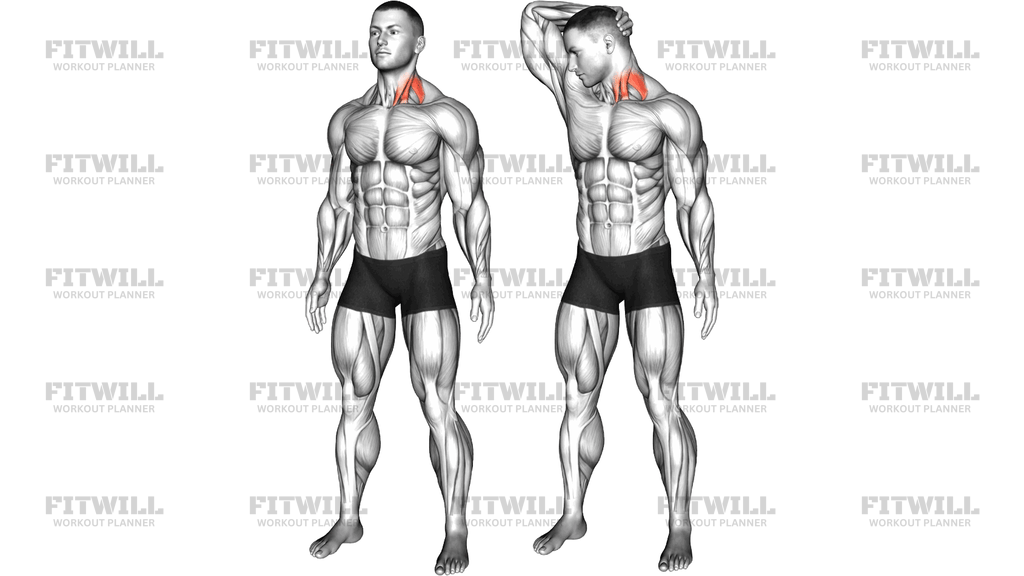
Neck Flexor And Rotational Stretch is a standing assisted neck mobility drill that uses a light hand-on-head assist to lengthen the side and front of the neck. In the pictured setup, the torso stays tall while the head moves through a controlled combination of side bend and small rotation. The goal is not to force a big range, but to create a clear stretch through the cervical muscles without letting the shoulders hike or the jaw tense up.
This movement is useful when the neck feels stiff from desk work, training posture, or repeated overhead and pulling work. The stretch can emphasize the sternocleidomastoid, scalenes, upper trapezius, and nearby stabilizers depending on the exact angle you choose. Small adjustments matter here: a slight chin tuck, a gentle turn, or a little more side bend can change where the tension lands. That is why the setup should feel calm before you start moving.
The best version is controlled and light. One hand rests on the head as a guide, not as a lever. You should feel the neck open gradually while the opposite shoulder stays dropped and the ribcage remains quiet. If you pull aggressively, shrug, or twist the torso to fake more range, the stretch stops being useful and starts becoming noisy compensation. The image shows a standing version, so a mat is optional rather than essential.
Use this stretch during a warm-up, after lifting, or as part of a mobility block when you want the neck to move more freely and comfortably. Keep the range pain-free, breathe slowly, and come out of the stretch with the same control you used to enter it. This is a precision mobility drill, not a forceful neck crank, so the win is a clean, repeatable position rather than the deepest possible angle.
[ Workout Log & Planner ]
Put your next workout in Fitwill
Keep your plan and training log ready when you are.


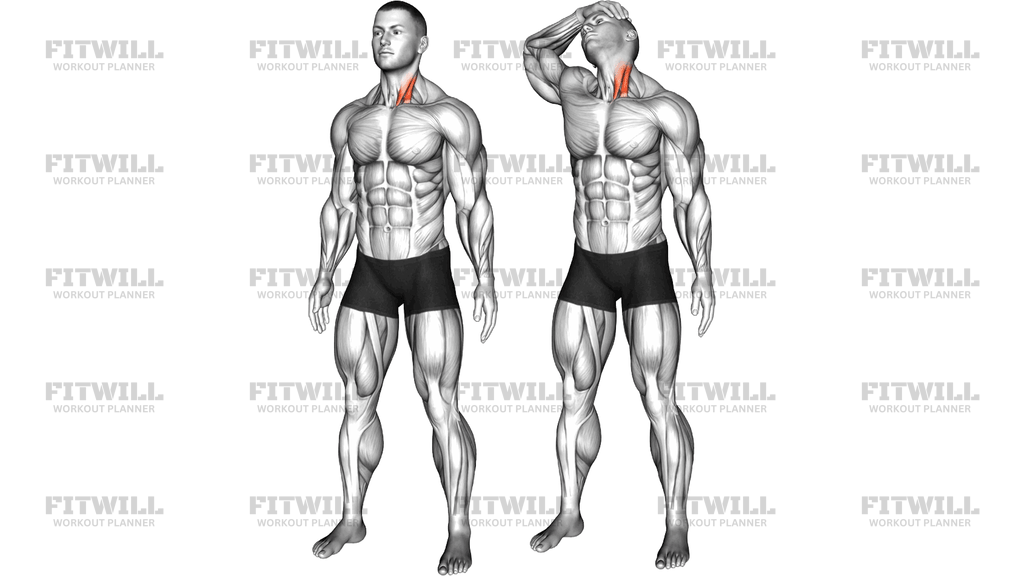
Instructions
- Stand tall with your feet about hip-width apart and your spine stacked over your pelvis.
- Place one hand lightly on top of your head and keep the other arm relaxed at your side.
- Set your shoulders down before you move so the neck, not the shoulder, does the work.
- Slowly guide your head into a gentle side bend with a small rotation until you feel a stretch in the front or side of the neck.
- Keep the hand as a light guide and avoid pulling hard on the head.
- Hold the end position without shrugging, twisting your torso, or letting your jaw clench.
- Breathe slowly and evenly while you keep the stretch.
- Return to the starting position with the same control, then repeat on the other side if needed.
Tips & Tricks
- Keep the pressure from your hand light; the stretch should come from position, not force.
- Drop the opposite shoulder before you start so the upper trap does not take over.
- A small chin tuck can help you find the front of the neck instead of collapsing backward.
- If the stretch jumps into the jaw or behind the ear, reduce the rotation and side bend.
- Keep your chest tall so you do not fold through the upper back to fake extra range.
- Breathe out slowly as you settle into the hold; that often lets the neck soften a little more.
- Do not chase symmetry by yanking harder on the tighter side.
- Stop if the stretch turns into sharp pain, tingling, dizziness, or a pinching sensation.
Frequently Asked Questions
What does Neck Flexor And Rotational Stretch work?
It mainly targets the front and side of the neck, especially the sternocleidomastoid, scalenes, and nearby upper-neck tissues.
Do I need a mat for this stretch?
No. The image shows a standing version, so you only need enough space to stand tall and move your head freely.
How hard should I pull on my head?
Very lightly. Your hand should guide the stretch, not force it.
Should my shoulders move during the stretch?
No. Keep both shoulders relaxed and down so the stretch stays in the neck instead of climbing into the upper trap.
Can beginners do this safely?
Yes, as long as the range is small, the pull is gentle, and the stretch stays pain-free.
Where should I feel the stretch most?
You should feel it along the side and front of the neck, sometimes near the upper shoulder line if the angle is tight.
How long should I hold each rep?
A short controlled hold is usually enough, with a calm breath or two before returning to center.
What should I avoid while doing this stretch?
Avoid yanking the head, twisting the torso, shrugging the shoulders, or pushing into sharp pain or tingling.