Arm Up Rotator Stretch
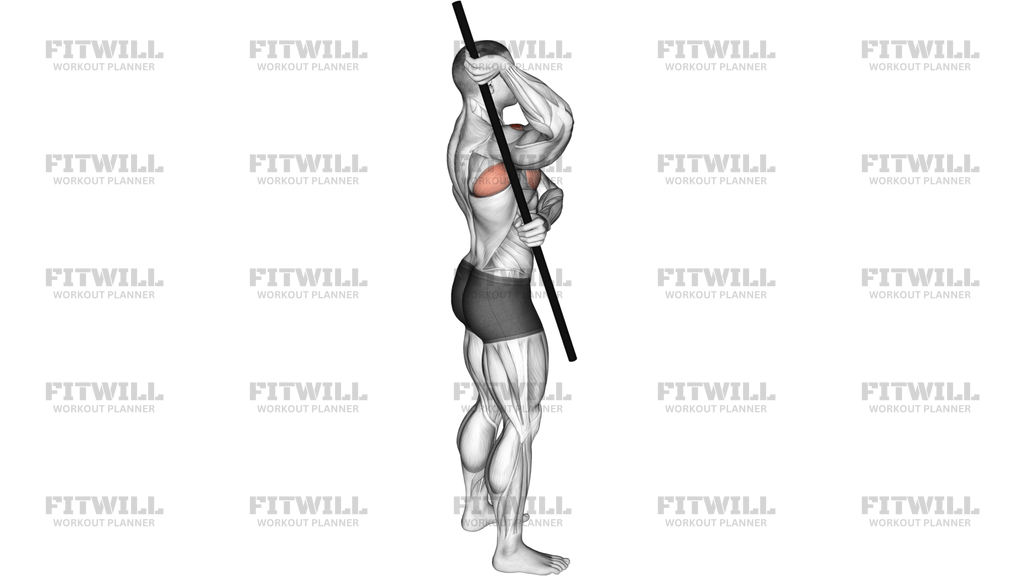
Arm Up Rotator Stretch is a standing shoulder mobility drill that uses a dowel or stick to guide one arm into an overhead reach while the other hand anchors the lower end behind the back. The long lever created by the stick keeps the arms linked, which helps you find a cleaner line through the shoulder, upper arm, and upper back without twisting or yanking the position out of place.
This stretch is usually felt across the deltoid, triceps, lat, and the back of the shoulder, with the upper back helping to stabilize the posture. It should be treated as a controlled mobility drill rather than a fast repetition. The aim is not to force the hands farther apart, but to build a steady, repeatable position where the shoulder can open while the ribs stay stacked over the pelvis.
To perform it well, stand tall with your feet planted, keep the head neutral, and let the top elbow point upward while the lower hand stays near the hip or lower back. Gently work the hands toward each other along the stick until you feel a strong but tolerable pull, then hold the position with slow breathing. If the shoulder pinches or the lower back arches to steal range, shorten the reach and reset.
Use Arm Up Rotator Stretch before pressing work, overhead lifting, throwing, or any session where shoulder rotation and overhead comfort matter. It can also be useful after upper-body training when the front of the shoulder, triceps, or lats feel tight. The stretch should feel like organized tension through the shoulder line, not pain in the joint. If you cannot keep the neck relaxed or the torso upright, reduce the range and make the position easier.
[ Workout Log & Planner ]
Put your next workout in Fitwill
Keep your plan and training log ready when you are.


Instructions
- Stand tall with your feet about hip-width apart and hold the dowel or stick vertically along the side of your body.
- Reach one arm overhead and bend the elbow so the hand settles behind or near the upper back.
- Slide the other hand behind the lower back and grasp the lower end of the stick.
- Keep your chest lifted, ribs stacked, and head neutral before you move into the stretch.
- Gently walk your hands toward each other until you feel a strong but tolerable pull through the shoulder line.
- Breathe slowly and let the exhale soften the stretch without letting the torso collapse.
- Hold the top position with control, then release the tension gradually instead of snapping out of it.
- Switch sides and repeat with the same posture and range on the other shoulder.
Tips & Tricks
- Keep the top elbow pointing up instead of drifting forward, or the stretch turns into a twist.
- Do not arch the lower back to fake extra shoulder range; keep the ribs stacked over the pelvis.
- Let the lower hand limit the stretch only as far as the shoulder can control without pain.
- A slow exhale usually helps the shoulder settle deeper than forcing the position with extra pressure.
- If you feel a pinch at the front of the shoulder, shorten the overhead arm before holding the stretch.
- Use the stick to keep the arms connected; if it drifts away from the body, the tension gets messy.
- Hold each side long enough to feel the tissue lengthen, but never bounce in and out of the end range.
- Stop immediately if you get sharp pain, tingling, or a numb sensation down the arm.
Frequently Asked Questions
What does Arm Up Rotator Stretch target most?
It mainly targets the deltoids and the surrounding shoulder tissues, with the triceps, lats, and upper back assisting in the stretch.
Do I need a dowel or can I use something else?
A dowel is ideal, but a broomstick, PVC pipe, or any long straight bar can work as long as it lets both hands stay linked.
Should I feel this in my neck?
No. Keep the neck relaxed and avoid shrugging the top shoulder toward your ear.
Why do I need to keep my ribs down?
If the ribs flare and the lower back arches, you can fake more range than the shoulder actually has.
Can beginners do this stretch?
Yes. Beginners should start with a smaller reach and a lighter overhead position, then build range gradually.
What is the most common mistake?
Forcing the hands farther apart or twisting the torso to make the stretch look bigger than it really is.
What if one shoulder feels much tighter than the other?
Use the tighter side as your reference, stay in a pain-free range, and match the other side without forcing extra depth.
When should I use this in a workout?
It fits well in a warmup before pressing or overhead work, or after training when the shoulders and lats feel tight.