Walking On Stepmill
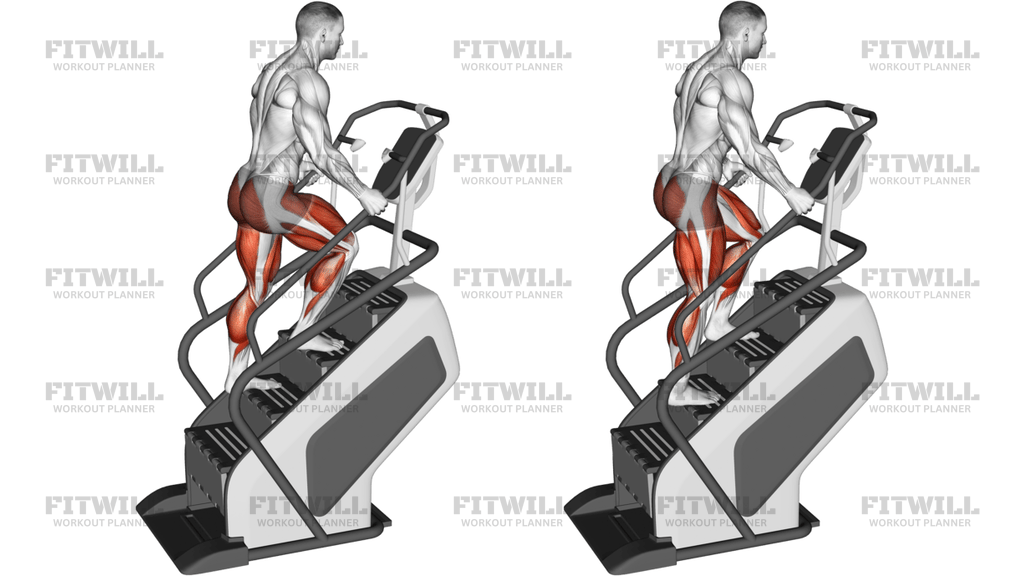
Walking on a stepmill is a continuous climbing pattern that trains the thighs while also demanding rhythm, balance, and conditioning. Each step places the working leg in repeated hip and knee flexion and extension, so the quads do a lot of the visible work while the glutes, calves, and trunk help you stay tall and controlled. Because the machine keeps moving under you, the quality of the setup matters as much as the pace.
This movement is useful when you want lower-body work that is more joint-friendly than sprinting but still challenging enough to raise heart rate and accumulate meaningful leg fatigue. The primary emphasis is on the quads, with support from the glutes, calves, hamstrings, and core as you stabilize against the moving steps. If you lean heavily on the handrails or bounce through the top of each stride, the exercise quickly shifts away from clean leg work and into momentum.
The best reps start before the first step. Stand upright on the pedals, keep the feet flat and centered on each tread, and hold the handles lightly instead of hanging on them. A small forward lean from the ankles is fine, but the chest should stay open and the pelvis should stay stacked so the hips can keep driving the climb. That setup keeps the stepping action smooth and reduces wasted motion through the lower back and shoulders.
During the climb, press the whole foot through the tread, let one leg finish the step before the other takes over, and keep the cadence steady enough that each step still looks deliberate. Lower the trailing foot with control instead of dropping your weight onto it. Breathe in a steady rhythm that matches the pace, and keep the stride consistent from the first minute to the last.
Walking on a stepmill fits well in warmups, conditioning blocks, fat-loss phases, and lower-body endurance sessions. It is also a practical option when you want to build work capacity without complex technique. Choose a pace and duration that let you maintain posture, control, and repeatable steps. The goal is not to sprint the machine; it is to climb efficiently enough that your legs do the work and your form stays organized.
Fitwill
Log Workouts, Track Progress & Build Strength.
Achieve more with Fitwill: explore over 9600 exercises with images and videos, access built-in and custom workouts, perfect for both gym and home sessions, and see real results.
Start your journey. Download today!




Instructions
- Step onto the machine one foot at a time and place the whole foot flat on each tread before the belt starts moving.
- Stand tall between the handles with a light grip, soft knees, and your weight centered over the middle of each foot.
- Set a small forward lean from the ankles, not the waist, so your torso stays long while you climb.
- Press through the front half of the foot and drive one step fully before the other leg takes over.
- Keep the pelvis level and let the hips rise smoothly instead of rocking side to side.
- Let the back foot leave the tread only after the working leg has taken your full body weight.
- Match your breathing to the pace and avoid holding your breath as the steps get harder.
- Stay on the same cadence and posture through the set, then step off carefully when you finish.
Tips & Tricks
- Keep only a light hold on the rails; using your arms to pull can turn the exercise into a partial upper-body support drill.
- If your heels are hanging off the back of the tread, reset your foot so the whole sole can press the step cleanly.
- A slightly slower cadence is often better than rushing, because it lets the quads and glutes finish each step instead of bouncing through it.
- Do not collapse into the handles when you get tired; a long torso makes the climbing pattern much more efficient.
- Shorten the stride if your hips start rocking or your knees cave inward on the rising step.
- Use the handrails for balance only, especially when you are starting out or increasing the resistance.
- Keep your gaze forward or slightly down so your neck stays relaxed and your chest does not fold toward the console.
- Stop the set if your foot placement becomes sloppy, because missed steps on a moving machine increase the risk of a slip.
Frequently Asked Questions
What muscles does walking on a stepmill work most?
The quads do most of the visible work, but the glutes, calves, hamstrings, and core all help keep each step controlled.
Is the stepmill more of a leg exercise or a cardio exercise?
It is both: the legs produce the climb, while the continuous stepping makes it a strong conditioning movement.
Should I hold the handrails while climbing?
Use the rails for light balance only. If you are pulling hard through the arms, the legs are no longer doing most of the work.
How do I keep from leaning too far forward on the stepmill?
Keep your chest open, hinge slightly from the ankles, and avoid folding at the waist or dumping your weight into the handles.
What is a common form mistake on a stepmill?
Taking short, bouncing steps and letting the hips sway side to side are two of the biggest technique breakdowns.
Can beginners use the stepmill?
Yes. Start at a conservative speed, keep both hands ready on the rails, and learn the foot rhythm before adding duration.
Where should my feet land on each tread?
Place the whole foot on the center of the tread so you can push through the step without slipping or hanging off the edge.
How can I progress this movement over time?
Progress by extending the work time, increasing the pace slightly, or maintaining cleaner posture at the same intensity.