Plank Butt WRONG-RIGHT
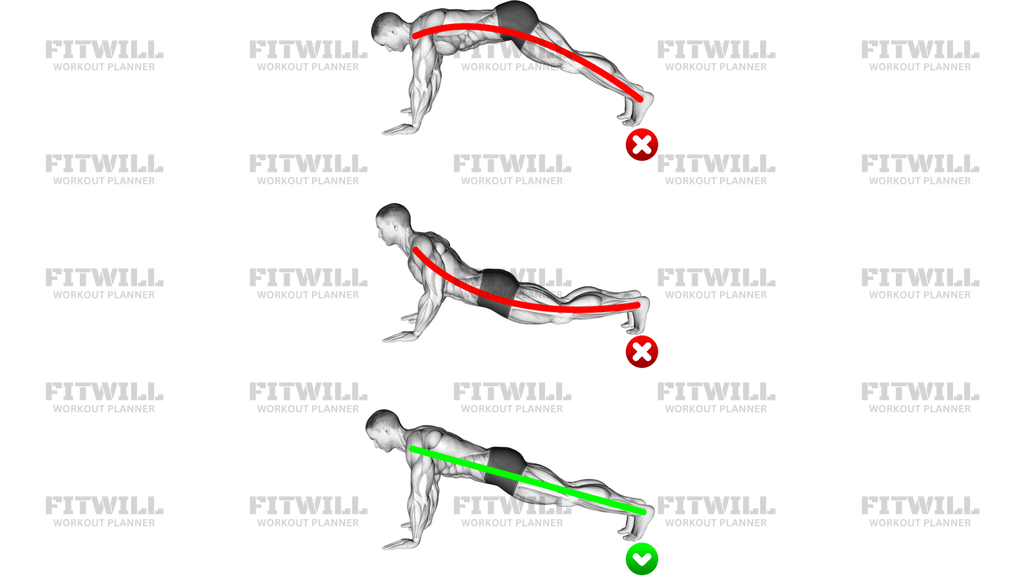
This exercise is a straight-arm plank performed as a form check: one version of the body line is too high at the hips, one sags at the midsection, and the correct position keeps the head, shoulders, hips, knees, and heels in one long line. It is a bodyweight anti-extension hold that trains the abs, deep core, and shoulder stabilizers to keep the trunk rigid while the arms support your body.
The image matters here because the goal is not to squeeze out a bigger range of motion. The goal is to hold a clean alignment with enough tension that the lower back does not arch and the pelvis does not drift upward. That makes this plank useful for core endurance, bracing practice, and learning how to keep the ribs stacked over the pelvis during loaded or athletic movements.
Start by placing the hands under the shoulders and stepping the feet back until the legs are straight. From there, press the floor away, tighten the glutes, and draw the ribs down without holding your breath. If the hips rise too high, the abs stop doing most of the work; if the hips sag, the low back takes over. The correct rep or hold feels long, steady, and organized from the crown of the head to the heels.
This is a good choice for beginners and advanced trainees alike because the difficulty comes from position and tension, not load. Use it in warm-ups, core circuits, or accessory work when you want to build cleaner plank mechanics, better shoulder support, and stronger bracing habits for presses, carries, squats, and running.
Keep the set honest: stop when you can no longer keep the body in a straight line or when your breathing gets choppy. Quality matters more than time. A short, perfect plank is more useful than a long hold with hips too high, a sagging lower back, or shrugged shoulders.
[ Workout Log & Planner ]
Put your next workout in Fitwill
Keep your plan and training log ready when you are.


Instructions
- Place your hands on the floor directly under your shoulders and step your feet back until your legs are straight.
- Set your feet about hip-width apart so you can balance without twisting side to side.
- Lock your ribs down and squeeze your glutes before you take weight through the hands.
- Press the floor away so your shoulder blades stay active instead of collapsing toward your ears.
- Hold your head in line with your spine and keep your eyes on the floor a short distance ahead of your hands.
- Keep the hips level with the shoulders and heels, avoiding the high-hip and sagging-back positions shown in the image.
- Breathe slowly through the nose or a controlled exhale while maintaining full-body tension.
- Hold for the planned time, then lower one knee at a time if you need to reset safely.
Tips & Tricks
- If your hips creep upward, shorten the hold and focus on pushing the floor away while squeezing the glutes harder.
- If your low back sags, widen your stance slightly and bring your ribs down before the next attempt.
- Keep the hands stacked under the shoulders; drifting far forward loads the front delts and makes the plank harder to hold.
- Think of reaching the heels back and the crown of the head forward so the body stays long without breaking at the waist.
- A mild posterior pelvic tilt helps keep the abdomen active and prevents the pelvis from dumping forward.
- Do not let the shoulders shrug into the neck; the upper back should feel strong, not compressed.
- Exhale under control every few seconds instead of holding your breath until the end of the set.
- Stop the set the moment the straight line disappears, because the wrong positions in the image are the easiest ones to drift into.
Frequently Asked Questions
What is the main goal of this plank?
To keep a straight line from head to heels while the abs and shoulder stabilizers resist the body dropping or piking.
Should my hips be high or low in a correct plank?
Neither. The correct position keeps the hips level with the shoulders and heels, unlike the two incorrect positions shown in the image.
Where should I feel the exercise most?
You should feel it mainly in the abs and deep core, with support from the shoulders, glutes, and upper back.
Can I do this on my forearms instead of my hands?
Yes. A forearm plank is a useful variation if straight-arm support bothers your wrists or if you want a slightly different shoulder angle.
Why do my shoulders burn before my abs?
That usually means your shoulder blades are not staying active or your hands are drifting too far forward. Stack the shoulders over the wrists and press the floor away.
What is the most common form mistake?
Letting the hips rise too high or sink too low. Both mistakes reduce core tension and turn the plank into a less effective hold.
Is this exercise suitable for beginners?
Yes. Beginners can start with shorter holds, a wider foot stance, or a knee plank and build up to the full version.
How do I make the plank harder without changing the exercise completely?
Use longer holds, bring the feet closer together, or add controlled shoulder taps once you can keep the trunk perfectly still.