Split Squat
Split Squat is a bodyweight lower-body exercise built around a fixed split stance, where one foot stays forward and the other stays back while you lower and rise under control. It is a simple-looking movement that asks for a lot of coordination: the front leg has to absorb most of the load, the hips have to stay square, and the torso has to stay stacked so each rep feels smooth instead of wobbly.
This version of Split Squat is especially useful when you want to train the glutes, hips, and supporting muscles without needing external load. The front leg does most of the work, with the rear leg acting mainly as a balance point, so the exercise is excellent for building single-leg strength, stability, and control. It also teaches you how to keep pressure through the whole front foot instead of bouncing between toes and heel.
The setup matters more than most people expect. A stance that is too short turns the movement into a cramped knee-dominant squat, while a stance that is too long makes it hard to stay balanced and get clean depth. Split Squat works best when the front foot stays flat, the rear heel stays lifted, and the hips point straight ahead as you descend. That position lets the front glute and thigh work through a useful range without twisting or collapsing.
On each repetition, lower straight down by bending both knees rather than stepping forward or backward. Keep the front knee tracking over the middle toes, let the rear knee travel toward the floor, and stop at a depth you can control without losing posture. Then drive through the front heel and mid-foot to stand back up. A small pause at the bottom can make the movement more honest and keep momentum from taking over.
Split Squat is a strong choice for warmups, accessory work, rehab-style strength building, or any session where you want unilateral leg work with a low equipment requirement. It can also reveal side-to-side differences quickly, which makes it useful when one hip or leg feels less stable than the other. Keep the reps clean, avoid rushing the descent, and adjust stance length before chasing more depth or speed.
[ Workout Log & Planner ]
Put your next workout in Fitwill
Keep your plan and training log ready when you are.


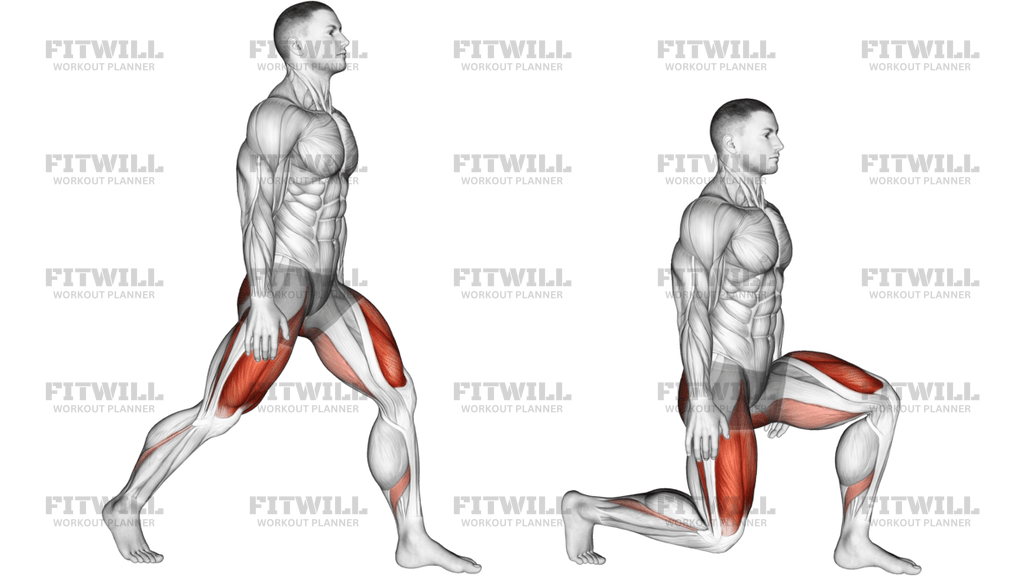
Instructions
- Stand in a split stance with your front foot flat, your rear foot on the ball of the foot, and enough space between your feet to lower straight down.
- Square your hips and chest forward, keep your torso tall, and let your arms hang at your sides or rest on your hips for balance.
- Brace your abdomen lightly before you descend so your ribs stay stacked over your pelvis.
- Bend both knees and lower your body straight down, keeping most of your weight over the front leg.
- Track the front knee over the middle toes and let the rear knee travel toward the floor without twisting the hips.
- Lower until the rear knee hovers just above the floor or makes a soft, controlled touch if your mobility allows it.
- Pause briefly at the bottom, then drive through the front heel and mid-foot to stand back up.
- Finish each rep by fully extending the front hip and knee without locking the knee hard, then reset your stance before the next rep or switch sides.
Tips & Tricks
- Take a longer stance if your front heel lifts or your torso collapses forward at the bottom.
- Keep pressure through the front heel, big toe, and little toe so the front foot does not roll inward.
- A small forward lean from the hips is fine if it helps you feel the front glute work, but keep your spine long.
- If the rear knee slams into the floor, shorten the range and keep the descent smoother.
- Use the floor as a light tap, not a bounce, so the front leg still does the work.
- Keep the front shin angled naturally; forcing it perfectly vertical often makes the stance too long.
- Hold onto a rack upright or wall lightly if balance limits your leg work more than the muscles do.
- For more glute emphasis, keep the stance slightly longer and push the floor away through the front heel.
- For more quad emphasis, stay a little more upright and shorten the stance slightly.
- Stop the set when your front knee caves inward or your pelvis starts rotating toward the back leg.
Frequently Asked Questions
What muscles does Split Squat work most?
Split Squat mainly trains the glutes and front-leg thigh muscles, with the hips and core helping you stay steady.
How is Split Squat different from a lunge?
Split Squat keeps your feet planted in one staggered stance, so you drop straight down and back up instead of stepping through each rep.
Should my rear knee touch the floor in Split Squat?
It can lightly touch if that feels controlled, but you do not need to slam it down. A soft hover just above the floor is enough for most people.
Where should my front knee track during Split Squat?
Your front knee should travel in line with the middle toes instead of collapsing inward or drifting way outside the foot.
Can beginners do Split Squat?
Yes. Bodyweight Split Squat is a good starting point if you keep the stance comfortable and use a support point for balance when needed.
How do I make Split Squat hit the glutes more?
Use a slightly longer stance, keep the front foot flat, and think about pushing the floor away through the front heel as you stand.
Why do I feel Split Squat mostly in my balance leg?
If the stance is too narrow or too short, the rear leg can take over. Widen the stance slightly and keep most of your weight on the front leg.
What should I do if Split Squat hurts my front knee?
Shorten the range, lengthen the stance a little, and keep the knee tracking over the toes instead of caving inward.