Barbell Split Squat
Barbell Split Squat is a unilateral lower-body strength exercise performed with a barbell racked across the upper back while you work from a split stance. One foot stays planted forward, the other stays back on the ball of the foot, and each rep trains the front leg and hip to control the descent, absorb load, and drive the body back to standing without losing balance.
The exercise is especially useful when you want to build stronger glutes, quads, and adductors while also challenging the hips and trunk to stay square. Because the stance is staggered, the working side has to stabilize the pelvis and torso while the rear leg provides balance rather than power. That makes the movement a good choice for strength work, hypertrophy, asymmetry correction, and athletes who need better single-leg force production.
Setup matters more here than in a bilateral squat because the length of your stance changes the feel of the rep. A longer stance usually lets the front hip work harder and keeps the torso more upright, while a shorter stance shifts more stress toward the knee and quad. The bar should sit securely on the traps or rear delts, the front foot should stay flat, and the rear heel should remain lifted with only the toes or ball of the foot touching down for balance.
To perform the rep well, lower straight down between your feet by bending the front knee and hip together. Keep the front knee tracking in line with the toes, let the rear knee travel toward the floor, and stop at the depth you can control without the torso folding or the pelvis twisting. Drive up through the whole front foot, finish by standing tall over the front leg, and reset the split stance before the next rep if you need to regain balance.
Use Barbell Split Squat when you want a loaded single-leg movement that is more stable than a rear-foot-elevated split squat but still demanding enough to expose side-to-side weaknesses. It works well in lower-body strength sessions, accessory work, or athletic prep. Keep the load honest, control the descent, and stop the set if your front heel lifts, your hips turn, or the bar starts to drift off the midline.
Fitwill
Log Workouts, Track Progress & Build Strength.
Achieve more with Fitwill: explore over 9600 exercises with images and videos, access built-in and custom workouts, perfect for both gym and home sessions, and see real results.
Start your journey. Download today!




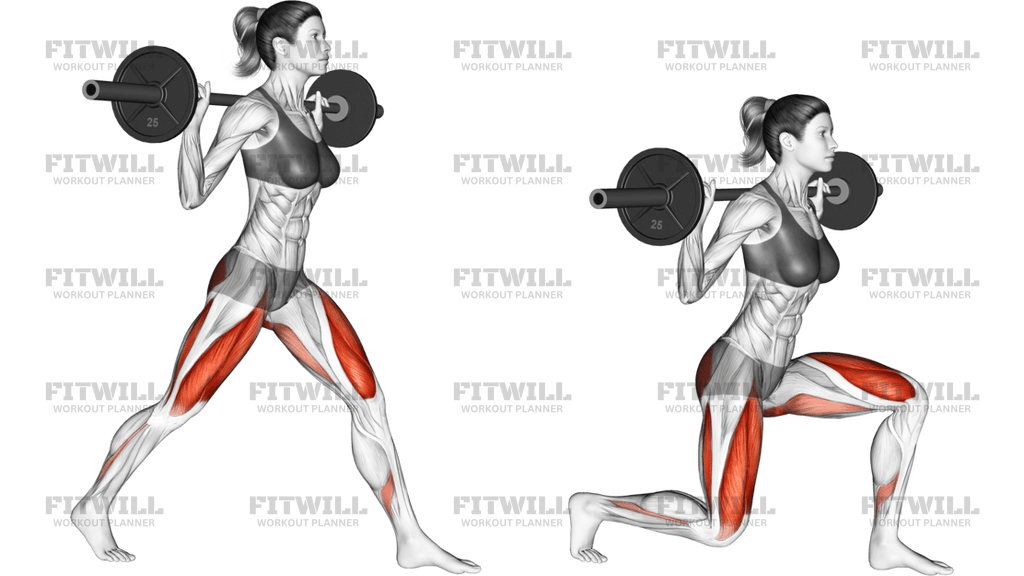
Instructions
- Set the bar across your upper back, brace it with both hands, and step out into a split stance with the front foot flat and the rear heel lifted.
- Place the front foot far enough ahead that you can lower straight down without the torso collapsing or the rear knee drifting too far back.
- Square your hips and ribs, keep your chest tall, and take a breath to brace your trunk before the first rep.
- Lower by bending the front knee and hip together, letting the rear knee travel toward the floor between your feet.
- Keep the front knee tracking over the middle toes while the front heel stays planted and the bar stays level.
- Descend until the rear knee hovers just above the floor or the front thigh reaches the depth you can control cleanly.
- Drive through the whole front foot to stand up, squeezing the front glute as you return to the top.
- Reset your stance and breathe before the next repetition, or rack the bar once the set is complete.
Tips & Tricks
- A slightly longer stance usually shifts more work to the front hip and glute; a shorter stance makes the front knee and quad do more of the job.
- Keep the bar pinned to the same spot on your upper back so the torso does not rotate or tip to one side as you lower.
- Think about dropping straight down between your feet instead of lunging forward with the chest.
- Use the rear leg only for balance; if you can push off it hard, the stance is probably too narrow or too short.
- Keep the front foot tripod rooted on the heel, base of the big toe, and base of the little toe to prevent wobbling.
- Let the rear knee travel down and slightly forward rather than reaching it far behind you.
- Exhale as you drive up through the sticking point, then re-brace before the next rep.
- If the front knee caves inward or the pelvis twists, reduce the load or shorten the range until the pattern stays clean.
Frequently Asked Questions
What muscles does the Barbell Split Squat train most?
It mainly trains the front leg glutes and quads, with the adductors, hamstrings, and trunk helping to stabilize the split stance.
Is this the same as a Bulgarian split squat?
No. In this version the rear foot stays on the floor behind you, while a Bulgarian split squat places the rear foot on a bench or box.
How far apart should my feet be in the split stance?
Long enough that you can lower straight down with the front heel flat and the rear knee close to the floor, but not so long that you have to lean forward to balance.
Should my front knee travel past my toes?
It can travel slightly past the toes if the heel stays planted and the knee tracks in line with the toes, but you should not force extra depth by collapsing forward.
How do I know if my stance is too short?
If your front knee shoots forward, your heel pops up, or the set feels like a lunge instead of a vertical drop, the stance is probably too short.
Can beginners use the Barbell Split Squat?
Yes, but only with a light load and enough balance to keep the pelvis level and the bar steady. Many beginners should learn the pattern with bodyweight first.
What is the most common form mistake?
Letting the torso fold or the hips twist as you descend. That usually means the stance is off or the load is too heavy.
When should I use this exercise in a workout?
It fits well in lower-body sessions, single-leg strength work, or accessory blocks after your main squat or deadlift pattern.