Barbell Curtsey Lunge
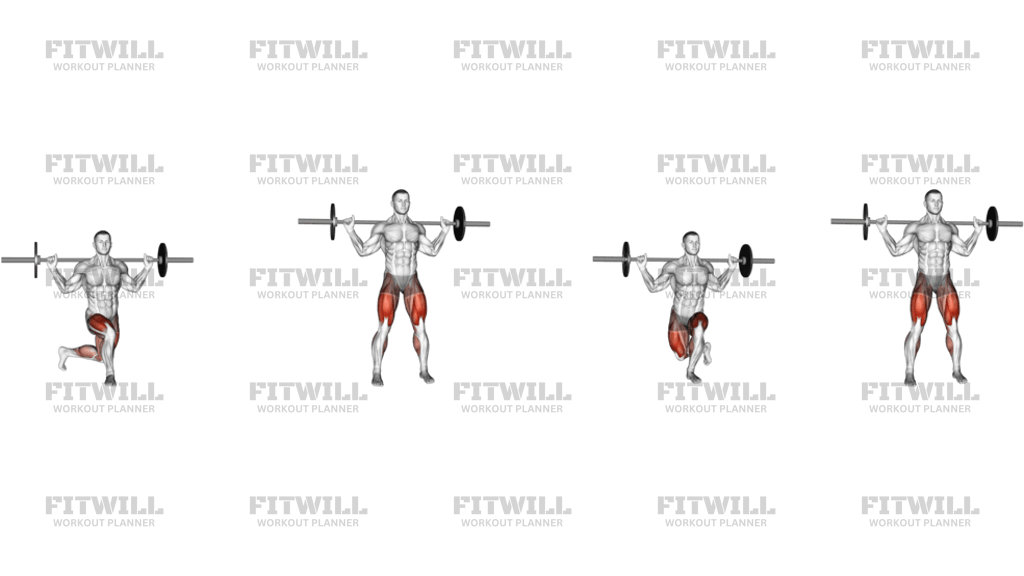
Barbell Curtsey Lunge is a loaded single-leg squat pattern that challenges the glutes, hips, and trunk while the rear leg steps behind and across the body. With the barbell supported across the upper back, the exercise asks one leg to stabilize, lower, and drive the body back to standing while the opposite hip controls the crossing motion.
That cross-behind path is what makes the curtsy lunge different from a regular reverse or split lunge. The front foot stays planted, the working knee tracks over the toes, and the pelvis has to stay level while the rear leg sweeps behind the stance leg. Done well, the movement builds strong glutes, adductors, and hip stabilizers while also demanding enough torso control that the trunk does not twist or collapse.
The setup matters. Place the bar securely across the upper back, stand tall, and choose a stance width that lets you step back and across without crossing so far that you lose balance. The front heel should stay rooted as you descend, and the torso should remain proud rather than folding forward. A controlled curtsy step should feel like a smooth diagonal drop, not a forced twist through the knee or hip.
On each rep, lower under control until the rear knee approaches the floor, then drive through the front heel and midfoot to come back up. The front hip and glute should do most of the work, with the core bracing to keep the ribcage stacked over the pelvis. Keep the bar path steady and the shoulders quiet so the legs, not the upper body, create the movement.
Use Barbell Curtsey Lunge when you want a lower-body strength accessory that favors unilateral control, glute emphasis, and hip stability. It fits well in hypertrophy blocks, athletic assistance work, or lower-body sessions where balance and coordination matter. Start light, own the diagonal step, and stop the set if the knee caves inward, the back foot lands too wide, or the bar starts to bounce on your shoulders.
[ Workout Log & Planner ]
Put your next workout in Fitwill
Keep your plan and training log ready when you are.


Instructions
- Place a barbell across your upper back, stand tall with feet about hip-width apart, and brace your core before the first rep.
- Fix your front foot on the floor and pick a working leg to move first.
- Step that leg diagonally back and across behind the stance leg, keeping your torso facing forward.
- Lower until the rear knee is close to the floor and the front knee stays aligned over the toes.
- Keep most of your weight on the front heel and midfoot as you descend.
- Drive through the front leg to rise back to standing without letting the torso twist.
- Reset your stance under control, then repeat on the same side or alternate sides as planned.
- Exhale as you drive up and inhale on the way down.
Tips & Tricks
- Keep the step diagonal, not straight behind you; a true curtsy path should feel like the back knee moves behind the stance leg, not into a twisting lunge.
- If the front heel wants to lift, shorten the step and widen the stance slightly so the front leg can stay planted.
- Think about sitting between the front hip and the rear leg rather than collapsing onto the front knee.
- Do not let the front knee cave inward as you stand; drive it in line with the second or third toe.
- A lighter barbell usually works better than a heavy one because the cross-behind step makes balance the limiting factor before strength.
- Keep the ribs stacked over the pelvis so the lower back does not arch to compensate for the diagonal step.
- Move slowly on the way down so you can keep the rear foot light and controlled instead of reaching hard for the floor.
- If the bar shifts or bounces on your back, reset before the next rep rather than trying to save the set.
- Start with shallow reps and only deepen the lunge if the front heel, knee, and pelvis stay stable.
Frequently Asked Questions
What muscle does Barbell Curtsey Lunge target most?
The glutes are the main target, especially the working-side hip as it controls the drop and drives you back to standing.
Can beginners perform this exercise?
Yes, but beginners should keep the bar light and start with a short, controlled diagonal step so balance does not break the movement pattern.
Where should the bar sit during the lunge?
It should rest across the upper back like a back squat, with the elbows angled down enough to keep the bar stable without shrugging.
What is the biggest mistake in a curtsy lunge?
Crossing too far behind is the most common error because it twists the hips and puts the front knee in a weak position.
Should my front knee move inward or outward?
It should stay in line with the toes. A little natural travel is fine, but the knee should not cave inward as you stand.
Why do I feel this more in one glute than both?
That is normal because the front leg carries most of the load. The standing-side glute and hip stabilizers do the majority of the work.
What should I do if the diagonal step feels awkward?
Reduce the depth, use a shorter step, and keep the torso square to the front. Once the pattern feels smooth, you can widen the range.
What is a good variation if my knees dislike the cross-behind position?
A reverse lunge or split squat is a better choice because it keeps the legs in a more straightforward path.