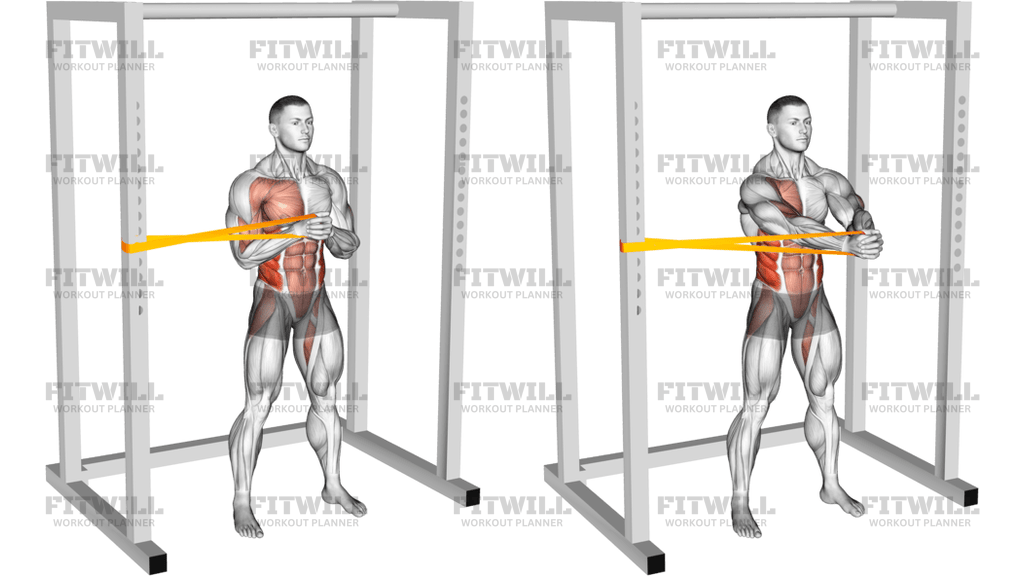
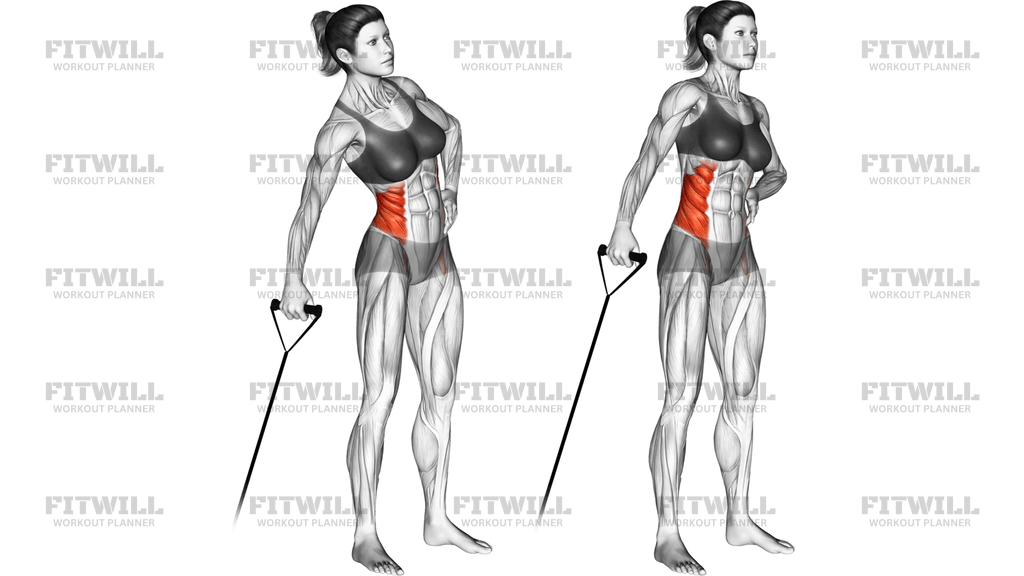
Band Seated Twist
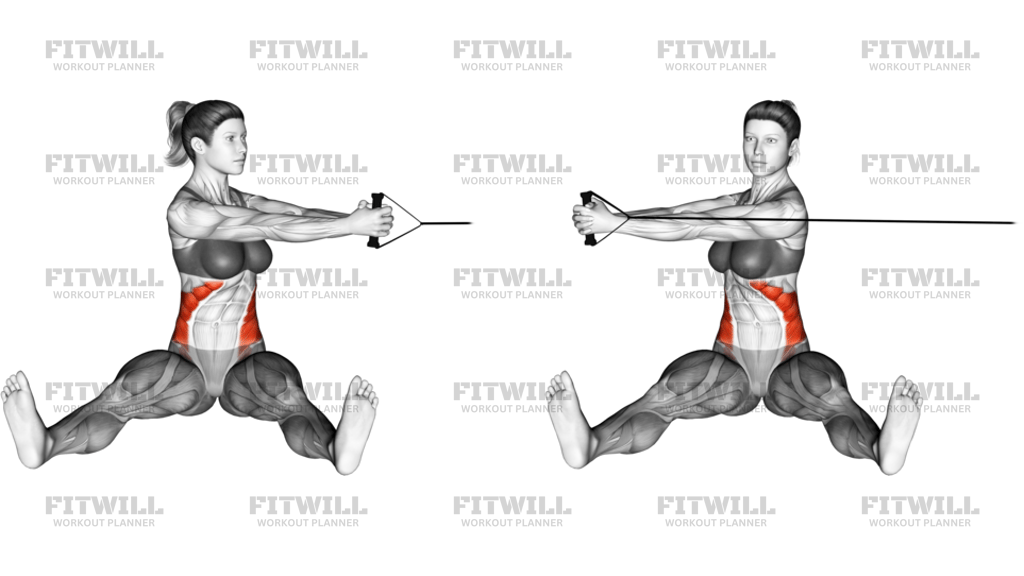
Band Seated Twist is a seated rotational core exercise that trains the waist to resist and control twisting under band tension. It is useful when you want the obliques, deep abdominal muscles, and hip stabilizers to work together without turning the movement into a fast, swinging chop. Because the legs stay planted and the torso does the work, it is a good way to practice clean trunk rotation instead of cheating with the shoulders or hips.
The setup matters because the band will try to pull your arms and chest out of position as soon as you start the rep. Sit tall on the floor with your legs supported, hold the band with both hands at chest height, and keep your arms long enough that the tension starts before you twist. A steady starting position lets you feel the trunk rotation more clearly and makes the exercise easier to scale by adjusting band tension or how far you rotate.
Each repetition should come from the ribcage and waist, not from a lurching turn of the whole body. Rotate smoothly to one side, pause for a brief squeeze when the band is tight, then return under control until your chest is back in the center. Keep your shoulders level, your neck relaxed, and your breathing steady so the twist stays centered through the core instead of collapsing into the lower back.
Band Seated Twist fits well in core circuits, warmups, or accessory work after bigger lifts when you want a controlled rotary drill rather than a heavy strength movement. It is usually a beginner-friendly exercise if the band is light and the torso stays tall, but the range should remain small enough that you can keep the hips quiet and the spine organized. Use it to build clean rotational control, not to chase speed or a huge range that turns the movement into momentum.
[ Workout Log & Planner ]
Put your next workout in Fitwill
Keep your plan and training log ready when you are.


Instructions
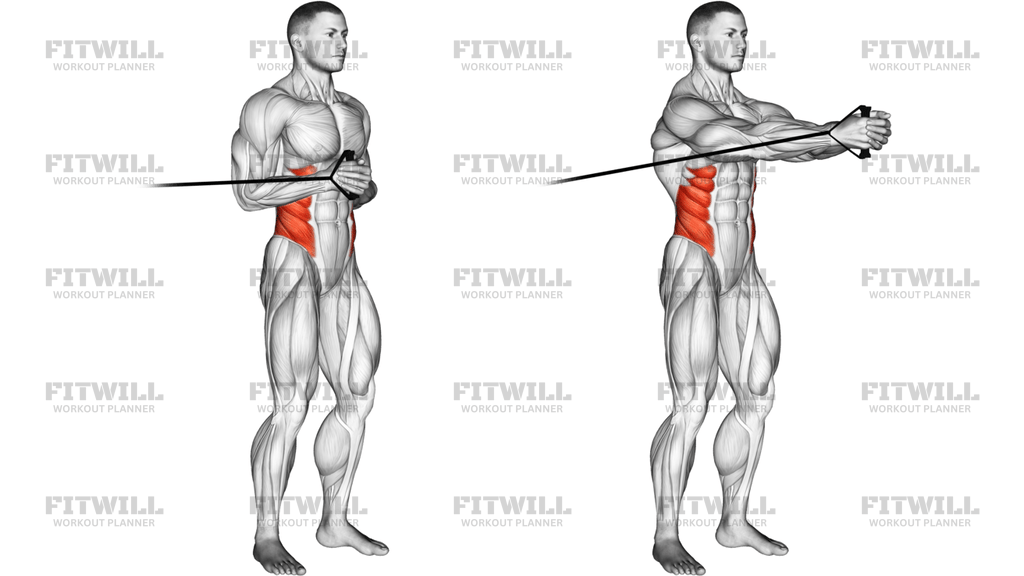
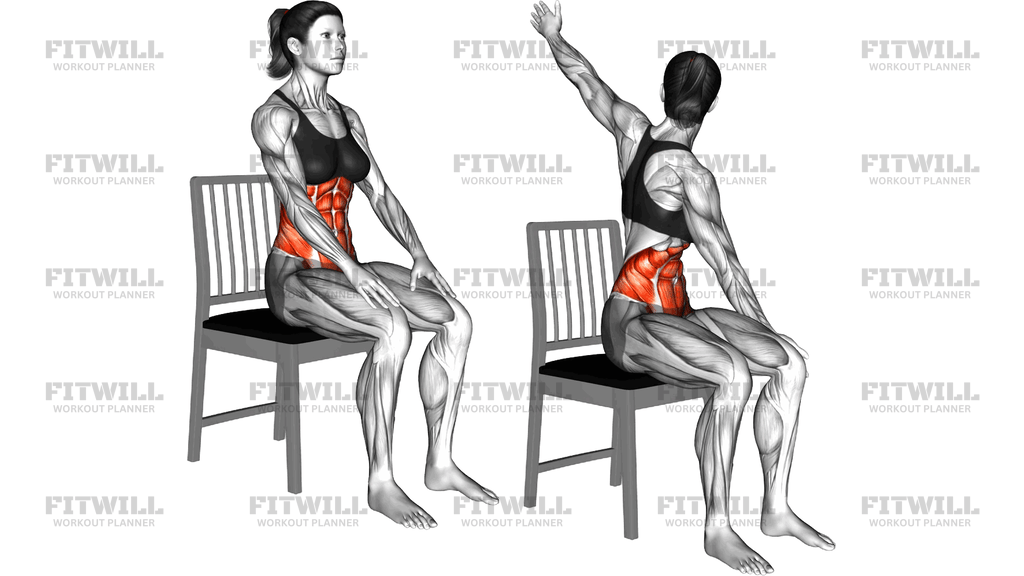
- Sit on a mat with your knees bent, feet braced on the floor, and your torso tall.
- Hold the band with both hands at chest height and extend your arms forward so the band is already under tension.
- Square your shoulders and ribs to the front before each rep, keeping your hips rooted to the floor.
- Exhale and rotate your ribcage and shoulders to one side without letting your knees swing with you.
- Turn only as far as you can while keeping your spine long and your arms level.
- Pause briefly at the end of the twist and feel the side of your waist tighten against the band.
- Inhale as you bring the band back to center under control, resisting the pull all the way back.
- Repeat to the other side or for the planned reps, keeping each twist smooth and even.
- Lower the band tension and reset your torso before standing up.
Tips & Tricks
- Keep the twist coming from your ribs, not from a jerking pull of the arms.
- If your shoulders creep upward, lower the band tension and keep your chest soft.
- A smaller twist with a tall spine is better than a bigger twist that rounds your lower back.
- Let your hips stay heavy on the floor so the band does not turn this into a full-body turn.
- If the band snaps you back to center, slow the return and shorten the range.
- Exhale into the twist to help the waist tighten before the band reaches peak tension.
- Keep your elbows long but not locked out hard enough to strain the shoulders.
- Use a lighter band if you feel the work mostly in your arms instead of the side of your torso.
- Stop the set when you have to rock the knees or lean the chest to finish the twist.
Frequently Asked Questions
What muscles does Band Seated Twist work?
It mainly hits the obliques and deep core muscles, with the hips and shoulders helping you stay organized during the rotation.
Should my knees move during Band Seated Twist?
No, the knees should stay quiet while the ribcage and shoulders rotate. If the legs swing with the band, the load is too heavy or the range is too big.
How far should I twist on this exercise?
Twist only until you can keep your spine long and your hips grounded. A clean, controlled half-turn is better than forcing a bigger range.
Is Band Seated Twist good for beginners?
Yes, if the band is light and the movement stays slow. Beginners should keep the torso tall and focus on controlling the return to center.
Why do I feel this in my shoulders and arms?
The arms are holding the band in position, so some shoulder work is normal. The main effort should still come from the waist and deep core rather than from pulling with the arms.
Can I do Band Seated Twist with my feet off the floor?
You can, but that makes the exercise much harder and shifts more demand to balance. Keep your feet planted first, then progress only if you can keep the torso steady.
Where should the band be anchored for Band Seated Twist?
Anchor it so the pull line stays around chest height and does not drag your shoulders downward. That makes it easier to rotate through the waist instead of leaning into the band.
What is the most common mistake with Band Seated Twist?
The biggest mistake is using momentum to whip from side to side. Keep the twist smooth, pause briefly at the end, and control the return every rep.