Glute Bridge One Leg On Floor Bent Knee
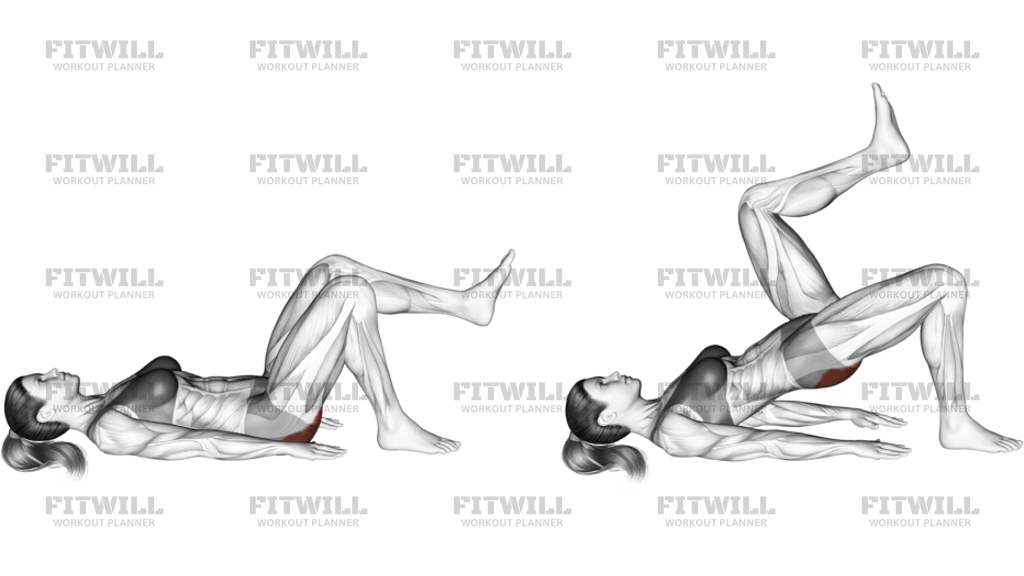
Glute Bridge One Leg On Floor Bent Knee is a bodyweight unilateral bridge that trains hip extension from the floor with one foot planted and the opposite knee held bent in the air. It is a useful way to load one side at a time without equipment, and it makes pelvic control, glute timing, and trunk stability much more obvious than a two-leg bridge.
The exercise is built around the glutes, with the planted-side hamstrings, abs, and spinal stabilizers helping keep the pelvis level as the hips rise. In anatomy terms, the main work centers on the Gluteus maximus, with support from the Biceps femoris, Rectus abdominis, and Erector spinae. Because the raised leg changes your balance and reduces how much help you get from the other side, small setup errors show up quickly. Foot placement, rib position, and pelvic alignment matter more here than brute force.
A good rep starts on the floor with the planted foot flat, the knee bent, and the shin close to vertical at the top of the bridge. The lifted leg stays bent, usually with the thigh roughly above the hip, so it acts as a counterbalance instead of swinging for momentum. Keep the ribs down, lightly brace the abs, and avoid arching through the lower back as you lift. The goal is a clean hip drive that finishes with the shoulders, hips, and planted knee in one line.
At the top, squeeze the glute of the working side for a brief pause, then lower slowly until the hips are back near the floor without fully relaxing. That controlled descent keeps tension on the glute instead of dumping the load into the low back or hamstrings. If the hamstrings cramp, the pelvis twists, or the raised leg starts kicking, the set is usually too fast or the foot is too far from the body. The best version looks smooth, level, and quiet from rep to rep.
Use this movement as accessory work, activation work, or a single-leg strength drill when you want more glute focus without adding external load. It is also useful when you need a floor-based option that is easy to regress and easy to judge visually. Beginners can use it if they can keep the pelvis stable and control the lowering phase. Stop the set when you can no longer hold the hips level, the chin relaxed, and the bridge driven by the glute instead of the lower back.
[ Workout Log & Planner ]
Put your next workout in Fitwill
Keep your plan and training log ready when you are.


Instructions
- Lie on your back with one foot flat on the floor and the other knee bent and lifted so the thigh is roughly above the hip.
- Place the planted foot close enough that the shin can stay near vertical when your hips are at the top.
- Rest your arms on the floor by your sides and keep both shoulders heavy and level.
- Brace your abs, keep your ribs down, and lightly tuck the pelvis so the lower back does not arch to start the rep.
- Drive through the heel and midfoot of the planted leg to lift the hips off the floor.
- Raise until the shoulders, hips, and planted knee form a straight line without twisting the pelvis.
- Pause briefly at the top and squeeze the working glute while keeping the lifted leg quiet and bent.
- Lower the hips under control until they nearly touch the floor, then begin the next rep without bouncing.
Tips & Tricks
- Keep the planted foot centered under the working side so the force goes through the heel and midfoot, not the toes.
- If you feel the hamstring more than the glute, bring the heel slightly closer and shorten the range until the pelvis stays stable.
- The lifted leg is only a counterbalance; do not kick it upward or let it drift to one side.
- Think about lifting the hips by tucking the tail slightly, not by arching the lower back.
- A short pause at the top makes the glute do the work and exposes any pelvic wobble.
- Lower slowly enough that the pelvis does not drop on the way down.
- Keep the neck relaxed and look straight up so you do not crane the head off the floor.
- If one side feels much weaker, start with that side first and match the same tempo on both sides.
Frequently Asked Questions
What does Glute Bridge One Leg On Floor Bent Knee train most?
It primarily trains the glutes on the planted side, with hamstrings and the core helping stabilize the pelvis.
Why is the free knee kept bent instead of straight?
Keeping the free knee bent makes the position easier to balance and keeps the exercise focused on hip extension rather than leg swinging.
Where should my planted foot be on the floor?
Place it far enough from your hips that the shin is close to vertical at the top of the bridge. That usually gives the glute the best leverage.
Should my hips stay level during the rep?
Yes. The pelvis should rise and lower without rotating or dropping to one side, especially when the free leg is lifted.
Why do I feel this in my hamstrings?
That usually happens when the foot is too far away, the toes are doing too much of the work, or the lower back is arching to finish the rep.
Can a beginner use this version of the bridge?
Yes, if they can keep the pelvis steady and control the lowering phase. If not, a two-leg glute bridge is a better starting point.
How many reps should I do on each side?
Most people use moderate sets of about 8-15 controlled reps per side, stopping before the hips start to twist or the low back takes over.
How can I make this exercise harder?
Add a longer pause at the top, slow the lowering phase, or progress to a loaded single-leg bridge once bodyweight reps stay clean.