Dumbbell Over Bench Reverse Wrist Curl
Dumbbell Over Bench Reverse Wrist Curl is a forearm isolation exercise that trains the wrist extensors through a small but very deliberate range of motion. It is useful when you want stronger, more resilient forearms for pulling work, racket sports, climbing, or simply better control when gripping bars, dumbbells, and handles. The movement looks simple, but the setup matters a lot because the wrists have to work without help from shoulder swing, elbow motion, or torso momentum.
In the start position, the forearms rest on a flat bench while the hands hang just beyond the edge with dumbbells in a pronated grip. That over-bench support keeps the elbows and upper arms still so the wrists do the work. When the bench height, forearm placement, and grip are right, the movement feels crisp and isolated instead of turning into a loose swing with the arms.
A good Dumbbell Over Bench Reverse Wrist Curl begins from a relaxed stretch at the bottom, then lifts the knuckles by extending the wrists until the backs of the hands come up against the pull of gravity. The forearms should stay planted on the pad the entire time, and the dumbbells should travel in a short, controlled arc rather than a jerky snap. That controlled arc is what loads the smaller forearm muscles without irritating the wrists or elbows.
Because the range is short, quality matters more than load. Light to moderate dumbbells are usually enough to challenge the forearms if you pause at the top and lower slowly. If the elbows drift off the bench or the shoulders start helping, the set is too heavy or the bench setup is off. Beginners can use this movement safely if they keep the wrists moving smoothly and avoid forcing the bottom stretch.
Dumbbell Over Bench Reverse Wrist Curl is often best placed near the end of a session after the larger pulling or arm work is done. It can also work well as accessory work on days when grip endurance and forearm balance matter. Treat it as a precision exercise: stable support, clean wrist extension, controlled lowering, and no wasted motion.
[ Workout Log & Planner ]
Put your next workout in Fitwill
Keep your plan and training log ready when you are.


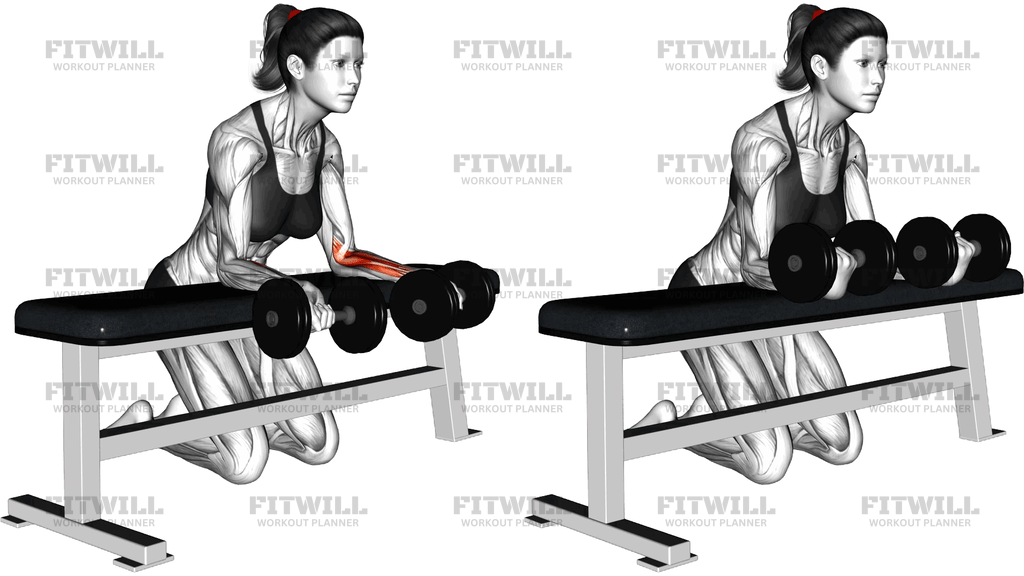
Instructions
- Place a flat bench in front of you and kneel or stand close enough that your forearms can rest fully on the pad with your hands hanging just past the edge.
- Hold a light dumbbell in each hand with your palms facing down and let your wrists drop below the bench edge while keeping your forearms planted.
- Set your elbows and forearms shoulder-width apart so the upper arms stay still and the wrists can move freely.
- Brace your torso lightly and keep your chest quiet so the dumbbells do not get swung upward.
- Curl the backs of your hands up by extending only at the wrists until the dumbbells rise in a short arc.
- Pause for a beat at the top while keeping the forearms pinned to the bench.
- Lower the dumbbells slowly until the wrists are back in the stretched bottom position.
- Keep breathing steady through the set and stop if the elbows start lifting or the motion turns jerky.
- Set the dumbbells down carefully after the last rep and reset your forearms before leaving the bench.
Tips & Tricks
- Keep the dumbbells light enough that the wrists, not the shoulders, control the lift.
- Let the hands drop fully below the bench edge, but do not force an aggressive stretch if the wrists feel pinched.
- If the forearms slide forward on the pad, move your body closer to the bench so the support stays fixed.
- Use a slower lowering phase than lifting phase to keep tension on the wrist extensors.
- Stop the set when the dumbbells start to bounce off the bottom position.
- A bench that is too high makes the setup awkward; a flat bench or firm box at elbow height is usually better.
- Keep the grip firm without squeezing so hard that the forearm flexors take over.
- If one wrist moves better than the other, match the smaller range instead of twisting the hands to chase height.
Frequently Asked Questions
What does Dumbbell Over Bench Reverse Wrist Curl train most?
It mainly trains the wrist extensors and the forearm muscles that lift the back of the hand toward the forearm.
Can beginners perform this exercise?
Yes. Start with very light dumbbells and focus on keeping the forearms still on the bench while the wrists do the work.
How should my forearms sit on the bench?
Rest the forearms flat on the pad with the hands hanging just off the edge so the wrists can move without the elbows sliding forward.
Should my palms face up or down?
For the reverse version, the palms face down in a pronated grip so the top of the hands lifts against the dumbbells.
Why use a bench instead of doing wrist curls standing?
The bench removes body sway and makes it easier to isolate the wrists, which is especially helpful with small forearm movements.
What if I feel this more in my elbows than my forearms?
Reduce the load and keep the upper arms relaxed against the setup. If the elbows still complain, shorten the range and slow the lowering phase.
How many reps work best for Dumbbell Over Bench Reverse Wrist Curl?
Higher-rep sets usually work well because the range is small and the forearm muscles respond well to controlled volume.
Can I alternate arms one at a time?
Yes. Single-arm sets are useful if one wrist is weaker or if you need to stabilize the bench position more carefully.