Push-Up On Stability Ball
Push-Up On Stability Ball is a bodyweight pressing exercise performed with the feet supported on a stability ball and the hands on the floor. It challenges the chest, triceps, front shoulders, and deep core at the same time, but the main training demand is not just pressing strength. The unstable foot position forces you to brace harder through the trunk and hips so the torso stays rigid while the arms move.
The ball changes the exercise more than a standard push-up. Because your feet can roll or drift, every repetition depends on how well you organize the body before you start. The shoulder blades need to move smoothly, the ribs need to stay down, and the hips need to stay level. If the midsection softens, the ball becomes harder to control and the press turns into a sway instead of a clean push-up.
A good rep starts with the hands planted slightly wider than shoulder width and the feet balanced on top of the ball. From there, lower the chest under control while keeping a straight line from shoulders to heels. The elbows should track at a comfortable angle, not flare hard out to the sides. Press back up by driving the floor away, finishing with the body still long and the ball quiet under the ankles or shins.
This variation is useful when you want a push-up that adds balance demand without needing external load. It fits well in strength circuits, upper-body accessory work, or core-focused training. It can also reveal left-to-right stability problems, because any hip shift or shoulder twist shows up quickly when the feet are unstable.
The safest, highest-quality version is the one you can repeat without chasing range that the shoulders or lower back cannot support. Keep the neck neutral, control the descent, and stop the set when the hips start piking or the ball starts rolling around under you. A smaller range with steady tension is better than a bigger rep that loses body position.
Fitwill
Log Workouts, Track Progress & Build Strength.
Achieve more with Fitwill: explore over 9600 exercises with images and videos, access built-in and custom workouts, perfect for both gym and home sessions, and see real results.
Start your journey. Download today!




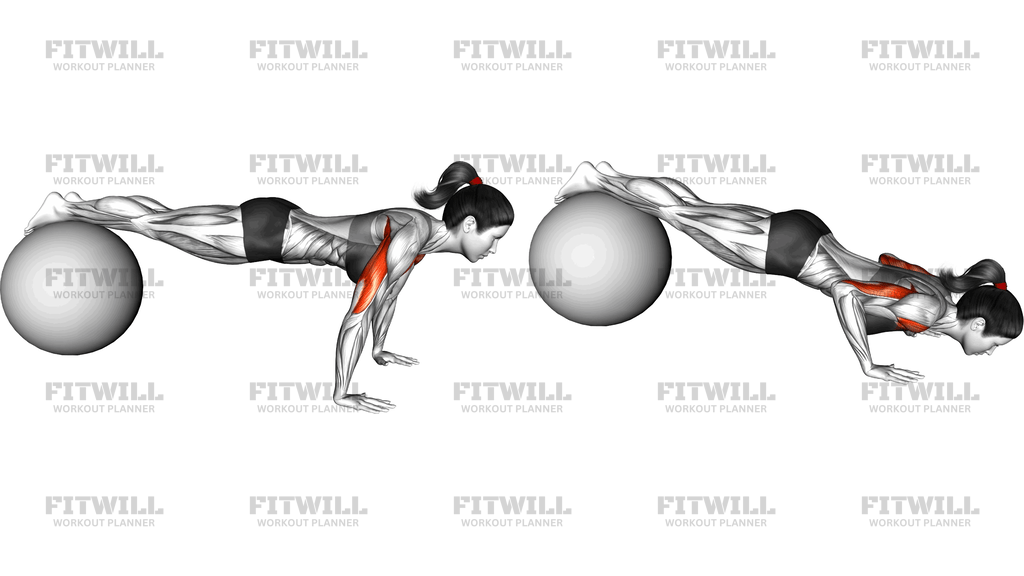
Instructions
- Place the stability ball behind you and set your feet on top of it, with your hands on the floor under or slightly wider than your shoulders.
- Walk your hands out until your body forms a straight line from shoulders to heels, then tighten your glutes and brace your abs.
- Keep your neck long and your eyes on the floor a little ahead of your hands.
- Lower your chest toward the floor in a smooth line while the ball stays centered under your feet.
- Let the elbows bend at a comfortable angle instead of flaring straight out to the sides.
- Touch your chest or come as low as your shoulders can control without losing the plank position.
- Press the floor away and return to the top while keeping the hips level and the ball steady.
- Exhale as you press up and reset your brace before the next repetition.
- Finish the set by carefully walking the hands back in and lowering the feet from the ball.
Tips & Tricks
- If the ball wobbles, shorten the range before you shorten the set. A controlled half rep is more useful than a shaky full rep.
- Keep the hips in line with the shoulders; if the pelvis starts sagging, the core is no longer doing its job.
- A small pause near the bottom makes the press harder without needing more speed or extra range.
- The hands should stay planted under the shoulders, not creep too far forward, or the shoulders take over too much of the work.
- Do not let the ball roll toward your shins on every rep. That usually means the brace is late or the feet are not centered.
- Use the glutes actively to help keep the legs long and the body rigid across the ball.
- Choose a stable ball size and inflation level that lets your feet stay secure without sinking too deeply into the surface.
- If your lower back arches first, reduce the difficulty by moving to a wall, bench, or floor push-up variation.
Frequently Asked Questions
What does the stability ball add to this push-up?
It adds instability under the feet, so the core and hips have to work harder to keep the body from twisting or sagging.
Where should my feet go on the ball?
Place the feet on top of the ball so the ankles or lower shins are supported and the ball sits centered behind you.
How wide should my hands be on the floor?
Start a little wider than shoulder width, which usually gives enough stability without dumping too much stress into the shoulders.
Why do my hips drop when I lower down?
Usually the brace is too loose or the exercise is too hard. Tighten the glutes, shorten the range, or move to an easier variation.
Can beginners do a push-up on a stability ball?
Only if they already own a solid push-up and can keep the ball steady. For most beginners, the floor version is a better start.
What are the main muscles worked?
The chest, triceps, and front shoulders do most of the pressing, while the abs, glutes, and hip stabilizers keep the body rigid.
What is the most common mistake with this exercise?
Letting the midsection relax so the lower back arches and the ball starts rolling around instead of staying controlled.
How do I make the movement easier?
Use a smaller range of motion, move the feet closer to the floor, or switch to an incline or standard floor push-up.