Barbell Standing Close-Grip Curl
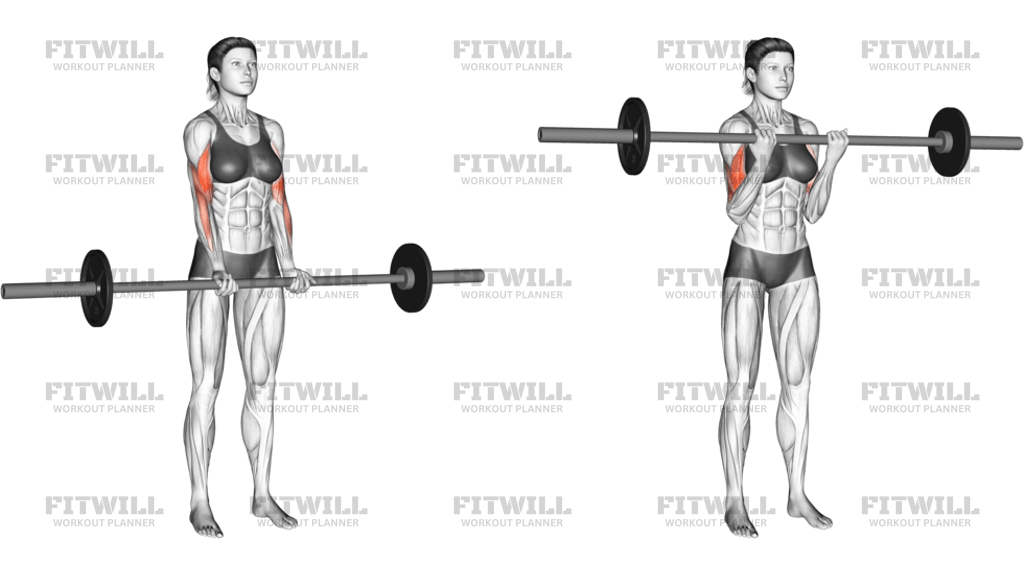
Barbell Standing Close-Grip Curl is a strict standing arm exercise performed with a narrow underhand grip on a straight barbell. The setup in the image shows the bar starting in front of the thighs, elbows tucked close to the ribs, and the torso held tall so the curl comes from the arms instead of from a hip swing. That narrow grip changes the feel of the movement compared with a wider curl because it asks the forearms and elbow flexors to work through a tighter line while the shoulders stay quiet.
This exercise is mainly used to build stronger, fuller-looking upper arms and better control through elbow flexion. In practice, the work comes from the biceps brachii with help from the brachialis, brachioradialis, and grip muscles, while the shoulders and trunk stay organized to keep the bar path clean. The close-grip position makes posture matter more, because if the elbows drift forward or the rib cage flares, the bar becomes easier to cheat upward and the tension shifts away from the arms.
A good repetition starts by standing balanced with the bar resting against the thighs, wrists straight, and the hands set just inside shoulder width. From there, the bar travels in a smooth arc toward the upper chest or lower chest line while the upper arms stay nearly fixed. The goal is not to throw the bar up; the goal is to keep the motion compact, controlled, and symmetrical so each arm contributes evenly and the range stays repeatable from the first rep to the last.
The lowering phase matters just as much. Bring the bar back down slowly until the elbows are nearly straight, but do not relax the shoulders forward or let the bar drop out of control. A steady descent keeps tension on the arm flexors, protects the elbows, and makes the set more productive at lighter and moderate loads. If the grip or wrists start to feel stressed, the close hand spacing may be too narrow for your structure and the load or stance should be adjusted before technique breaks down.
Barbell Standing Close-Grip Curl fits well in an upper-body accessory block, arm day, or any session where you want a simple standing curl pattern with strict form and no bench support. It is also useful for practicing honest rep quality, because the standing position exposes body sway, shoulder shrugging, and excessive lean-back immediately. Done well, it is a small exercise with a clear payoff: cleaner elbow flexion, better arm tension, and stronger control over the top and bottom of the curl.
[ Workout Log & Planner ]
Put your next workout in Fitwill
Keep your plan and training log ready when you are.


Instructions
- Stand tall with your feet about hip-width apart and hold the barbell in front of your thighs with a narrow underhand grip.
- Set your wrists straight, pull your shoulders down, and keep the bar close to your body before the first rep.
- Pin your elbows near your ribs so the upper arms stay quiet while the forearms do the work.
- Curl the bar upward in a smooth arc toward your lower chest or upper chest without swinging your torso.
- Keep the bar path tight and symmetric, and avoid letting the elbows drift far forward as the bar rises.
- Squeeze briefly at the top when the forearms are fully flexed and the bar is controlled near the chest line.
- Lower the bar slowly until the arms are nearly straight, keeping tension through the biceps and forearms.
- Reset your brace and breathing before the next rep so every repetition starts from the same position.
Tips & Tricks
- Set the hands just inside shoulder width; a grip that is too narrow can stress the wrists and make the curl awkward.
- Keep the bar brushing close to the front of the thighs on the way up so the rep stays strict instead of turning into a swing.
- If your chest pops forward or your lower back arches, the load is too heavy for a clean standing curl.
- Let the elbows stay near the sides and think about bending the bar up, not pulling the shoulders up with it.
- A slightly slower lowering phase usually makes this movement feel better and keeps tension on the arm flexors longer.
- Use full elbow extension only if your elbows feel good there; stop just short of locking out if you want to keep constant tension.
- The narrow grip can expose wrist limitations quickly, so an EZ bar or a slightly wider narrow grip may be a better fit for some lifters.
- Stop the set when the bar starts drifting forward or you have to lean back to finish the curl.
Frequently Asked Questions
What muscles work hardest in a barbell standing close-grip curl?
The biceps do most of the work, with the brachialis, brachioradialis, and forearm flexors helping to control the bar.
Why use a close grip instead of a shoulder-width curl?
The narrower hand position changes the arm angle and usually makes the curl feel more concentrated through the elbow flexors and forearms.
How high should I curl the bar?
Bring it up to about the lower chest or upper chest line, then stop once the elbows are fully flexed without shrugging the shoulders.
Should my elbows move forward during the rep?
A small natural shift is fine, but the upper arms should stay mostly by your sides; big elbow drift usually means you are cheating the curl.
Can beginners use this exercise?
Yes, as long as the load is light enough to keep the torso still and the wrists comfortable.
What is the most common mistake with this curl?
The biggest mistake is leaning back and swinging the bar up, which turns the set into a body-english lift instead of an arm curl.
Is an EZ bar a good substitute?
Yes. An EZ bar often feels better on the wrists and elbows while keeping the same close-grip curl pattern.
How should I breathe during the set?
Exhale as you curl the bar up and inhale as you lower it, then reset your brace before starting the next repetition.