Dumbbell Lying Pronation On Floor
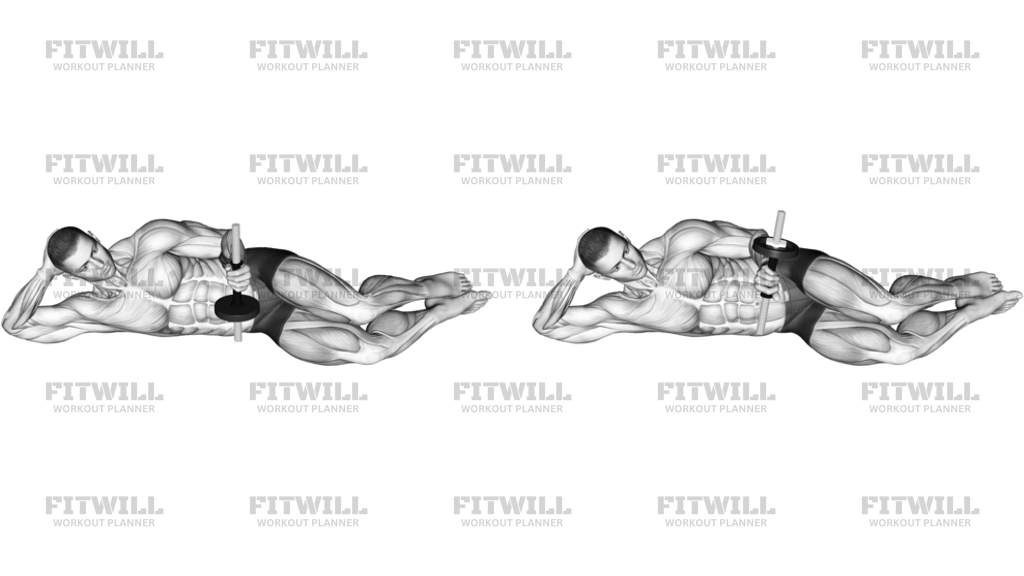
Dumbbell Lying Pronation On Floor is a side-lying forearm rotation exercise that trains pronation control, wrist stability, and grip endurance with very little body English. The floor gives you a fixed body position, which makes it easier to isolate the forearm and keep the upper arm quiet while the hand rotates the dumbbell through a controlled arc.
The setup matters because this movement is small and easy to cheat. Lying on your side with the head supported and the working elbow tucked against the ribs removes most of the torso swing you would get in a standing variation. That makes the exercise useful when you want to clean up forearm control, build rotational strength, or warm up the elbows and wrists before heavier pulling work.
Each rep should come from the forearm, not the shoulder. Hold the upper arm still, start with the wrist stacked over the elbow, and rotate the hand until the palm turns down as far as you can control. The dumbbell should travel with a smooth, deliberate turn rather than a jerk. If the shoulder rolls forward, the elbow drifts away from the torso, or the wrist bends back, the load is too heavy or the range is too aggressive.
This exercise fits well in accessory work, arm day finishers, rehab-style conditioning, or warmups for pulling sessions that depend on elbow health and grip stability. Use light resistance, slower tempo, and clean pauses at both ends of the range. The goal is not to chase fatigue with a heavy dumbbell; it is to keep the forearm working in a stable position and to make every rep look identical.
Beginners can use it safely when the dumbbell is very light and the movement stays pain-free through the wrist and elbow. If the floor position bothers the shoulder or neck, shorten the set or switch to a supported seated pronation variation. Keep the motion smooth, breathe normally, and stop the set if the rep turns into a twist of the torso instead of a forearm rotation.
Fitwill
Log Workouts, Track Progress & Build Strength.
Achieve more with Fitwill: explore over 9600 exercises with images and videos, access built-in and custom workouts, perfect for both gym and home sessions, and see real results.
Start your journey. Download today!




Instructions
- Lie on your side on the floor and support your head with the lower arm so your torso stays relaxed and stacked.
- Tuck the working elbow against your ribs and bend it to about 90 degrees so the upper arm stays fixed.
- Hold the dumbbell in the working hand with the forearm vertical and the wrist straight, not bent back.
- Set the shoulder down and keep the elbow pinned in place before you begin the rotation.
- Start with the palm angled slightly in, then rotate the forearm until the palm turns down under control.
- Keep the dumbbell moving as one smooth turn instead of letting the wrist flick or the shoulder roll forward.
- Pause briefly at the end of the rotation, then reverse the motion slowly back to the starting angle.
- Exhale as you turn the forearm and inhale as you return, keeping the torso still for every rep.
- Reset the elbow and wrist before the next repetition if the arm starts drifting or the range gets sloppy.
Tips & Tricks
- Use a very light dumbbell; this is a rotational control drill, not a grip-max exercise.
- Keep the upper arm glued to your side so the rotation stays in the forearm instead of the shoulder.
- A slower return usually exposes weak control faster than trying to spin the weight quickly.
- If the wrist bends backward, reduce the load and keep the knuckles stacked over the forearm.
- Let the floor keep your torso quiet; if your rib cage twists, the set has become too heavy.
- Stop the rep at the point where the forearm still feels smooth and the elbow does not drift.
- Shorter, cleaner reps are better than forcing a bigger turn with a twisted trunk or flared elbow.
- Choose a range that feels stable on the wrist and elbow, especially if you are using this as a warmup.
Frequently Asked Questions
What does Dumbbell Lying Pronation On Floor train?
It trains forearm pronation control, wrist stability, and grip endurance while keeping the upper arm quiet.
Why do it lying on the floor instead of standing?
The floor removes most of the body sway, so the forearm has to do the rotation instead of the torso helping.
Where should the elbow be during each rep?
Keep the elbow tucked against the ribs and bent around 90 degrees so the upper arm does not chase the dumbbell.
How heavy should the dumbbell be?
Light enough that you can rotate smoothly without wrist breakage, shoulder movement, or a jerky finish.
Should I feel this more in the forearm or shoulder?
Most of the work should be in the forearm; the shoulder should only stabilize the arm, not drive the motion.
Can beginners use this exercise?
Yes, beginners can use it if they keep the load very light and the rotation pain-free through the wrist and elbow.
What is the most common mistake?
The biggest mistake is letting the elbow leave the ribs or twisting the torso to fake a bigger range.
What can I use instead if the floor position feels awkward?
Try a seated pronation variation with the elbow braced on a thigh or bench so you can still isolate the forearm.