Dumbbell Lying Supination On Floor
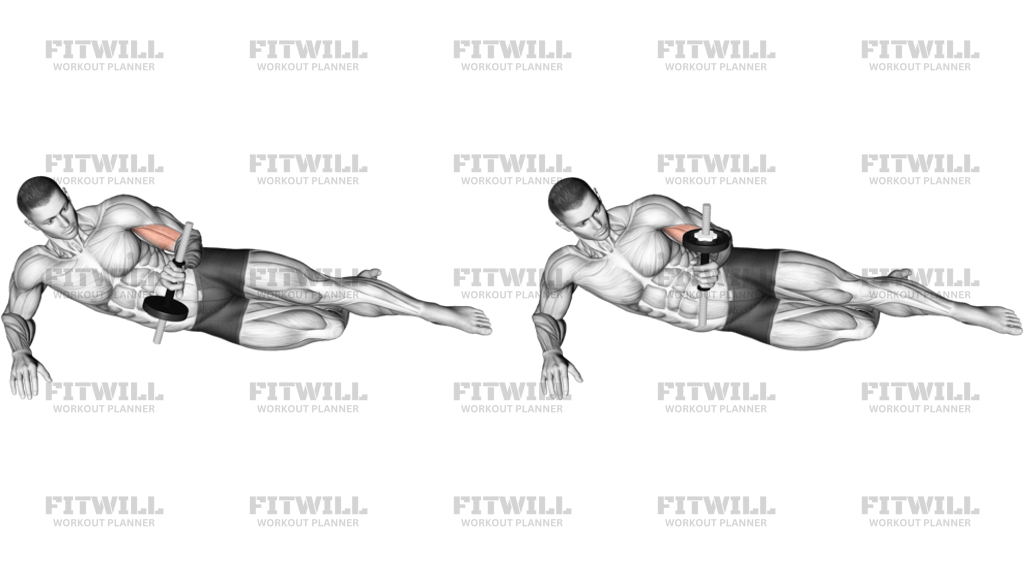
Dumbbell Lying Supination On Floor is a side-lying forearm drill that isolates rotation at the wrist and forearm while the upper arm stays quiet. Lying on the floor removes most of the cheating you can get from swinging the shoulder or using the torso, so each rep is a cleaner test of forearm control. It is especially useful when you want to strengthen supination for arm training, grip work, or elbow-friendly accessory volume.
The main action is rotating the dumbbell from a more neutral or palm-down start toward a palm-up finish. That makes the biceps and the smaller supinator muscles do the work, while the forearm flexors and extensors stabilize the wrist and keep the handle aligned. Because the exercise is performed on the floor, you also get feedback from the surface: if the elbow drifts forward or the shoulder starts rolling, the setup immediately feels unstable.
A good rep starts with your body stacked on one side, knees and hips relaxed, and the working upper arm pinned close to the ribs. The elbow should stay bent and fixed so the forearm can rotate without turning the motion into a press, curl, or shoulder movement. That fixed position is the point of the exercise, and it is what makes Dumbbell Lying Supination On Floor different from a standing wrist drill.
Use a very light dumbbell at first and rotate slowly enough that you can feel the forearm turn the handle rather than the hand yanking the weight around. The finish should be a clean palm-up position with the wrist still straight, not cocked back. From there, lower under control to the starting angle and let the forearm unwind without losing contact between the upper arm and the torso.
This movement fits well as an accessory drill, warm-up, or rehabilitation-style strength exercise when you need smaller, precise work instead of heavy loading. It can also be a useful add-on for athletes and lifters who want better elbow control in pressing, pulling, and carrying work. Keep the load modest, keep the elbow quiet, and stop the set if the wrist or elbow starts to feel strained rather than worked.
[ Workout Log & Planner ]
Put your next workout in Fitwill
Keep your plan and training log ready when you are.


Instructions
- Lie on one side on the floor with the working arm on top, knees stacked, and the lower arm resting on the floor for balance.
- Bend the top elbow to about 90 degrees and pin the upper arm against your ribs so the shoulder stays quiet.
- Hold a light dumbbell in the working hand with the wrist straight and the forearm starting in a neutral or slightly palm-down position.
- Set your ribs down, keep your neck long, and brace just enough to stop your torso from rolling backward.
- Rotate the forearm so the palm turns up toward the ceiling while the elbow stays glued to your side.
- Finish the rep with the palm fully supinated and the wrist still stacked over the forearm, not bent back.
- Pause briefly at the top to feel the rotation instead of the shoulder helping you finish the rep.
- Lower the dumbbell slowly back to the start, letting the forearm unwind under control on the way down.
- Keep your breathing steady and switch sides only after you finish the planned reps with clean elbow position.
Tips & Tricks
- If the top elbow slides away from your ribs, the dumbbell is too heavy for this drill.
- Think about turning the palm with the forearm, not curling the weight with the wrist.
- A small, slow range is better than forcing a bigger twist and letting the shoulder roll open.
- Keep the wrist straight at the top; a bent wrist usually means the forearm has lost control of the handle.
- Use a very light dumbbell or even a partial range if you feel the movement mostly in the elbow or wrist joint.
- The floor should make the setup feel stable; if you are rocking, reset your hips and stack the legs again.
- A slower lowering phase helps the biceps and forearm rotators do more of the work than momentum.
- Stop before fatigue turns the rep into a shoulder adjustment or a side-to-side torso twist.
Frequently Asked Questions
What does Dumbbell Lying Supination On Floor train most?
It mainly trains forearm supination, with the biceps and smaller forearm rotators helping turn the palm upward.
Why do this exercise lying on the floor?
The floor reduces body swing and makes it easier to keep the upper arm pinned, so the forearm has to do the rotation.
Should my elbow move during Dumbbell Lying Supination On Floor?
No. The elbow should stay fixed against your side so the motion comes from the forearm, not the shoulder.
Is Dumbbell Lying Supination On Floor more for biceps or forearms?
It is mostly a forearm rotation drill, but the biceps contribute strongly because they help supinate the forearm.
How heavy should the dumbbell be?
Light enough that you can rotate smoothly without wrist bending, elbow drift, or torso rotation.
What should I do if I feel it in my shoulder?
Reduce the load and keep the upper arm glued to your ribs. If the shoulder still helps, shorten the range and slow the rep down.
Can beginners do Dumbbell Lying Supination On Floor?
Yes. It is beginner-friendly when you start very light and focus on a clean, controlled twist instead of speed.
What is a good substitute for Dumbbell Lying Supination On Floor?
A seated dumbbell supination or a cable forearm rotation can work if you want a similar forearm emphasis with a different setup.