Strongman Barbell Farmers Walk
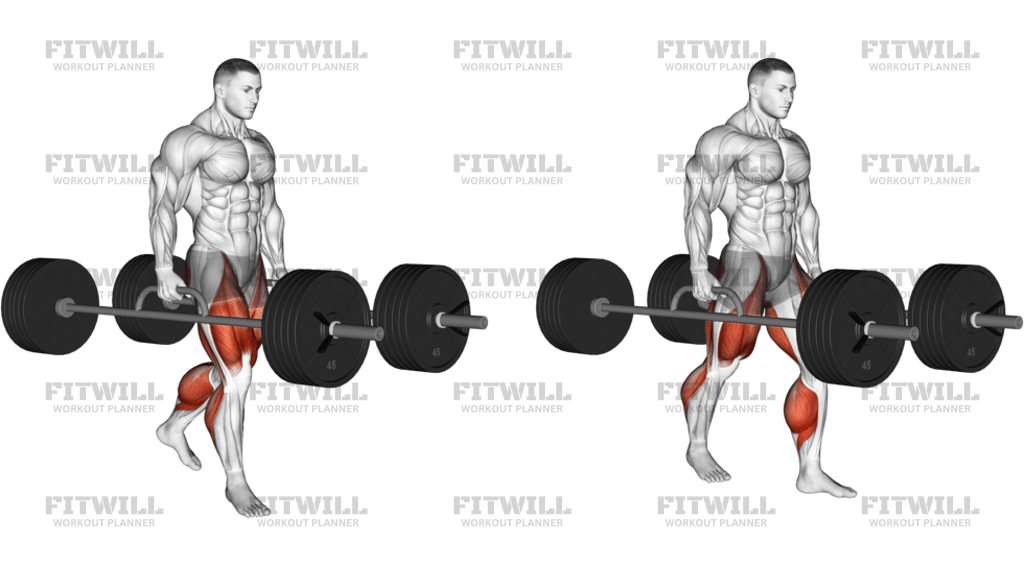
Strongman Barbell Farmers Walk is a loaded carry built around walking with a barbell held at your sides. The exercise trains grip endurance, trunk stiffness, shoulder positioning, and the ability to keep posture organized while the legs move under load. Because the bar sits low and long across the body, small changes in stance, brace, and step quality make a big difference to how stable the carry feels.
This movement is most useful when you want whole-body tension rather than a single-joint pump. The forearms have to keep the bar pinned in the hands, the upper back has to resist rounding, and the core has to stop the ribs from flaring as each step shifts the load side to side. The result is a simple but demanding test of control that carries over well to strongman work, general strength, and conditioning blocks.
Setup matters more here than on many other exercises because the carry starts before the first step. Stand the bar up or deadlift it into position with the sleeves loaded evenly, then rise tall with the handles close to your thighs. Keep the shoulders down, the neck long, and the chest stacked over the pelvis so the bar does not drift forward. Once you begin walking, the goal is steady, short steps with no bouncing or leaning.
A good rep is really a controlled walk: lift the bar with clean tension, take measured steps, and keep the torso quiet while the feet do the work. If the bar starts swinging, shorten the stride and slow the pace. If the grip starts to slip, finish the carry with control instead of fighting for speed. The exercise rewards patience, especially when the load is heavy enough to challenge the hands but not so heavy that posture collapses.
Use Strongman Barbell Farmers Walk as a finisher, a grip builder, or a stand-alone strongman carry when you want practical strength under fatigue. It works well for athletes who need better bracing, people training for obstacle events or strongman-style events, and lifters who want a straightforward way to build work capacity without complicated technique. Keep the carry pain-free and stop if the bar, wrists, or low back begin to feel unstable.
Fitwill
Log Workouts, Track Progress & Build Strength.
Achieve more with Fitwill: explore over 9600 exercises with images and videos, access built-in and custom workouts, perfect for both gym and home sessions, and see real results.
Start your journey. Download today!




Instructions
- Load the barbell evenly on both ends and stand it up or deadlift it into place so the shaft sits level in front of your thighs.
- Stand tall with your feet about hip-width apart, grip the bar just outside your legs, and let your arms hang straight without shrugging.
- Set your ribs over your pelvis, pull your shoulders down, and brace your trunk before the first step.
- Lift the bar by extending your hips and knees together until you are fully upright and the plates clear the floor.
- Take short, controlled steps forward while keeping the bar close to your legs and the torso as still as possible.
- Keep your gaze forward and your neck neutral so you do not chase the bar with your head or chest.
- Breathe in behind the brace as you move, then reset the brace before each few steps or each turn if the carry is long.
- Turn carefully at the end of the lane, keeping the bar level and your steps small so the plates do not swing.
- Lower the bar to the floor with control when the carry is finished, then rest before the next round.
Tips & Tricks
- Choose plates that leave enough clearance for the bar to start and finish without scraping your shins.
- Keep the hands just outside the thighs so the bar does not drift forward and turn the carry into a shrug.
- Think about walking quietly; loud footfalls usually mean you are bouncing or overstriding.
- If the bar starts pulling you to one side, slow down and shorten the step instead of leaning to correct it.
- Keep the elbows straight and long so the forearms do the gripping instead of the upper traps taking over.
- Use a weight you can carry with an upright torso for the full distance, not just for the first few steps.
- Avoid looking down at the plates, which tends to round the upper back and shorten the carry.
- Set the bar down before your grip fails completely so the last rep stays clean and controlled.
Frequently Asked Questions
What does Strongman Barbell Farmers Walk train most?
It is primarily a grip and trunk-strength carry, with the legs, upper back, and shoulders working to keep the bar stable while you walk.
Is the bar supposed to stay right against my legs?
Yes. Keep it close to the thighs without banging into them so the load stays centered and the walk stays efficient.
How far should I walk with the barbell?
Use a distance you can cover without losing posture, usually a short lane or a set number of controlled steps.
Should I keep the bar level while turning around?
Yes. Slow the turn down, keep the plates even, and use small steps so the bar does not swing across your body.
Can beginners do this exercise?
Yes, if the load is light enough to keep the torso upright and the grip secure. Start conservatively and build distance before load.
Why does my upper back get tired first?
The carry asks your traps, rhomboids, and spinal stabilizers to keep the torso tall while the bar tries to pull you forward or sideways.
What is the biggest mistake with this carry?
Usually it is overstriding or leaning back to balance the bar. Short steps and a stacked torso are more effective.
How do I progress Strongman Barbell Farmers Walk?
Add distance first, then load, or extend the carry time while keeping the same upright posture and steady breathing.