Standing Hip Extension Straight Leg
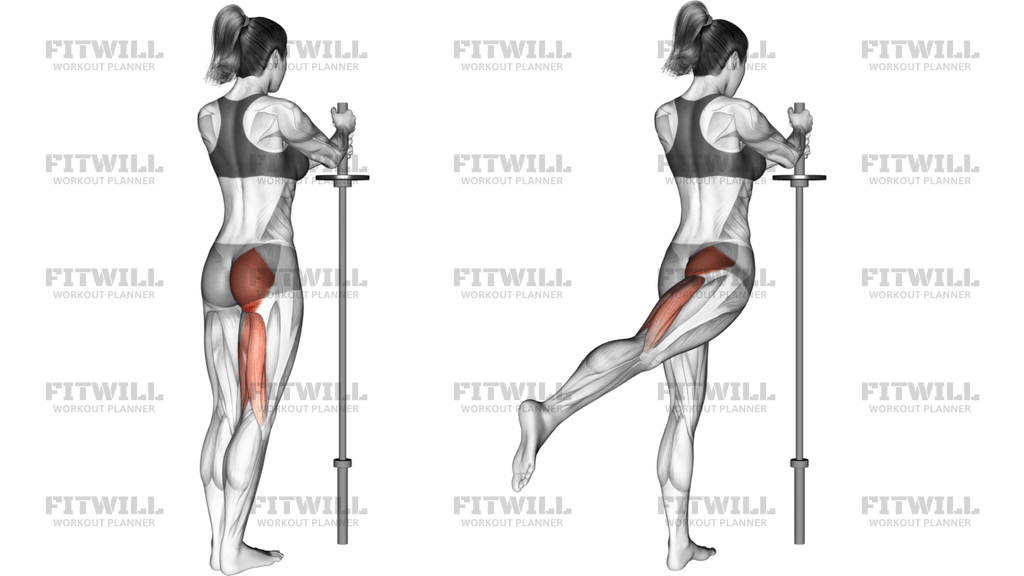
Standing Hip Extension Straight Leg is a bodyweight hip-dominant exercise performed while holding a vertical support for balance. The working leg stays mostly straight as it moves behind the body, which makes the movement more about hip extension and glute squeeze than about knee bend or swing. It is useful when you want a simple, controlled way to train the glutes, hamstrings, and trunk without needing a bench, cable, or machine.
The image shows a tall standing posture with one hand braced on a post and the torso staying upright while the leg reaches back. That support matters: it reduces side-to-side sway and lets you keep the pelvis square while the hip does the work. In anatomy terms, the main target is the Gluteus maximus, with the Biceps femoris helping behind the thigh and the Rectus abdominis and Erector spinae helping you hold position.
Good reps start from a quiet setup. Stand close enough to the support that you can hold it lightly, place the working foot on the floor under your hip, and keep the standing knee soft but stable. From there, brace your midsection and extend the trail leg backward without arching the low back or turning the hip open. The goal is a clean leg path that comes from the hip joint, not from swinging the torso.
At the top, squeeze the glute of the working side and stop before the lower back takes over. Lower the leg slowly until you are back in the starting stance, then reset before the next rep. This exercise is most useful as accessory work, activation work, or part of a lower-body session when you want high-quality reps and clear glute tension rather than heavy loading. Beginners can do it well because the support makes balance easier, but the movement still demands control and honest range.
Keep the set strict enough that every rep looks the same. If the body starts leaning, the foot swings, or the pelvis twists, the set has drifted away from the target. Use that as your cue to shorten the range, slow the tempo, or stop the set before compensation builds.
[ Workout Log & Planner ]
Put your next workout in Fitwill
Keep your plan and training log ready when you are.


Instructions
- Stand next to a vertical support and hold it lightly with the hand on the same side as the working leg.
- Place the standing foot under your hip, keep a soft bend in that knee, and square your hips and shoulders.
- Shift your weight onto the standing leg without leaning into the support or arching your lower back.
- Brace your midsection, keep the working leg long, and prepare to drive the heel backward.
- Extend the trail leg behind you in a smooth arc while keeping the torso tall and the pelvis level.
- Stop when the glute is fully squeezed and the movement is still coming from the hip, not the spine.
- Lower the leg under control until the foot returns close to the start position.
- Reset your posture and breathe before the next repetition.
Tips & Tricks
- Hold the support with just enough pressure to balance; if you are pulling on it, the working hip is doing less of the job.
- Keep the working leg long and resist the urge to bend the knee and turn it into a kickback.
- Think about moving the heel back and slightly up while the pelvis stays pointed forward.
- Do not arch the low back to get extra height; the rep should finish when the glute stops, not when the spine starts.
- Use a small to moderate range if your torso starts swaying or the standing foot shifts around.
- Exhale as the leg drives back and inhale as it returns to the start.
- Pause for a brief squeeze at the top instead of bouncing through the rep.
- Keep the standing knee unlocked so the hip can extend without locking the joint rigid.
- If balance is limiting the set, slow the tempo before you make the movement bigger.
Frequently Asked Questions
What does Standing Hip Extension Straight Leg train most?
It primarily targets the glutes, especially the gluteus maximus, with the hamstrings helping the leg move back.
Why do I need to hold the support post or wall?
The support lets you balance without turning the set into a hip swing. A light hand on the post helps keep the pelvis square and the torso tall.
Should the working knee stay straight the whole time?
Yes, it should stay mostly straight. A small natural bend is fine, but the movement should look like a hip extension, not a bent-knee kickback.
How far back should the leg move?
Only as far as you can go while keeping the pelvis level and the lower back quiet. If you have to arch to lift higher, the range is too big.
Can beginners do this exercise safely?
Yes. It is beginner-friendly because the support reduces balance demands, but beginners should keep the range small and the tempo slow.
What are the main form mistakes with this movement?
The most common mistakes are twisting the hips open, leaning the torso forward, using momentum, and finishing the rep with the low back instead of the glute.
Is this more of a strength exercise or an activation drill?
It can serve as either. Light, controlled sets work well for activation or warm-up work, while slower, stricter sets can be used as accessory strength work.
What should I do if I feel it in my lower back?
Shorten the range and stop lifting once the glute is fully engaged. If the lower back still takes over, reduce the height of the leg and keep the ribs stacked over the pelvis.