Plank Walk-Up
Plank Walk-Up is a plank-based conditioning drill that challenges your core, shoulders, chest, and triceps while the support point changes under you. In the version shown here, the body stays long and rigid as the hands work on and around a low step or box. The goal is not to race through the movement. It is to keep the torso square, the hips steady, and the shoulders stacked while you shift from one support to the next.
This exercise is useful when you want a movement that builds anti-extension strength and upper-body control at the same time. Because one arm is often carrying more of the bodyweight during the transition, the workout stresses the front of the shoulder, the serratus, and the deep core muscles that keep the ribs from flaring. If the step is set too high or the feet are too narrow, the drill turns into a twisting, sagging plank instead of a clean walk-up.
The setup matters more here than with a simple hold. Place the box or step where you can reach it without shrugging your shoulders or overreaching with your arms. Before the first repetition, step the feet back, brace the midsection, squeeze the glutes, and make sure your head, ribs, pelvis, and heels all stay in one line. That alignment gives you a stable base so each hand change is controlled rather than rushed.
As you move, keep pressure through the planted hand and walk the other hand to the next contact point in a smooth, deliberate way. Each time the support changes, the torso should stay quiet and the hips should resist rotation. If the lower back starts to dip, shorten the range, raise the support, or slow the transition until you can own the position again. The safest reps are the ones where the body stays organized through the entire transfer.
Plank Walk-Up fits well in warm-ups, core circuits, athletic conditioning blocks, or accessory work when you want quality tension without external load. Use it for crisp reps, short sets, and controlled breathing. It should feel like a coordinated plank variation, not a scramble. When done well, it teaches you how to hold a strong midline while the arms and shoulders work dynamically.
[ Workout Log & Planner ]
Put your next workout in Fitwill
Keep your plan and training log ready when you are.


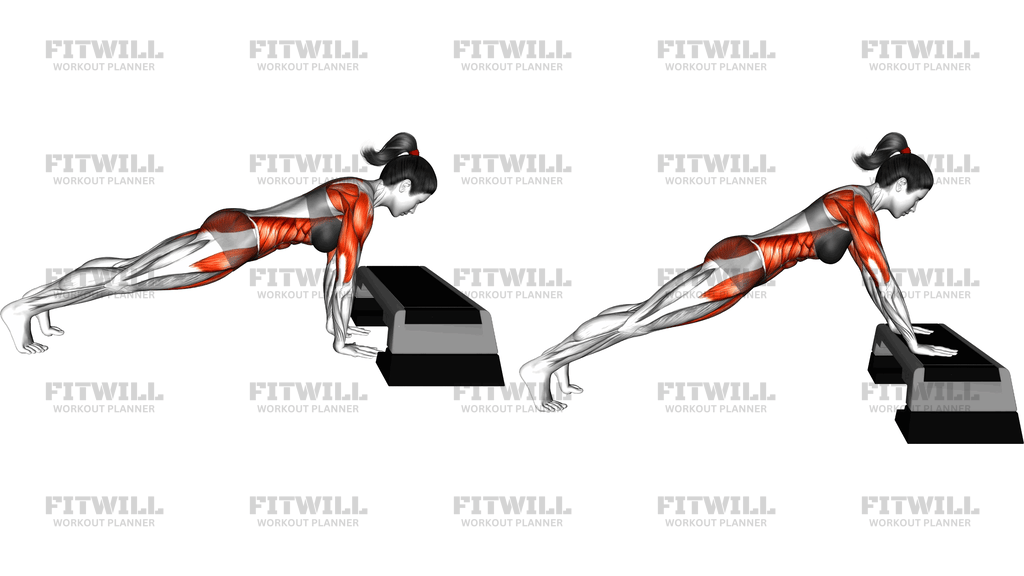
Instructions
- Set a low step or box in front of you and start in a strong plank with your hands placed so you can reach the next support without shrugging.
- Walk your feet back until your body forms a straight line from head to heels, then brace your abs and squeeze your glutes.
- Keep your shoulders stacked over the planted hand or forearm before you begin the first transition.
- Press through the support that is already down and move the opposite hand to the next contact point in a smooth, controlled step.
- Bring the other hand across so both sides are matched again before you shift to the next repetition or direction.
- Keep your hips level and resist twisting as each arm takes a turn supporting your weight.
- Exhale during each hand change and avoid holding your breath while you stabilize.
- Use the shortest clean path possible if the box height or reach starts to break your plank line.
- Finish the set by lowering under control and resetting your plank before you release the position.
Tips & Tricks
- Choose a step height that lets you keep your ribs down; if your lower back arches, the box is too high for the set.
- Set your feet a little wider than hip-width if the torso wants to rock from side to side.
- Push the floor or step away through the planted hand instead of collapsing into the shoulder.
- Keep your neck long and look slightly ahead of your hands rather than craning up at the box.
- Slow the hand change enough that your hips do not swing to help the movement.
- If the wrists get irritated, shorten the set or use a lower support so the hands do less catching and less dumping.
- Treat each transfer like a pause rep: stabilize, move one hand, stabilize again, then continue.
- Stop the set as soon as the shoulders start to shrug or the low back begins to sag.
Frequently Asked Questions
What does Plank Walk-Up train?
It trains core stiffness, shoulder stability, and pressing endurance while your hands move between supports.
Is Plank Walk-Up more of a core or upper-body exercise?
It is both. The core keeps the body from sagging or twisting, while the shoulders, chest, and triceps hold and transfer your weight.
Should my hands stay on the step or move to the floor?
Follow the version shown in your program or image, but keep the same rule: each hand change should be smooth, controlled, and square through the torso.
Why do my hips twist when I do this on a box?
The box is usually too high, the feet are too narrow, or the hand is reaching too far. Lower the support and widen your stance until the plank stays level.
Can beginners do Plank Walk-Up?
Yes, if the support is low and the transitions stay strict. Start with short sets and stop before the low back or shoulders lose position.
What is the safest way to breathe during the rep?
Exhale as one hand moves, then reset your brace before the next transfer instead of holding a long breath through the whole set.
What should I do if my wrists hurt?
Use a lower step, shorten the set, or switch to a forearm-supported variation so the wrists do not take the full transition load.
How do I make Plank Walk-Up harder?
Lower the support, slow the transfers, add a pause after each hand change, or lengthen the working set while keeping the same body line.