Bench Reverse Crunch Circle
Bench Reverse Crunch Circle is a bodyweight core drill performed seated on a flat bench with the hands braced beside the hips and the torso slightly reclined. The legs travel through a controlled circular path while the pelvis stays tucked and the trunk stays quiet, so the work stays centered on the lower abs, hip flexors, and the stabilizers that keep the pelvis from tipping forward.
The bench setup matters because it gives the hands a fixed support point and frees the hips to move without the whole body collapsing backward. Sit near the edge of the bench, press the palms into the pad, and keep the shoulders packed down so the upper body acts as a stable base. From there, the legs can move as one unit instead of turning the exercise into a swinging sit-up or a loose leg raise.
The movement should feel like a reverse crunch blended into a small leg circle: draw the knees in, curl the tailbone slightly under, then sweep the feet through a smooth loop before extending back out under control. The circle should stay compact enough that the lower back never yanks off the bench and the hips do not jerk through the range. Exhale as the knees come in, then inhale as the legs lengthen back out.
This is useful as a focused accessory movement when you want more pelvic control, better lower-abdominal tension, or a low-load finisher after heavier lower-body training. It also works well in core sessions and warm-ups because it teaches the trunk to stay organized while the hips move. Keep the range pain-free, shorten the circle if the low back takes over, and use a bent-knee version before progressing to straighter legs.
[ Workout Log & Planner ]
Put your next workout in Fitwill
Keep your plan and training log ready when you are.


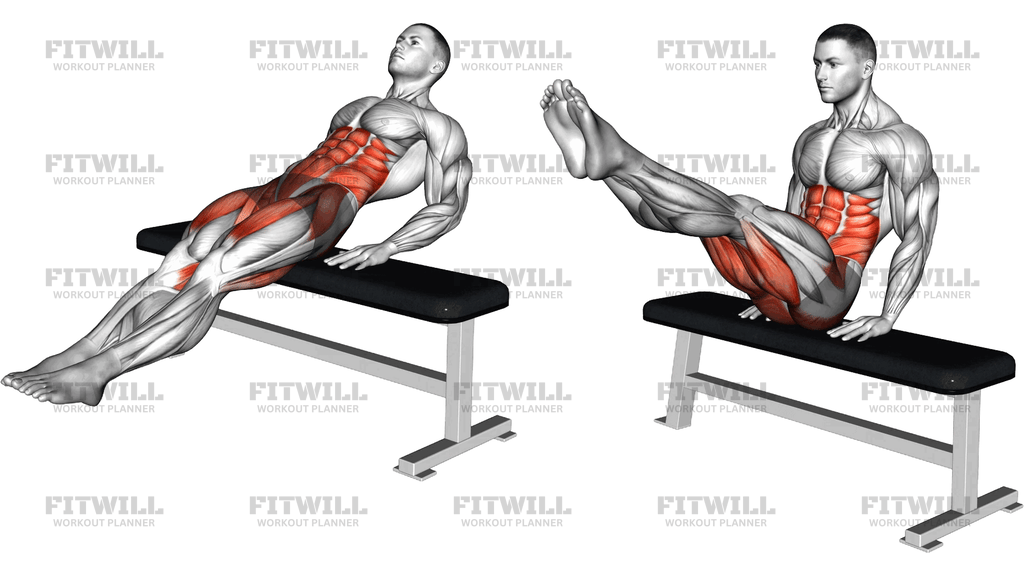
Instructions
- Sit near the edge of a flat bench with your palms on the pad beside your hips and your fingers pointing forward or slightly out.
- Lean back just enough to balance on your hands, keep your chest open, and let your shoulders stay down instead of shrugging.
- Bring your legs forward and slightly off the floor so your heels are clear and your knees are softly bent.
- Brace your midsection and lightly tuck your pelvis so the lower back stays controlled before each rep starts.
- Pull your knees toward your chest in a reverse-crunch motion while keeping the movement smooth, not jerky.
- Sweep the legs through a small circular path, then lengthen them back out to the starting position without losing tension.
- Keep your torso mostly still while the hips do the work, and do not let momentum swing the legs through the circle.
- Exhale as the knees come in and inhale as the legs extend back out.
- Stop the set if you lose the pelvic tuck, feel the low back arch hard, or have to kick the legs to finish the rep.
Tips & Tricks
- Keep your hands planted beside the hips so they stabilize you, not push you through the rep.
- A smaller leg circle usually gives better lower-abdominal tension than a big sweeping arc.
- If the hip flexors dominate, bend the knees more and shorten the range before adding speed.
- Keep the thighs together so the circle comes from the pelvis and hips instead of each leg drifting separately.
- Do not let the chest collapse toward the thighs; the upper body should stay slightly reclined and quiet.
- If your wrists feel overloaded, shift the hands a little farther back on the bench for more support.
- Slow the lowering part of the circle so the legs do not drop and pull the low back out of position.
- Progress by straightening the legs a little more, not by throwing them higher or faster.
Frequently Asked Questions
What does Bench Reverse Crunch Circle work most?
It mainly challenges the lower abs, hip flexors, and deep core muscles that control pelvic position.
How do I set up on the bench correctly?
Sit close to the edge, place your palms beside your hips, and lean back only far enough to keep your balance without rounding the upper body.
Should the legs stay straight during the circle?
A slight knee bend is usually better because it keeps the circle controlled and reduces the chance of swinging.
Why does my lower back want to arch?
The circle is probably too big or you are letting the pelvis tip forward. Shorten the path and keep the tuck in place.
Can I use this as a beginner core exercise?
Yes, if you keep the knees bent, make the circle small, and move slowly enough to avoid swinging.
What is the most common form mistake?
Most people either yank the legs through the circle or let the torso rock backward, which takes tension off the abs.
How can I make the exercise harder?
Straighten the legs a little more, slow the tempo, and keep the circle small so the core has to control a longer lever.
Should I hold my breath during the rep?
No. Exhale when the knees draw in and inhale as the legs extend so the brace stays consistent.