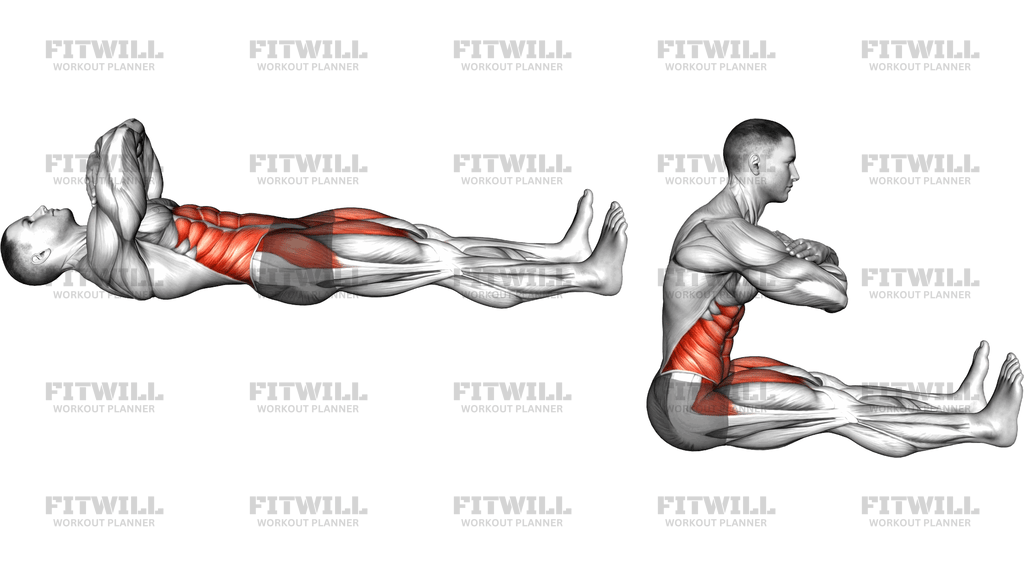
V-Up Down With Stability Ball
V-Up Down With Stability Ball is a floor-based core transfer exercise that combines a V-up with a controlled hand-to-foot pass. You lie on your back, fold your torso and legs toward each other, and move the ball between your hands and feet as you rise and lower. That makes it more demanding than a basic crunch because it asks your abs, hip flexors, and deep core to coordinate force, timing, and control at the same time.
The movement is mainly about the rectus abdominis, with the obliques and transverse abdominis helping you stay tight as the body folds and unfolds. Because the ball has to be secured cleanly at the top of the rep, the exercise also exposes weak links in coordination and midline control. If the transfer gets sloppy, the lower back usually starts to arch or the shoulders begin to jerk, which is why the tempo matters more here than in simpler ab work.
Set up on a mat with enough room to open fully overhead and out in front of you. Start flat on your back, keep the ball within easy reach, and make the first rep from a long, straight position rather than a tucked one. The goal is to lift the shoulders and legs together, meet the ball at the top, and pass it without twisting through the ribs or swinging the legs to create momentum.
As you lower, keep the same tension through the abdomen and let the spine unfold under control instead of dropping back to the floor. This exercise works well in core-focused sessions, finishers, or as an accessory drill for athletes who need better trunk compression and hip flexion control. It is also useful as a progression from basic V-ups or dead-bug-style work, but it should stay pain-free and crisp; if the neck, hips, or low back take over, shorten the range and simplify the transfer before adding volume.
Fitwill
Log Workouts, Track Progress & Build Strength.
Achieve more with Fitwill: explore over 9600 exercises with images and videos, access built-in and custom workouts, perfect for both gym and home sessions, and see real results.
Start your journey. Download today!




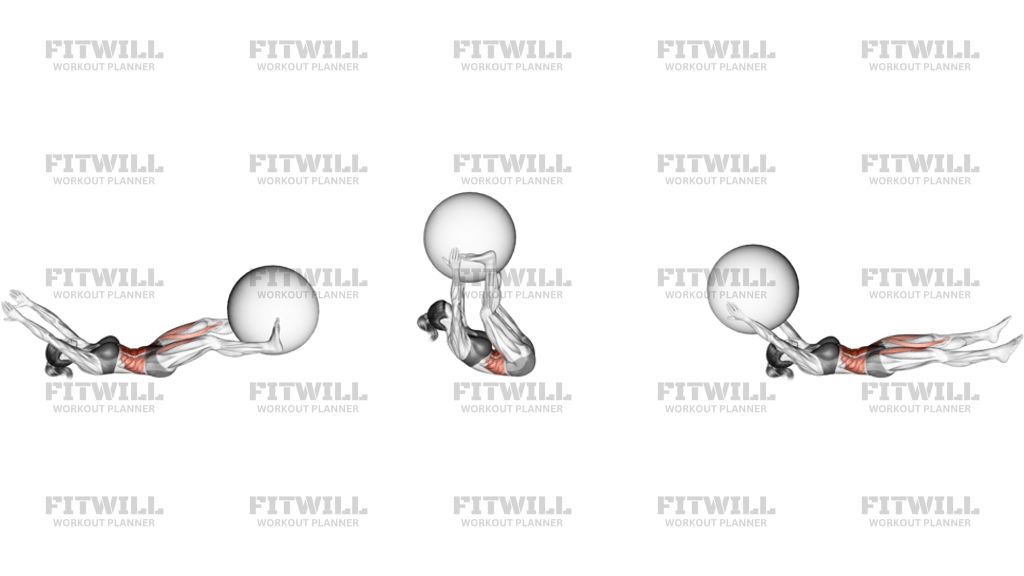
Instructions
- Lie face up on a mat with your legs straight and the stability ball held between your hands above your chest.
- Reach your arms back and extend your legs long so your body is flat and the ball stays close enough to control without reaching.
- Press your lower back gently into the floor, brace your midsection, and keep your chin tucked so your neck stays long.
- Exhale as you lift your shoulders and legs together into a V shape, bringing the ball toward your feet.
- Meet the ball at the top of the rep and pass it smoothly from your hands to your feet without twisting your torso.
- Keep your legs straight but not locked as you secure the ball between your feet and lower your upper body under control.
- Lower back to the floor with the ball now held by your feet, keeping tension through your abs instead of dropping quickly.
- On the next rep, fold back up, transfer the ball from your feet to your hands, and repeat the same clean path.
- Finish the set by lowering the ball safely to the floor and relaxing your legs before you sit up.
Tips & Tricks
- Use a soft, easy-to-grip stability ball so the hand-to-foot transfer does not turn into a wrestling match.
- Keep the ball close to your torso on the way up; a long reach usually pulls the low back off the floor.
- If your feet cannot secure the ball cleanly, bend your knees slightly and shorten the lever before the next rep.
- Think about lifting your ribs toward your pelvis instead of throwing your arms and legs upward.
- Squeeze the ball firmly with your feet before you release it from your hands so it does not slip mid-transfer.
- Lower in a slow count so the abs stay loaded through the down phase instead of letting gravity finish the rep.
- If your neck starts to strain, keep your eyes on the ball and stop trying to reach with your head.
- Stop the set as soon as the ball transfer becomes noisy, crooked, or dependent on momentum.
Frequently Asked Questions
What muscle does V-Up Down With Stability Ball target most?
It mainly targets the rectus abdominis, with the obliques and hip flexors helping during the lift and transfer.
How do I pass the stability ball during V-Up Down With Stability Ball?
Lift into the V position, bring the ball to your feet, secure it between your feet, then lower with the ball held by your legs.
Is V-Up Down With Stability Ball good for beginners?
It is better as an intermediate core drill. Beginners can start with a basic V-up or keep the knees slightly bent before adding the ball transfer.
Why does my lower back come off the floor?
The lever is probably too long or the ball is too far away. Shorten the reach and keep your ribs pulled down as you fold up.
Should my legs stay straight the whole time?
Mostly yes, but a small knee bend is fine if it helps you control the ball and keep the rep smooth.
Can I use a medicine ball instead of a stability ball?
Use a soft ball that you can pass and clamp securely between your hands and feet. A hard or slippery ball makes the transfer less stable.
What should I feel at the top of the rep?
You should feel your abs compress hard and your hips fold without neck strain or a jolt through the low back.
How can I make V-Up Down With Stability Ball harder?
Slow the lowering phase, pause longer during the transfer, or extend the legs a little farther as long as the ball still moves cleanly.