Cable Stiff Leg Deadlift From Stepbox
Cable Stiff Leg Deadlift From Stepbox is a cable-based hip hinge that trains the back side of the body with constant tension and a long stretch through the hinge. Standing on a stepbox gives you extra room to push the hips back, which makes the movement feel different from a floor-based deadlift or a barbell Romanian deadlift. It is especially useful when you want focused work for the glutes, hamstrings, and trunk without needing a heavy barbell setup.
The stepbox changes the start position in a useful way: your feet are elevated, the cable stays angled under tension, and the handle can travel a little farther before the plates stop moving. That extra travel should come from the hip hinge, not from rounding the lower back or turning the rep into a squat. Keep the knees softly bent, the ribs stacked over the pelvis, and the shoulders packed enough to keep the handle close to your legs.
This exercise works best when you treat it as a controlled stretch-and-drive pattern. Lower by sending the hips back, keeping the shins nearly vertical, and letting the torso tip forward while the spine stays long. At the bottom, you should feel tension across the hamstrings and glutes, not a pinch in the low back. Stand back up by driving through the feet, extending the hips, and finishing tall without leaning back or snapping the cable upward.
Because the load comes from a cable, the resistance does not disappear at the top or bottom of the rep the way it sometimes can with free weights. That makes Cable Stiff Leg Deadlift From Stepbox a good accessory exercise for lower-body days, posterior-chain work, or technique-focused conditioning. It also rewards clean positioning, so a lighter load with a precise hinge usually produces a better training effect than a heavier stack with a shorter range.
Use it when you want to build hinge strength, improve hip control, and reinforce a strong braced posture under continuous tension. Start conservatively, especially if the stepbox height changes your balance or range of motion. The best reps look smooth, controlled, and repeatable from the first hinge to the last reset.
Fitwill
Log Workouts, Track Progress & Build Strength.
Achieve more with Fitwill: explore over 9600 exercises with images and videos, access built-in and custom workouts, perfect for both gym and home sessions, and see real results.
Start your journey. Download today!




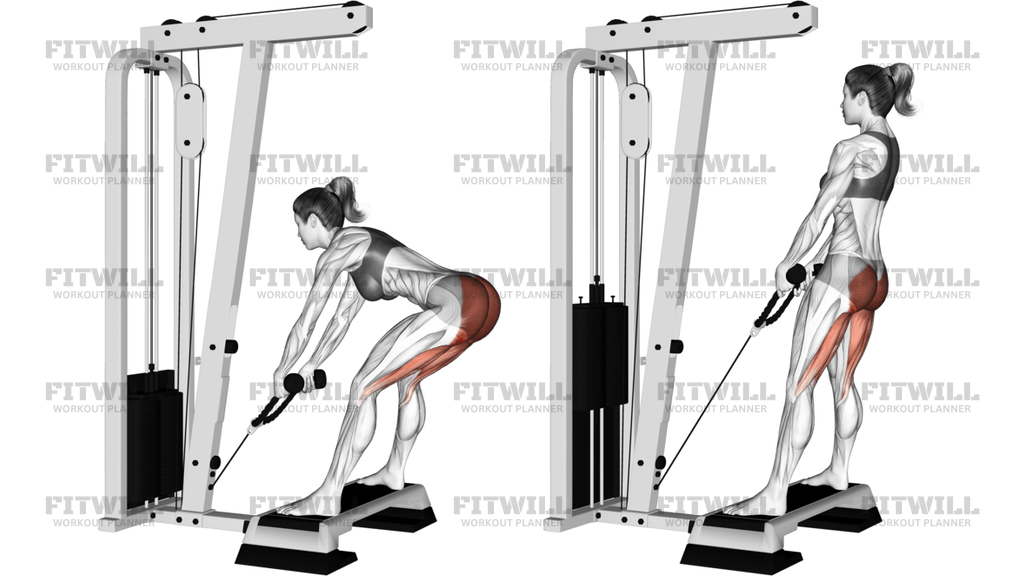
Instructions
- Place a stepbox in front of a low cable pulley and stand on it with feet about hip-width apart, holding the handle attachment with both hands in front of your thighs.
- Step far enough from the stack that the cable stays taut when your arms hang straight and the handle is just in front of your legs.
- Soften your knees, brace your midsection, and set your chest proud without arching your lower back.
- Push your hips back and let your torso hinge forward while keeping your shins nearly vertical and your weight centered through the midfoot and heel.
- Slide the handle down close to your thighs and shins as your hips travel back, keeping your arms long and your shoulders square.
- Lower until you feel a strong stretch in your hamstrings and glutes while your spine stays long and neutral.
- Drive through your feet, extend your hips, and stand tall as the handle travels back up the same path close to your legs.
- Finish by squeezing your glutes without leaning backward or shrugging your shoulders.
- Lower the handle under control, reset your hinge, and repeat for the planned reps.
Tips & Tricks
- Keep the cable taut before you start so the first rep does not jerk you out of position.
- Treat the stepbox as a range-of-motion helper, not a place to bounce; the hinge should create the stretch, not a quick drop.
- If your knees drift forward, shorten the range and send the hips farther back to keep this as a hinge instead of a squat.
- Let the handle skim close to your legs so the cable does not pull your shoulders forward.
- Stop the descent when your lower back wants to round; the goal is a long spine, not the deepest possible reach.
- Exhale as you drive the hips forward and stand up, then reset your breath before the next rep.
- Use a lighter load if the box height makes you wobble or shift onto your toes.
- A brief squeeze at the top is enough; do not lean back to finish the rep.
- Slow down the lowering phase to keep tension on the hamstrings and glutes the whole time.
Frequently Asked Questions
What does Cable Stiff Leg Deadlift From Stepbox train most?
It mainly trains the glutes and hamstrings through a loaded hip hinge, with the core working hard to keep the torso stable.
Why stand on a stepbox for Cable Stiff Leg Deadlift From Stepbox?
The stepbox gives you extra clearance for the cable and lets you reach a longer hinge position, which increases the stretch on the back of the legs.
Should my knees stay locked in Cable Stiff Leg Deadlift From Stepbox?
No. Keep a soft bend in the knees so the movement stays a hip hinge and does not turn into a squat or a locked-out pull.
Where should I feel Cable Stiff Leg Deadlift From Stepbox?
You should feel tension in the hamstrings, glutes, and midsection. A light stretch in the lower back can happen, but sharp pressure there usually means you hinged too far.
Is Cable Stiff Leg Deadlift From Stepbox good for beginners?
Yes, if the load is light and the hinge is learned slowly. Start with a shorter range until you can keep the cable close and the spine neutral.
What is the most common mistake on this exercise?
Most people either squat the movement or round the lower back at the bottom. Push the hips back, keep the shins fairly vertical, and stop before posture breaks.
How heavy should I go on Cable Stiff Leg Deadlift From Stepbox?
Use a load that lets you keep steady cable tension, a controlled lowering phase, and a clean hip drive without leaning back at the top.
Can I substitute this for a barbell Romanian deadlift?
Yes, it is a good cable-based alternative when you want constant tension and a slightly longer, more guided range of motion.