Side Plank Hip Adduction
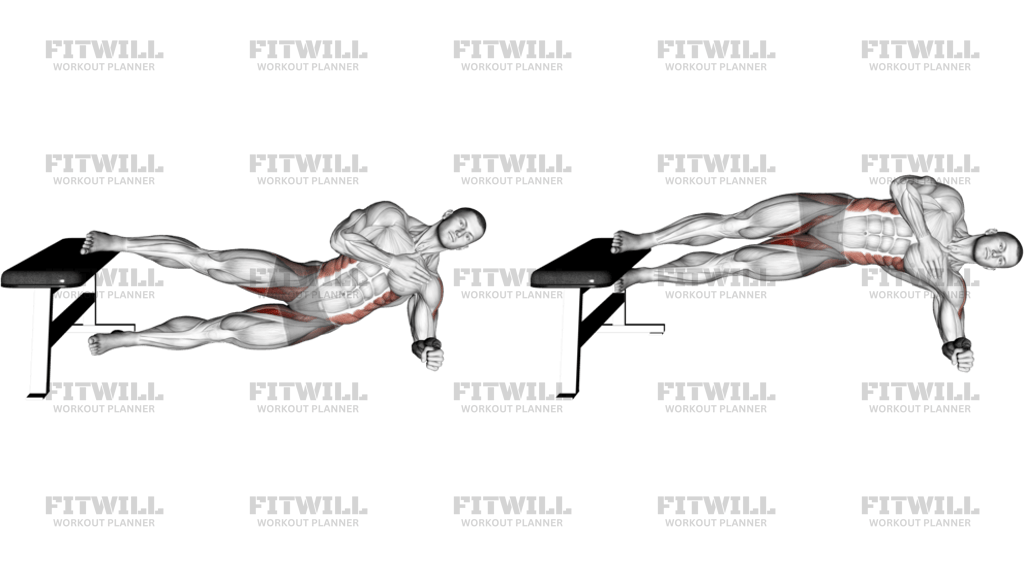
Side Plank Hip Adduction is a bodyweight side-plank variation that uses a bench to create a long lever for the hips and trunk. One foot is supported on the bench while the torso stays stacked on the forearm, which makes the exercise more about controlled pelvic position and inner-thigh control than about speed or range. The setup matters because a small shift in the shoulder, ribs, or hips changes the feel of the whole rep.
This movement trains the hip adductors hard, especially the inner thigh of the moving leg, while the obliques, deep core, and shoulder stabilizers keep the body from rotating. It is useful when you want adductor strength with a strong side-body stability demand. The bench support gives you enough leverage to challenge the adductors without needing a machine or cable setup.
The best reps start with a clean side plank. Keep the forearm directly under the shoulder, press the floor away, and extend the body in a straight line from head to heels. From there, draw the free leg toward the supported leg with control, keeping the chest quiet and the hips lifted. The movement should feel like the inner thigh is pulling the leg inward, not like the torso is twisting to create motion.
Because the exercise combines adduction with plank stability, it is easy to cheat by dropping the hips, rolling the chest open, or swinging the leg. Shorter range, slower tempo, and a firm pause at the top usually produce better tension than forcing a bigger sweep. If the shoulder, wrist, or inner thigh feels strained in a bad way, reduce the range or use a simpler side-plank variation before adding load or volume.
Use Side Plank Hip Adduction as accessory strength work, core training, or part of an athletic warm-up when you want better lateral control and groin resilience. It pairs well with other hip stability drills, but it should still be treated as a precise exercise: stay stacked, keep the ribs down, and let the moving leg travel under control instead of chasing momentum.
[ Workout Log & Planner ]
Put your next workout in Fitwill
Keep your plan and training log ready when you are.


Instructions
- Place one forearm on the floor directly under the shoulder and line your body up in a side plank beside a bench.
- Set the foot on the bench and keep the other leg long, with the hips stacked and the chest facing mostly forward.
- Lift the hips so your body forms a straight line from head to feet, then brace the ribs down.
- Inhale to prepare, then keep the neck long and the supporting shoulder packed away from the ear.
- Draw the free leg inward toward the supported leg without letting the torso rotate or the hips sag.
- Squeeze the inner thigh briefly at the top of the motion.
- Lower the leg slowly until you feel the adductors lengthen again, keeping the plank shape intact.
- Reset the side plank before the next rep and keep the breathing steady throughout the set.
Tips & Tricks
- Keep the elbow under the shoulder so the plank is supported by bone and not by the front of the shoulder.
- Think about pulling the inner thigh toward the midline instead of kicking the leg.
- If your torso rotates open, shorten the leg path until the chest stays quiet.
- A one-second squeeze at the top usually works better than a fast touch-and-go rep.
- Keep the bottom ribs tucked so the core stays connected to the hip movement.
- Do not let the supporting hip collapse toward the floor as the working leg moves.
- If the adductors cramp, reduce the range and slow the lowering phase before adding load.
- Use a lower bench or a bent-knee side plank version if the straight-leg lever is too difficult.
Frequently Asked Questions
What does Side Plank Hip Adduction train most?
It mainly trains the hip adductors on the moving leg, with the obliques and shoulder stabilizers working hard to keep the side plank from rotating.
Which foot goes on the bench?
Place one foot on the bench to anchor the side plank, then move the free leg inward under control while keeping the torso stacked.
How do I keep my hips from sagging during the rep?
Press the floor away through the forearm, keep the ribs tucked, and stop the leg from moving the moment the pelvis starts to drop.
Should the chest stay open or square to the floor?
Keep the chest mostly square and avoid rolling backward as the leg moves, because that turns the exercise into a trunk twist instead of a clean adduction.
Can beginners use this exercise?
Yes, but a bent-knee side plank or a shorter leg path is usually a better starting point before using the full straight-leg version.
Why does the bench matter in this variation?
The bench gives the side plank a fixed support point and changes the leverage, which makes the adductors and trunk stabilizers work against a longer side-body line.
What are the most common mistakes?
Dropping the hips, swinging the free leg, and rotating the chest open are the biggest errors because they reduce tension on the inner thigh.
How can I progress it safely?
Use a cleaner pause at the top, a slower lowering phase, or a longer lever before adding external load.