Shoulder Flexion Back To Wall
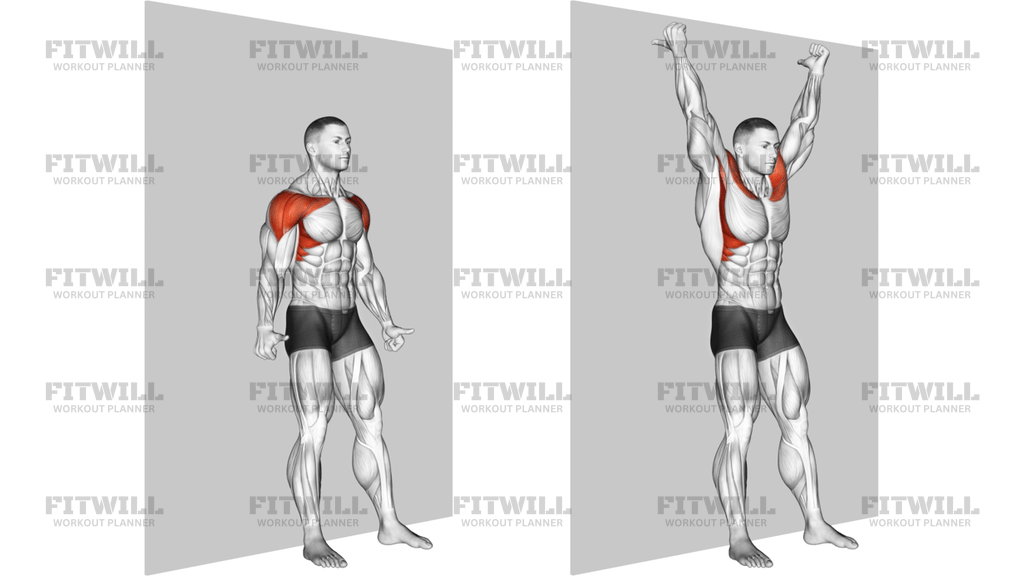
Shoulder Flexion Back to Wall is a bodyweight wall mobility drill for improving how your shoulders reach overhead while your trunk stays stacked and controlled. The exercise is usually used to open up overhead range, clean up scapular motion, and teach you to raise the arms without turning the movement into a low-back arch. It is especially useful before pressing, pulling, overhead work, or any session where the arms need to travel high without rib flare.
The wall gives you immediate feedback. If the ribs pop forward, the lower back arches, or the head drifts away from the wall, the arms may have more range than your current shoulder and thoracic position can support. Done well, the drill shows you where the restriction is coming from and helps you own the top position with better alignment. The goal is not to force the hands flat at any cost; the goal is to find the cleanest overhead line you can control.
Start by standing with your back against the wall, feet placed a short distance in front of you, and your pelvis and ribs stacked so your torso stays long instead of collapsed. From there, lift the arms forward and upward in a smooth arc until they approach the wall overhead. Keep the elbows straight only as far as you can maintain position, and let the movement slow down if one side wants to shrug, twist, or drift ahead of the other. A small range done perfectly is better than a bigger range that steals position from the spine.
This movement is often paired with warm-up work, shoulder prep, postural reset drills, or overhead screening. It can also help lifters notice side-to-side differences, since one arm may touch sooner or stay closer to the wall than the other. If you feel pinching in the front of the shoulder, back off slightly and shorten the range. If the lower back is doing the work, reset your feet, lower the rib cage, and repeat the lift with less range and more control.
Treat the rep like a position drill rather than a max-effort strength exercise. Breathe steadily, keep the neck quiet, and finish each rep in the exact shape you want to repeat. Over time, better wall contact, smoother upward rotation, and less compensation usually carry over to overhead pressing, snatches, handstand work, and other positions that demand clean shoulder flexion.
[ Workout Log & Planner ]
Put your next workout in Fitwill
Keep your plan and training log ready when you are.


Instructions
- Stand with your back against a wall and place your feet a short distance forward so you can stay balanced without arching your lower back.
- Stack your pelvis and ribs, keep your chin gently tucked, and let your arms hang by your sides with relaxed shoulders.
- Press the back of your head, upper back, and pelvis toward the wall without forcing a painful position.
- Lift both arms forward and up in a smooth arc, keeping them as close to the wall as your current mobility allows.
- Continue reaching overhead until you feel the first clear stretch or the first sign that your ribs want to flare.
- Pause briefly at the top and check that your neck stays long and your lower back stays quiet.
- Lower the arms back to your sides under control, keeping the same stacked torso position.
- Reset your breathing and repeat for the planned number of reps or hold time.
Tips & Tricks
- If your ribs flare the moment your arms pass eye level, shorten the range and keep the cage stacked instead of chasing the wall.
- A slight bend in the knees can help you keep the pelvis neutral if your hamstrings pull your hips into an arch.
- Keep the elbows straight enough to show the overhead path, but do not lock them so hard that the shoulders shrug.
- Move slowly through the last third of the range, where most people lose wall contact and start compensating through the low back.
- If one arm reaches farther than the other, watch whether the shoulder blade on that side lifts or rotates sooner.
- The wall should be a reference point, not something you slam into; gentle contact gives you better feedback on alignment.
- Exhale as the arms rise to help keep the rib cage from tipping forward.
- Stop the rep if you feel a pinch in the front of the shoulder and retry with less range or a slightly wider stance.
Frequently Asked Questions
What is Shoulder Flexion Back to Wall mainly used for?
It is mainly used to improve overhead shoulder flexion while teaching you to keep the ribs, pelvis, and head stacked against the wall.
Can beginners perform this exercise?
Yes. Beginners can use a smaller range and focus on staying flat against the wall instead of forcing the arms all the way overhead.
Do my hands need to touch the wall?
Not necessarily. The priority is a clean overhead path without losing rib and pelvis position, even if the hands stop short of the wall.
What usually limits this movement?
Tight lats, limited thoracic extension, or poor scapular upward rotation often show up first when the arms approach overhead.
Why do my ribs pop off the wall when I raise my arms?
That usually means the shoulders do not have enough overhead range yet, so the body steals it from the low back.
Should I feel a stretch during this drill?
You should usually feel a controlled stretch through the shoulders, lats, or upper back, but not a sharp pinch in the front of the shoulder.
Can I use this before pressing or overhead sports work?
Yes. It fits well as a warm-up or reset before overhead pressing, throwing, Olympic lifting, or handstand practice.
How do I make the drill harder without adding weight?
Use a slower tempo, hold the top position longer, or move your feet slightly closer to the wall while keeping the torso stacked.