Side Lunge
Side Lunge is a bodyweight lower-body exercise that shifts your weight from one leg to the other in the frontal plane. It trains the glutes, hips, adductors, hamstrings, and core while teaching you to control your pelvis and knee alignment as you move sideways instead of straight forward or backward.
The pictured setup uses a tall standing start with the hands held in front of the chest, feet set wide, and the toes mostly forward. That position matters because it gives you a stable base before you sit into one hip. From there, the working leg bends, the opposite leg stays long, and the torso stays braced instead of collapsing into the lane of the bent knee.
A good side lunge is not a drop straight down. You step or shift out, then send the hips back toward the bent leg while keeping the other foot rooted and the trailing leg extended. The bent knee should track over the toes, the arch should stay active, and the chest should stay proud enough that the spine does not round as you reach the bottom.
This exercise is useful for warmups, athletic prep, accessory work, and general lower-body strength because it builds control in a pattern many people miss in straight-line training. It is also a practical way to load the adductors and glute medius without a machine. If the range gets too deep or the knee caves inward, shorten the step and reduce depth until the motion stays smooth and repeatable.
Use breathing to keep the rep organized: inhale before you move, exhale as you drive back to center, and reset your stance before the next rep. If you want more challenge, slow the lowering phase, pause in the bottom, or hold a weight at the chest. If the hips or knees feel pinched, reduce the depth and keep the shin angle more vertical until the movement feels clean.
[ Workout Log & Planner ]
Put your next workout in Fitwill
Keep your plan and training log ready when you are.


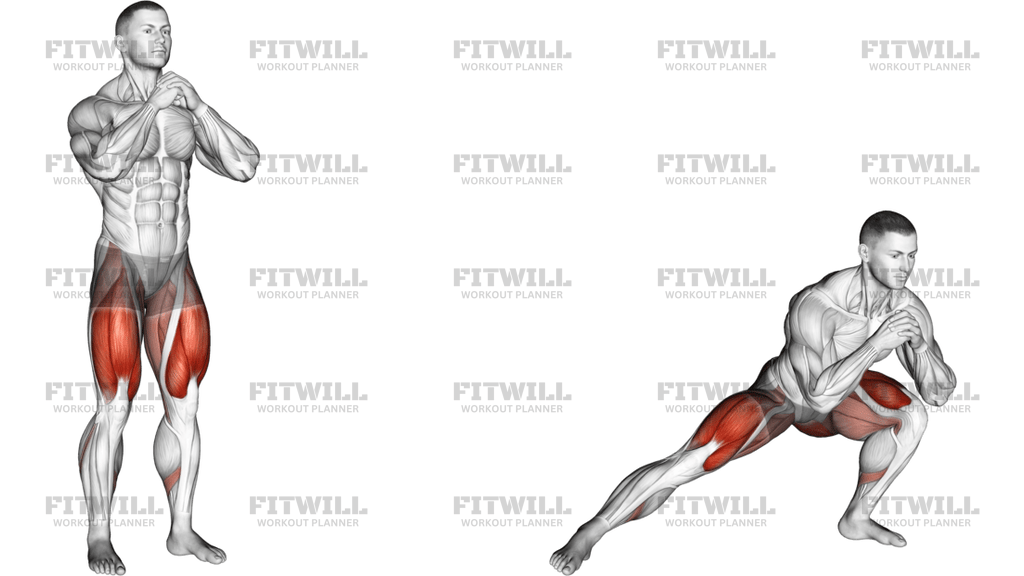
Instructions
- Stand tall with your feet wider than shoulder width, toes mostly forward, and your hands clasped in front of your chest.
- Brace your torso and keep your chest up before you shift to either side.
- Step your weight to one side and let that knee bend while the opposite leg stays long and grounded.
- Sit your hips back toward the bent leg instead of dropping straight down.
- Keep the bent knee tracking in line with the toes and avoid letting it cave inward.
- Stay balanced through the working foot, with the heel and midfoot pressing into the floor.
- Push through the bent leg to return to the center under control.
- Reset your stance and repeat on the other side for the planned number of reps.
Tips & Tricks
- Keep the non-working leg long rather than turning the movement into a squat.
- Let the hips travel back so the glute and inner thigh of the bent side can load.
- If your heel pops up, shorten the step or reduce the depth until the foot stays planted.
- Point both toes mostly forward to make the side shift cleaner and easier to control.
- Stop the descent when the bent knee and hip stay aligned; do not force extra depth if the pelvis tucks under.
- A slower lowering phase will usually reveal whether you are controlling the side-to-side shift or just falling into it.
- Keep the hands at chest height if you want a simple balance cue and a lighter counterweight.
- Exhale as you drive back to the middle to help keep the torso from folding forward.
Frequently Asked Questions
What muscle does Side Lunge target most?
The glutes are the main target, with the adductors, quads, and hamstrings working hard to control the side-to-side shift.
Can beginners perform this exercise?
Yes. Beginners can start with a smaller step and shallow depth while keeping the hands at the chest for balance.
Should my chest stay upright the whole time?
It should stay braced and tall, but a slight forward lean is normal as long as the spine stays long and the back does not round.
What is a common mistake with the bent knee?
Letting the knee collapse inward is the biggest issue. Keep it tracking in line with the toes as you sit back.
How wide should my stance be?
Wide enough to shift cleanly into one hip without losing balance, but not so wide that you cannot keep the working foot flat.
Why does the other leg stay straight?
Keeping the other leg long helps load the glutes and inner thigh of the working side instead of turning the rep into a regular squat.
What should I do if my hips or knees feel tight?
Shorten the step, reduce the depth, and keep the foot angle more forward until the movement feels smooth and pain-free.
How can I make Side Lunge harder?
Slow the lowering phase, pause at the bottom, or hold a load at the chest while keeping the same clean side-shift pattern.