Side Lunge
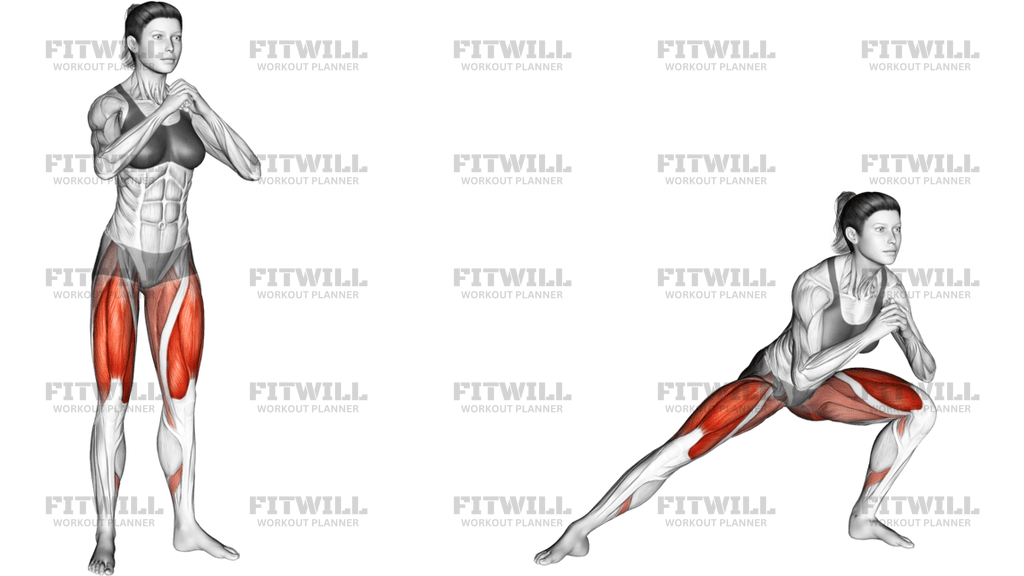
The Side Lunge is a bodyweight frontal-plane lower-body exercise that builds strength, control, and mobility through one leg at a time. It asks the working hip to absorb load while the other leg stays long and quiet, which makes it useful for glute development, adductor loading, and better control over side-to-side movement. Because the set is driven by body position rather than external load, the quality of the stance, knee tracking, and hip shift matters more than speed.
The main training emphasis is the glutes, with the hamstrings, inner thigh muscles, core, and lower back helping stabilize the pelvis and trunk. In anatomy terms, the primary mover is the Gluteus maximus, with support from the Biceps femoris, Rectus abdominis, and Erector spinae. This makes the exercise valuable when you want hip strength that carries over to change-of-direction work, lateral athletic positions, and general lower-body balance.
The setup should feel athletic and grounded before you move. Stand tall with your feet under control, then step one leg out to the side and let that working foot plant firmly. Keep the non-working leg extended as you shift your hips back and sit into the bent leg. The chest stays proud, the spine stays long, and the working knee tracks in line with the toes rather than collapsing inward.
At the bottom of the repetition, the bent leg should own the load while the opposite leg stays relatively straight and the foot stays connected to the floor. From there, drive the floor away with the bent-leg heel and midfoot, squeeze the glute to stand, and bring your body back to the start with control. A smooth return matters because the side lunge is as much about deceleration and hip control as it is about pushing back up.
Use the side lunge as a warm-up drill, accessory movement, or bodyweight strength exercise when you want to train the hips without needing a machine or barbell. It is especially useful if your program includes squats, lunges, running, or sports that demand lateral force production. Keep the range pain-free, move deliberately, and make each rep look the same so the working side can do the job without twisting, bouncing, or drifting forward.
[ Workout Log & Planner ]
Put your next workout in Fitwill
Keep your plan and training log ready when you are.


Instructions
- Stand tall with your feet about hip-width apart, hands in front of your chest, and your weight evenly balanced.
- Step one foot out to the side and plant it flat, keeping the other leg extended and the toes facing mostly forward.
- Shift your hips back toward the stepping leg while keeping your chest lifted and your spine neutral.
- Bend the stepping knee and sit into that hip until you feel the working glute and inner thigh take the load.
- Keep the opposite leg long and quiet, with the heel down and the knee straight or only slightly bent.
- Pause briefly at the bottom without letting your torso collapse forward or your knee cave inward.
- Drive through the heel and midfoot of the bent leg to push your hips back to center.
- Bring your feet back under you under control, reset your stance, and repeat on the same side or alternate sides as prescribed.
Tips & Tricks
- Keep the stepping foot pointed mostly forward so the knee and hip can track naturally instead of twisting outward.
- Push the hips back, not just the knee forward; the movement should feel like a side step and squat, not a sideways bend at the waist.
- Let the non-working leg stay long so you load one hip at a time instead of shortening the range with both knees bent.
- Press through the heel and midfoot of the bent leg to bias the glute and avoid falling into the front of the knee.
- Stop the descent when the working heel starts to lift or the pelvis starts to tilt and lose alignment.
- Keep the chest up and eyes forward so the torso does not fold and steal tension from the hip.
- Exhale as you drive back to center, then inhale as you step and lower into the next rep.
- Use a shallower range at first if the groin or inner thigh feels strained, then deepen only as control improves.
Frequently Asked Questions
What does the side lunge work most?
It primarily trains the glutes, with strong involvement from the adductors, hamstrings, and core.
Should my stepping foot stay flat in the bottom position?
Yes, the stepping foot should stay planted so you can load the hip and push back out without wobbling.
How far should I step out to the side?
Step far enough to feel a clear hip shift and knee bend, but not so far that you lose balance or turn the movement into a split squat.
Why does the other leg stay straight?
Keeping the opposite leg long helps load one hip at a time and increases the stretch through the inner thigh of the extended side.
Can I do side lunges if I am new to training?
Yes. Start with a short range of motion and bodyweight only until you can keep the knee tracking and the torso stable.
What should I avoid at the bottom of the rep?
Avoid letting the working knee cave inward, the heel rise, or the chest collapse over the thigh.
Is this the same as a lateral lunge?
Yes, side lunge and lateral lunge are commonly used to describe the same side-stepping hip-dominant movement.
How can I make the exercise harder without adding weight?
Use a deeper controlled range, pause at the bottom, or slow the return to center while keeping the working foot planted.