Low Glute Bridge On The Floor
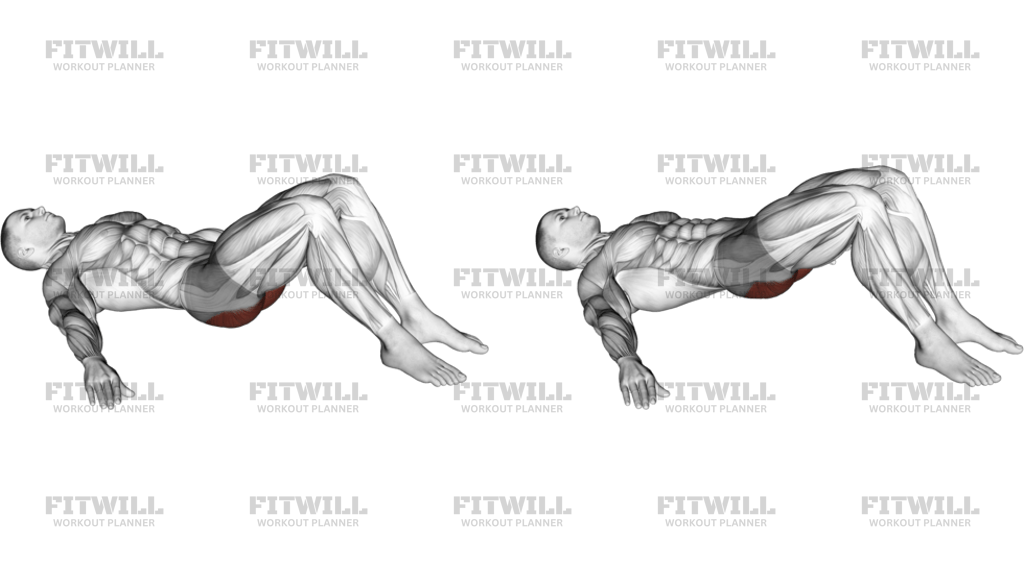
Low Glute Bridge On The Floor is a bodyweight bridge variation that trains the glutes through a short, controlled hip extension from the floor. It is useful when you want to warm up the hips, reinforce glute contraction, or add lower-body volume without loading the spine or requiring equipment. The movement looks simple, but the quality of the rep depends on how well you set the feet, brace the trunk, and finish the lift without turning it into a low-back arch.
The main emphasis is on the glutes, with the hamstrings helping to extend the hips and the core and lower back working to keep the torso steady. In anatomy terms, the prime mover is the Gluteus maximus, assisted by Biceps femoris, Rectus abdominis, and Erector spinae. Because the range is modest, this exercise is often used to build better awareness of the top position and to teach the pelvis to stay controlled while the hips move.
The setup matters more than people expect. Lie on your back with your knees bent, feet flat, and heels close enough to the body that you can drive through the floor without reaching. Place your hands on the floor beside you for balance, then set your ribs down and lightly tuck the pelvis so the lower back is not already arched before the first rep. That starting position gives the glutes a better line of pull and makes the bridge feel more like a hip extension than a back bend.
As you lift, press through the feet and raise the hips until the knees, hips, and shoulders form a clean line or slightly below it, which matches the low bridge style shown here. Squeeze the glutes at the top for a brief pause, then lower with control until the pelvis returns to the floor. Keep the chin relaxed, breathe steadily, and avoid flaring the ribs or shifting the weight into the toes. The return should be smooth and deliberate so each rep starts from the same stable position.
Low Glute Bridge On The Floor is a practical choice for warmups, accessory work, and glute-focused circuits, especially for beginners or lifters who need a lower-intensity option than a weighted bridge or hip thrust. It also works well when you want to reinforce pelvic control before heavier lower-body training. Treat it as a quality exercise, not a speed drill: cleaner reps with a clear glute squeeze will teach more than trying to force a bigger range or more reps than you can control.
[ Workout Log & Planner ]
Put your next workout in Fitwill
Keep your plan and training log ready when you are.


Instructions
- Lie on your back with your knees bent, feet flat on the floor, and your heels close enough that you can press through them without sliding.
- Place your arms on the floor beside you with your palms down for balance, and keep your head and upper back relaxed on the mat.
- Set your feet about hip-width apart and angle your toes slightly forward so both knees can track in the same direction.
- Exhale to lower your ribs and lightly tuck your pelvis so your lower back stays long before you start the lift.
- Press through your heels and midfoot to raise your hips off the floor in a smooth arc.
- Lift until your hips, knees, and shoulders line up or stop just short of that point if your low-back starts to arch.
- Squeeze your glutes hard at the top and hold the bridge briefly without shifting into your toes.
- Lower your hips back to the floor under control, keeping tension in the glutes instead of dropping fast.
- Reset your feet and pelvis before the next rep, then repeat for the planned number of repetitions.
Tips & Tricks
- If your hamstrings take over, walk your feet slightly farther from your glutes and focus on driving through the heels instead of pulling with the heels.
- Keep the ribs down at the top; if your chest flares up, the lift is turning into a low-back arch instead of a glute bridge.
- A short pause at the top is more useful here than a bigger range, because the exercise is designed to teach a clean glute squeeze.
- Do not let the knees drift wide or collapse inward; keep both thighs parallel so the hips stay evenly loaded.
- If the bridge feels cramped in the front of the hips, check that your feet are not too close to your glutes at the start.
- Move slowly enough that each rep starts from a dead stop on the floor instead of bouncing through the bottom.
- Keep your shoulders heavy on the floor and avoid pushing through the hands, which can reduce the work on the glutes.
- Use this as a glute activation drill before squats, deadlifts, or lunges when you want better hip extension without fatigue.
Frequently Asked Questions
What muscles does Low Glute Bridge On The Floor work most?
It mainly targets the glutes, with the hamstrings helping to extend the hips and the core stabilizing the torso.
Is Low Glute Bridge On The Floor good for beginners?
Yes. It is a simple floor-based bridge that lets beginners learn hip extension and glute contraction without heavy loading.
Where should my feet be in Low Glute Bridge On The Floor?
Place your feet hip-width apart with your heels close enough that you can press the floor without reaching. If the hamstrings cramp, move the feet a little farther away.
Why do my lower back and not my glutes feel Low Glute Bridge On The Floor?
That usually means the ribs are flaring or the hips are lifting by arching the low back. Reset with a small pelvic tuck and stop the lift before the spine takes over.
Should I push through my toes or heels?
Drive mostly through the heels and midfoot. If you shift too far onto the toes, the glutes usually lose tension and the quads take more of the work.
How high should I lift in Low Glute Bridge On The Floor?
Lift until the hips, knees, and shoulders form a straight line or just below it. Going higher often turns the rep into a low-back arch rather than a better glute contraction.
Can I make Low Glute Bridge On The Floor harder without adding weight?
Yes. Slow the lowering phase, add a longer pause at the top, or place your feet slightly farther away to increase tension.
What is the difference between this and a hip thrust?
Low Glute Bridge On The Floor stays on the floor and uses a shorter range, which makes it simpler and often easier to learn than a bench-supported hip thrust.