Lever Deadlift Plate Loaded
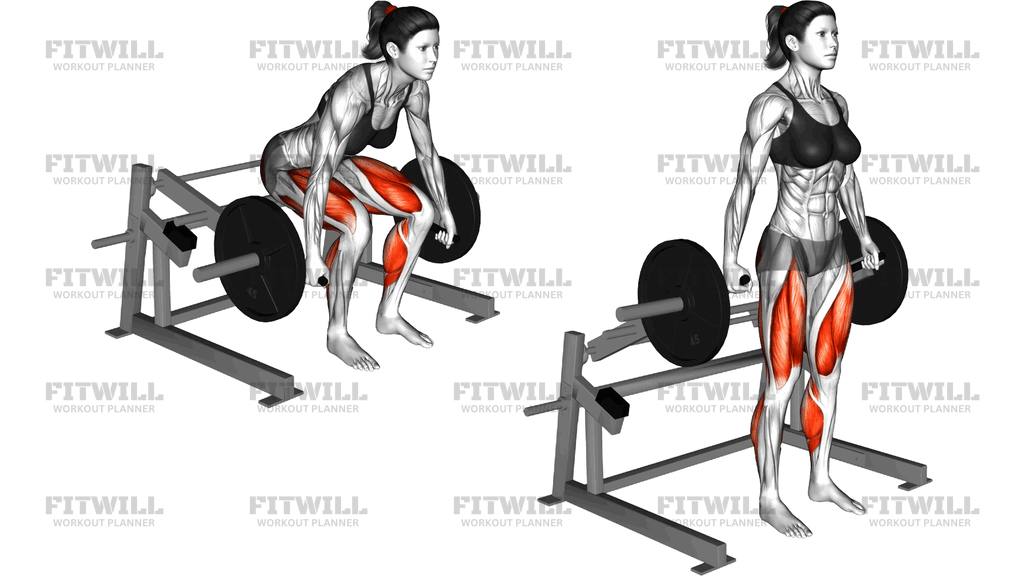
The Lever Deadlift Plate Loaded is a guided hip-hinge exercise built around the same mechanics as a deadlift, but with the path controlled by the machine. It loads the posterior chain through a fixed arc so you can focus on position, force production, and a clean lockout without having to balance a free bar. In the image, the lifter starts with the torso hinged forward, arms hanging long at the sides, then stands tall by driving the hips through and finishing with the machine arms traveling close to the legs.
Because the lever arm determines the path, setup matters more than brute force. Your feet should stay planted, your grip should stay neutral, and your spine should stay long as you shift from the bottom position into the standing finish. The movement should feel like a strong hip drive with the knees bending just enough to let the hips travel back on the way down and forward on the way up. When the stance is right, the glutes and hamstrings do most of the work while the core and upper back keep the torso organized.
This is a useful variation when you want deadlift-style training with a little more stability than a barbell pull. It is especially helpful for learning hinge mechanics, building lower-body strength, or adding volume without the same balance demands as a free-weight deadlift. The machine can also make it easier to train hard with repeatable reps, because the lever keeps the resistance consistent and the handle path stays predictable.
The key technical goal is to keep the handles close, avoid rounding the back, and finish each rep by standing tall rather than leaning backward. At the bottom, push the hips back first and keep the chest from collapsing. At the top, squeeze the glutes and brace the trunk without overextending the lower back. Controlled lowering is just as important as the pull, since the eccentric phase sets up the next rep and keeps tension where it belongs.
Use this exercise when you want a machine-based posterior-chain lift that still feels like a real deadlift pattern. It works well in strength blocks, accessory work, or lower-body sessions where you want to train hip extension with stable footing and a clear range of motion. Beginners can use it if the load is light enough to keep the torso braced and the machine path smooth, but the exercise still rewards the same discipline as any hinge: controlled setup, clean drive, and a quiet reset before each repetition.
Fitwill
Log Workouts, Track Progress & Build Strength.
Achieve more with Fitwill: explore over 9600 exercises with images and videos, access built-in and custom workouts, perfect for both gym and home sessions, and see real results.
Start your journey. Download today!




Instructions
- Stand inside the lever deadlift machine with your feet about hip-width apart, toes slightly turned out, and the handles aligned beside your legs.
- Hinge your hips back and bend your knees until your torso is angled forward and you can grasp the handles with straight arms and a neutral spine.
- Set your shoulders down and back, stack your ribs over your pelvis, and feel your weight spread through the whole foot before you start the pull.
- Exhale slightly to brace, then drive the floor away and extend your hips and knees together until you stand tall.
- Finish the rep with your glutes tight and your torso upright, but do not lean backward or snap the lower back into extension.
- Lower the handles by pushing your hips back first, then bending your knees as the machine travels close to your legs.
- Keep the descent controlled until you reach the same hinged start position with the plates under tension.
- Reset your breath and repeat for the planned number of reps.
Tips & Tricks
- Keep the handles close to your thighs and shins so the lever does not drift forward and pull you out of position.
- Think hips back on the way down, not squat down; too much knee travel turns the pull into a mixed squat pattern.
- At the top, finish with a tall torso and squeezed glutes, but stop short of leaning back and compressing the lower spine.
- Use a foot position that lets you keep full-foot pressure; if your heels pop up, the stance is usually too narrow or too close to the machine.
- Let the machine settle under control on the descent instead of dropping into the bottom and bouncing the plates.
- Keep your neck in line with your torso by looking a few feet ahead on the floor rather than cranking your chin up.
- If your grip gives out before your legs do, use straps so the set is limited by hip drive, not hand fatigue.
- Choose a load that lets you repeat the same hinge angle every rep; if your back position changes, the weight is too heavy.
Frequently Asked Questions
What muscles does the Lever Deadlift Plate Loaded work?
It mainly targets the glutes and hamstrings, with the quads, spinal erectors, upper back, and grip helping stabilize the pull.
Can beginners perform this exercise?
Yes. The fixed machine path makes it easier to learn a hip hinge, as long as the load stays light enough to keep the spine and pelvis controlled.
Where should my feet be on the machine?
Start with your feet about hip-width apart and your mid-foot under the load path so you can keep the handles close without rocking onto your toes.
Should this feel like a squat or a deadlift?
It should feel like a deadlift. Your hips travel back on the way down and drive forward on the way up, while the knees only bend enough to keep the hinge clean.
Why does the machine path matter so much?
The lever arm controls the arc of the pull, so your job is to stay stacked, keep the handles close, and let the machine move instead of trying to invent your own bar path.
How do I know if I am overextending at lockout?
If your ribs flare, your lower back arches hard, or you feel yourself leaning behind the machine, you are finishing too aggressively. Stand tall and stop there.
What should I do if I feel this mostly in my lower back?
Reduce the load, hinge deeper at the hips, and keep the handles close. If the torso position keeps changing, the weight is usually too heavy.
Can I use straps on this movement?
Yes, straps are fine if your grip fails before your hips do. They let you keep the focus on the hinge and the lower body.