Archer Pull-Up
Archer Pull-Up is a bodyweight pulling exercise that builds upper-back strength, unilateral control, and shoulder stability in a very specific way. One arm does most of the work while the other stays straighter on the bar, so each rep challenges the lats, upper back, biceps, and grip without turning into a pure two-arm pull-up. It is useful for intermediate lifters who want a harder bodyweight variation and for athletes who need stronger side-to-side control through the shoulders and trunk.
The movement is especially demanding because the working side has to pull while the other side helps only enough to keep you centered. In user-facing terms, the main emphasis is on the lats, with upper back, biceps, and forearms assisting to keep the body tight and the bar path clean. The technical work centers on the latissimus dorsi, with help from rhomboids, biceps brachii, and forearm flexors. If the torso twists hard or the hips swing, the set stops being an archer pull-up and starts becoming a momentum drill.
The setup matters because it determines how much of the rep is actually coming from the pulling arm. Grip the bar a little wider than shoulder width, start in a full hang, and keep the ribs down so the body does not over-arch before the first pull. From there, think about pulling one elbow down and back toward the working side while the opposite arm stays long and acts as a guide rather than a full contributor.
At the top, the chest should travel closer to the pulling hand, but the shoulders should still stay organized and not shrug up toward the ears. Lower yourself under control, keeping tension through the back and arms instead of dropping out of the hang. A brief pause at the top can help reinforce position, but the rep should still look smooth and repeatable rather than forced or jerky.
Archer Pull-Up works well as a strength accessory, a progression toward one-arm pulling, or a high-skill back exercise in a bodyweight session. It rewards quality over volume, so fewer clean reps are better than a long set with swinging and half reps. If you cannot keep one arm nearly straight while the other side pulls cleanly, use a band-assisted version, a lower rep target, or a slower eccentric until the pattern is solid.
[ Workout Log & Planner ]
Put your next workout in Fitwill
Keep your plan and training log ready when you are.


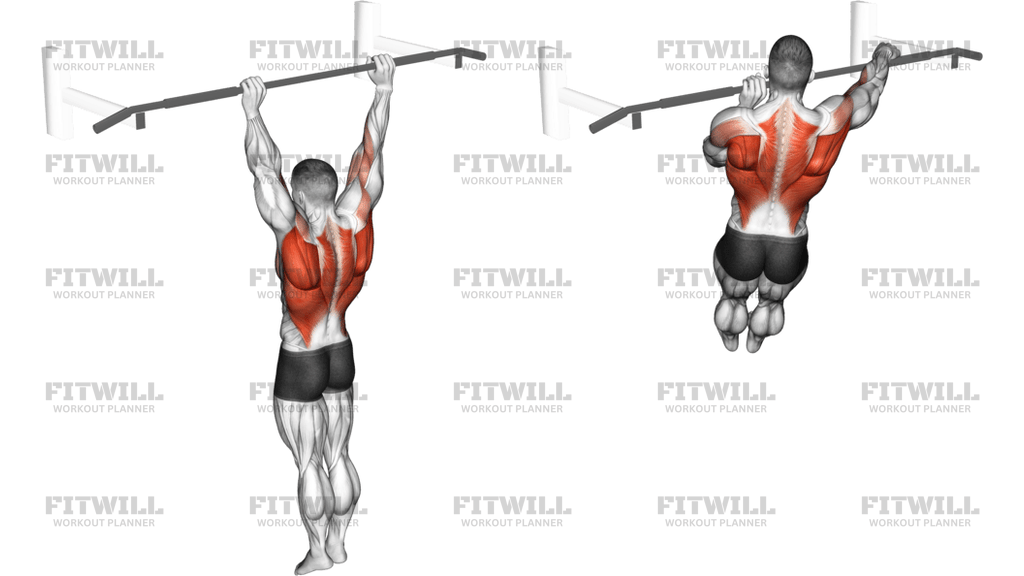
Instructions
- Grip a pull-up bar slightly wider than shoulder width and hang with both arms straight, shoulders active, and legs together.
- Set your ribs down, squeeze your glutes lightly, and keep your body long so you do not start with an exaggerated arch.
- Shift one shoulder toward the pulling side while the opposite arm stays long and mostly straight on the bar.
- Pull the working elbow down and back as you drive your chest toward that hand.
- Keep the non-working arm extended to help guide your body instead of turning the rep into a regular pull-up.
- Pause briefly near the top when your chin and chest are high without shrugging your shoulders forward.
- Lower yourself slowly, resisting the drop so the working side stays loaded through the whole descent.
- Reset in the dead hang with both shoulders controlled before starting the next repetition or switching sides.
Tips & Tricks
- Think about pulling one armpit toward the bar while the other arm stays long; that cue keeps the rep anchored to the working side.
- If your torso twists hard, use a narrower archer angle and keep both feet together to reduce swinging.
- Keep the straight arm active rather than limp so the shoulder stays centered and you do not dump into the joint.
- Use a slow descent of about two to four seconds to make each side earn the rep instead of bouncing out of the bottom.
- Stop the set before your chin starts drifting forward and your shoulders creep toward your ears.
- A small kip turns this into a momentum pull-up, so keep the legs quiet and let the back do the work.
- If one side feels far weaker, add assisted singles or negatives on that side before trying to match the stronger arm.
- Do not flare the elbows wide on the pulling side; keep the elbow tracking down and slightly back.
Frequently Asked Questions
What muscles does Archer Pull-Up work most?
It primarily targets the lats, with strong help from the upper back, biceps, and forearms. The straight arm and trunk also work hard to keep the body from rotating.
How is Archer Pull-Up different from a regular pull-up?
A regular pull-up shares the load more evenly between both arms. Archer Pull-Up shifts most of the work to one side while the other arm stays straighter, which makes the pulling side work harder and the torso fight rotation.
Should my straight arm stay fully locked out on Archer Pull-Up?
It should stay long and mostly straight, but you should still keep the shoulder active. A dead, passive hang on that side can make the rep sloppy and harder on the joint.
Can beginners do Archer Pull-Up?
Most beginners should build to it first with regular pull-ups, band-assisted pull-ups, or slow negatives. The movement is demanding because each side has to control its own share of the load.
What is the most common mistake on Archer Pull-Up?
The biggest mistake is twisting and swinging the hips to fake the pull. Keep the legs quiet and let the working elbow travel down and back instead.
How far should I pull on Archer Pull-Up?
Pull until your chest gets close to the working hand and your chin clears the bar without losing shoulder position. If you have to shrug or twist hard to reach that point, the rep is too aggressive.
Can I use Archer Pull-Up to build toward one-arm pull-ups?
Yes, it is one of the better progressions for that goal because it teaches one side to handle more of the load. Pair it with assisted one-arm work and controlled eccentrics for best results.
How should I handle the lowering phase?
Lower under control on the same side you used to pull, instead of dropping back to a dead hang. A slower eccentric keeps tension on the lats and makes the exercise much more productive.