Frog Planche
Frog Planche is a bodyweight arm-balance where you support your body on your hands while your knees rest high on the upper arms and your feet stay lifted. The position turns the floor into a stability test: you have to keep the shoulders leaned forward, the elbows organized, and the trunk tightly folded so the balance point stays over the hands. It is a small-looking movement, but it demands a lot from the wrists, shoulders, upper back, core, and hip flexors.
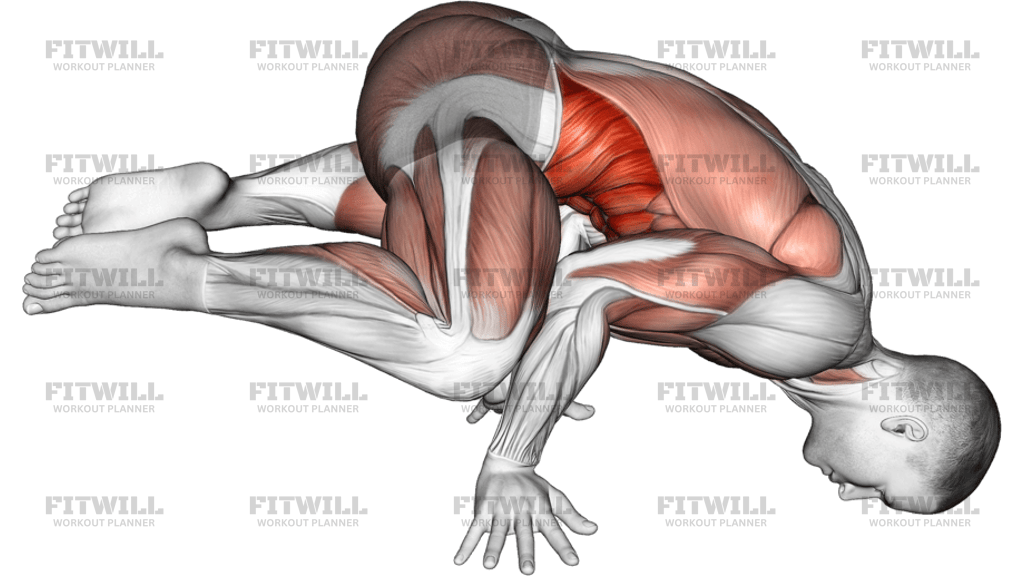
This exercise is usually taught as a control drill for calisthenics and yoga-style strength work. The target is not speed or height. The target is to find a stable tuck with the knees braced on the triceps or upper arms, then hold that shape without collapsing through the chest or drifting backward. The image shows the classic compact position: palms planted, fingers spread, head low, knees tucked tightly, and the body rounded forward over the hands.
Because the frog planche depends on balance, the setup matters more than force. A slightly forward shoulder position, active finger pressure, and a rounded upper back help keep your center of mass over your palms. If you stay too upright, the feet will never feel light enough to lift. If you lean too far or let the elbows flare unpredictably, the wrists and shoulders take over and the hold becomes shaky. Clean alignment keeps the load on the muscles that should be doing the work.
Use this movement for short holds, technique practice, or strength-building progressions. It works well when you want to develop better scapular control, midline tension, and confidence supporting your body weight on your hands. Beginners usually need a low box, blocks, or a spotter to find the position safely, while stronger athletes can use longer holds or more difficult balance progressions. Keep every rep controlled, exit deliberately, and stop before the shoulders, wrists, or lower back lose the shape that makes the hold worthwhile.
Fitwill
Log Workouts, Track Progress & Build Strength.
Achieve more with Fitwill: explore over 9600 exercises with images and videos, access built-in and custom workouts, perfect for both gym and home sessions, and see real results.
Start your journey. Download today!




Instructions
- Place your hands on the floor slightly wider than shoulder-width, then spread your fingers and grip the ground with your fingertips.
- Set your knees high on the backs of your upper arms or triceps and walk your feet in so your body forms a compact tuck.
- Lean your shoulders forward past your wrists while keeping your elbows straight or only very slightly bent.
- Round your upper back and draw your ribs in so your hips stay tucked instead of hanging open.
- Shift more weight into the palms until the feet feel light and begin to leave the floor together.
- Hold the balance with your knees pressing into the arms and your eyes fixed a few inches ahead of your hands.
- Breathe in short, controlled breaths without letting the chest collapse or the shoulders drift back.
- Lower the feet back to the floor with control, reset the tuck, and repeat for the planned hold or repetition count.
Tips & Tricks
- Use your fingertips to save the balance; if the weight drifts forward, press harder through the pads of the fingers instead of collapsing the shoulders.
- Keep the knees high on the upper arms so they act like shelves; low knee placement usually makes the balance much harder to hold.
- A rounded upper back is part of the exercise, but the lower back should stay tucked rather than arching into a loose banana shape.
- If your wrists feel overloaded, shorten the hold and work on a stronger forward lean before trying longer sets.
- Do not try to lift the feet by kicking; the feet should become light because your balance shifts forward, not because you jump.
- Keep the elbows pointed generally backward and stable; flaring them wildly makes the position leak force.
- Look slightly ahead of the hands instead of at your feet so your neck stays neutral and your balance point is easier to find.
- Stop the set as soon as the shoulders slide back behind the wrists, because that usually ends the hold fast and dumps pressure into the wrists.
Frequently Asked Questions
What does the Frog Planche train the most?
It mainly trains core compression, shoulder balance, wrist loading tolerance, and the ability to hold a tucked body position on the hands.
Is the Frog Planche the same as a frog stand?
They are very similar. In many gyms the terms are used interchangeably, but both refer to the tucked arm-balance with the knees resting on the upper arms and the feet lifted.
Where should my knees sit in the setup?
Place them high on the upper arms or triceps, close enough to create a shelf for balance. If they slide too low, the position becomes unstable and harder to control.
Do I need straight arms for Frog Planche?
Straight or nearly straight arms are the standard goal. A tiny bend may happen while you balance, but big elbow flexion usually turns it into a different drill.
How long should I hold each rep?
Use short, high-quality holds at first, then extend the duration only when you can keep the shoulders forward, the knees anchored, and the feet lifted without wobbling.
What is the biggest mistake people make?
The most common mistake is leaning back or letting the hips open up, which removes the balance point and shifts too much stress into the wrists.
Can a beginner learn this exercise?
Yes, but most beginners should practice it with a spot, blocks, or a low forward lean before trying to hold the full bodyweight balance on the floor.
How do I make Frog Planche harder?
Make the hold longer, lean the shoulders slightly farther forward, reduce support from the feet, or move toward cleaner, more stable freestanding holds.