Barbell Thruster
The Barbell Thruster combines a front squat with an overhead press in one continuous rep, so it trains leg drive, trunk stiffness, and upper-body coordination at the same time. In the image, the bar starts in the front rack across the shoulders, the athlete drops into a deep squat, then stands up and uses that upward drive to press the bar to full lockout overhead. That makes the setup important: if the bar is not stable on the shoulders or the stance is too narrow, the press becomes sloppy and the squat loses power.
This exercise puts the biggest demand on the thighs, especially the quads, but it also asks the shoulders, triceps, upper back, and core to work together. The front-rack position keeps the torso honest during the squat, while the overhead finish rewards a strong, vertical drive. Because the lift links two movements together, it is most useful when you want a full-body strength pattern, conditioning work, or a demanding accessory exercise that still rewards crisp technique.
Good reps start with the bar resting across the front of the shoulders, elbows lifted, chest tall, and feet planted slightly wider than hip width. From there, lower into a controlled squat by letting the knees travel forward and the hips sit between the heels. At the bottom, reverse direction without collapsing the torso, then stand up hard and transfer that momentum into a straight overhead press. The bar should travel close to the face on the way up and finish stacked over the shoulders, hips, and midfoot.
The common breakdowns are easy to spot: heels lifting, elbows dropping in the squat, pressing too early from the bottom, or leaning back to finish the overhead portion. Those mistakes usually mean the load is too heavy or the timing is off. A good thruster looks smooth through the transition, with the squat and press connected by one strong leg drive instead of two separate, disconnected efforts.
Use a lighter load than you would for a pure squat or pure press, because the limiting factor is usually the quality of the transition. Beginners can learn the pattern with an unloaded bar or very light weight, but only if they can keep the front rack secure and the bar path controlled. As fatigue builds, stop the set when the squat depth shortens or the bar starts drifting forward. The goal is a repeatable rep that preserves leg drive, shoulder position, and balance from start to finish.
[ Workout Log & Planner ]
Put your next workout in Fitwill
Keep your plan and training log ready when you are.


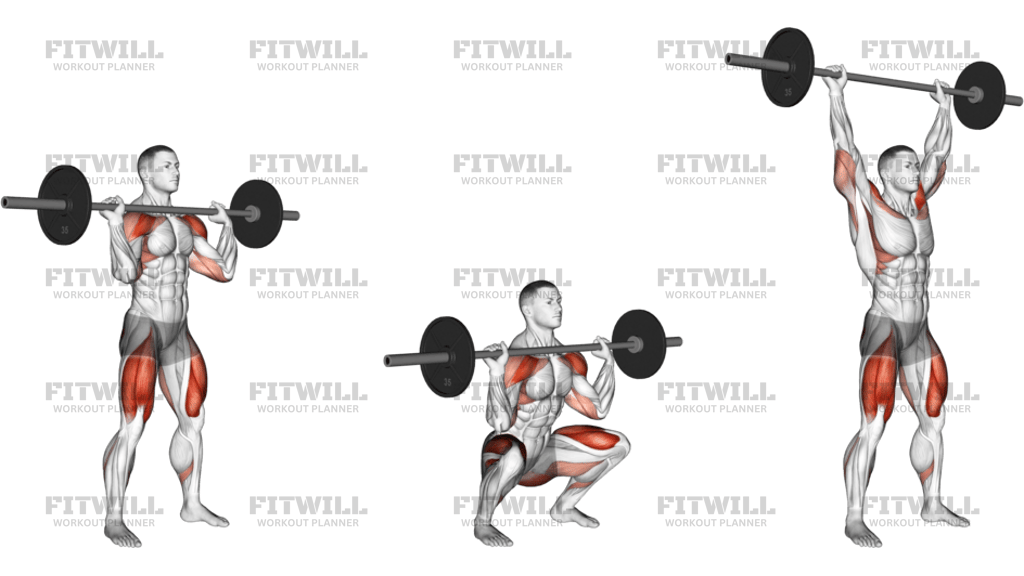
Instructions
- Set the barbell across the front of your shoulders in a front rack, with your elbows lifted, chest tall, and feet about shoulder width apart.
- Grip the bar just outside shoulder width and keep it close to your throat so it stays balanced over your midfoot.
- Take a breath, brace your trunk, and lower into a front squat by sending your hips down between your heels.
- Keep your heels grounded and your knees tracking over your toes as you reach the bottom of the squat.
- Drive up out of the squat by pushing through your whole foot and standing tall with the bar still on your shoulders.
- As you finish the stand, use that upward drive to press the bar straight overhead without leaning back.
- Lock the elbows fully overhead, with the bar stacked over your shoulders, hips, and ankles.
- Lower the bar back to the front rack with control, then descend into the next squat for the next rep.
Tips & Tricks
- Keep the elbows high in the front rack so the bar does not roll onto your hands and dump the torso forward.
- Let the knees travel forward in the squat; forcing the shins to stay vertical usually turns the thruster into a hinge.
- Use a dip-and-drive from the legs, but avoid turning the press into a push press with a second bounce.
- Press the bar straight up, not forward; if it drifts in front of your face, the overhead finish becomes unstable.
- Choose a load that lets you keep the squat depth consistent on every rep, not just the first one.
- Breathe in before each squat and exhale as you drive the bar overhead to help keep the trunk braced.
- Keep your ribs down as the bar reaches overhead so you do not overarch the lower back at lockout.
- If the rack position hurts your wrists or shoulders, reduce the load and work on front-rack mobility before adding weight.
Frequently Asked Questions
What muscles do barbell thrusters train most?
They emphasize the quads first, but the shoulders, triceps, glutes, and core all contribute to the full rep.
Do I keep the bar on my shoulders during the squat?
Yes. The bar should stay in the front rack across the shoulders until you drive up and press it overhead.
Should the press start before I stand up?
No. Finish the squat first, then use the upward leg drive to help move the bar overhead in one smooth transition.
Why does the bar drift forward on some reps?
That usually happens when the elbows drop, the chest collapses, or the bar travels too far away from the face during the press.
Is a thruster the same as a squat clean and press?
No. A thruster starts from the front rack and uses a squat to generate the press, while a clean and press includes a clean to get the bar to the shoulders.
Can beginners learn this movement safely?
Yes, if they start with a light bar and can hold a solid front rack, squat depth, and overhead lockout without losing control.
What is the most common technical mistake?
Rushing the transition and turning the rep into a partial squat, then a weak press, instead of one connected movement.
What should I do if overhead lockout bothers my back?
Reduce the load, keep your ribs down, and finish with the bar stacked over your midfoot instead of leaning backward.