Bent-Over Twist
Bent-Over Twist is a hip-hinged trunk-rotation exercise that trains the obliques to control turning while the torso stays folded forward. It is usually done with body weight or a very light dowel used as a positional guide, so the focus stays on alignment instead of load. The goal is not to spin as far as possible; it is to rotate smoothly from one side to the other without losing the hinge, the spine angle, or the connection between ribs and pelvis.
Because the hips are fixed in a hinge, the exercise asks the waist to do the work. The external obliques and the deeper abdominal wall help rotate and stabilize the trunk, while the rectus abdominis and spinal erectors keep the torso braced. If you let the lower back arch or the pelvis drift, the movement turns into a sway instead of a controlled twist.
Start by folding at the hips until the torso is close to parallel to the floor, then set the feet and knees so you can keep balance. Hold the stick or body position lightly, brace before each rep, and turn the ribcage under control. A small, deliberate range done with clean lines is more useful than a big range that comes from momentum.
Use Bent-Over Twist as a warm-up, activation drill, or accessory core movement when you want rotational control without heavy spinal loading. It pairs well with anti-rotation and anti-extension work. Stop if you feel sharp pinch in the lower back or if the rotation starts coming from the knees instead of the trunk.
[ Workout Log & Planner ]
Put your next workout in Fitwill
Keep your plan and training log ready when you are.


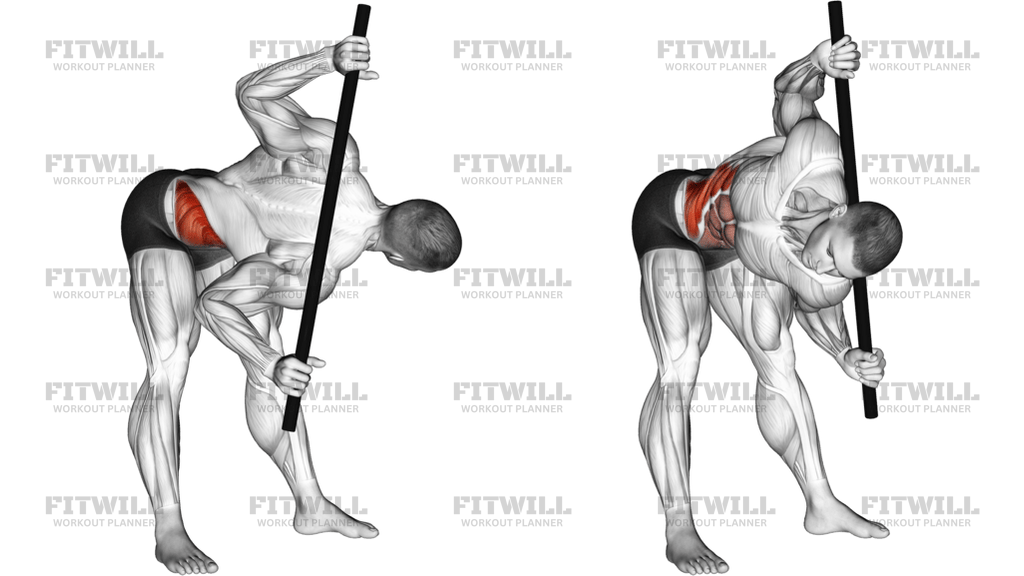
Instructions
- Stand with your feet about shoulder-width apart, hinge at the hips, and fold your torso until your chest is close to parallel to the floor.
- Keep a soft bend in the knees and let your weight stay in the midfoot and heels so you can rotate without losing balance.
- Hold the dowel, stick, or the shown support lightly and keep your shoulders packed instead of shrugging them up.
- Brace your abs, then rotate the ribcage toward one side while keeping the hips mostly fixed in the hinge.
- Let the movement come from the waist and upper trunk, not from swinging the arms or yanking the neck.
- Pause briefly at the end of the twist, then reverse smoothly through center to the opposite side.
- Keep both sides of the trunk working evenly and avoid letting the lower back collapse or arch as you turn.
- Exhale as you twist, inhale as you pass back through center, and stop the set if you lose the hip hinge.
Tips & Tricks
- Keep the hinge angle consistent from rep to rep; if the torso rises as you turn, the obliques lose tension.
- Think about turning the sternum, not just the shoulders, so the twist stays in the trunk instead of only the arms.
- If the bar or dowel starts drifting away from your body, lighten the grip and slow the rep down.
- A smaller range with full trunk control is better than forcing extra rotation through the lumbar spine.
- Keep the chin tucked enough to stay long through the neck so the head does not lead the twist.
- If your hamstrings limit the hinge, bend the knees a little more so the spine does not round to reach the floor.
- Use a deliberate tempo on the way back to center; the return phase is where momentum often takes over.
- Stop the set when the pelvis starts opening with the torso, because that usually means the obliques are no longer driving the movement.
Frequently Asked Questions
What muscles does Bent-Over Twist work most?
It mainly targets the obliques, especially the external obliques, with the rectus abdominis, transverse abdominis, and spinal erectors helping stabilize the trunk.
Is the bar or stick meant to be heavy?
No. In this movement the stick is usually just a positional guide, so light contact and clean rotation matter more than resistance.
How low should my torso be in the bent-over position?
Hinge until your chest is close to parallel to the floor, or as far as you can keep a flat, braced back and stable knees.
Should my hips rotate with me?
Only a little. The goal is to keep the hinge mostly fixed so the twist comes from the waist and ribcage rather than a full body turn.
Why do I feel this in my lower back?
If the lumbar spine is moving too much, the load shifts off the obliques. Shorten the range, brace harder, and keep the rotation cleaner.
Can beginners do this exercise?
Yes, if they keep the motion small, use body weight or a very light dowel, and focus on hinge control before speed or range.
What is the most common mistake with the bar?
Pulling with the arms and letting the stick drift while the torso stays unchanged. The hands should guide the position, not create the twist.
How does this differ from a standing twist?
The bent-over version adds a hip hinge and more trunk stabilization demand, so it challenges the obliques without relying on upright body sway.