Narrow Squat From Deficit
Narrow Squat From Deficit is a bodyweight squat variation performed from a small raised platform or deficit so the hips can travel through a deeper range of motion. The narrow stance and extra depth make the movement feel more demanding than a flat-floor squat, especially on the quads, glutes, and lower body stabilizers. It is useful when you want a simple bodyweight drill that builds leg strength, control, and clean squat mechanics without external load.
The deficit changes the bottom position in a meaningful way. Because the feet are elevated, the knees travel farther forward and the hips must stay organized through a deeper squat before you stand back up. That makes Narrow Squat From Deficit a good option for improving leg strength, ankle tolerance, and control in the bottom of the squat, as long as the depth stays pain-free and the heels remain planted.
The setup matters because a narrow stance can get unstable quickly if the feet are placed too close together or the platform is too high. Stand on a low step or plate with the feet about hip-width apart, toes turned out only slightly, and the torso tall. Hands on the hips, as shown in the image, can help you feel whether the ribcage stays stacked over the pelvis while you descend.
On each rep, lower straight down under control, let the knees track in line with the toes, and keep pressure through the whole foot rather than dumping forward onto the toes. At the bottom, stay tight instead of bouncing off the deficit. Drive back up by pushing the floor away and standing tall without locking into a lean-back finish or letting the knees cave inward.
This exercise fits well in accessory work, warm-ups, or lower-body conditioning when you want a squat pattern that is simple to learn but still demanding enough to expose weak control in the hips, knees, and ankles. Beginners can use it if the step height is modest and the range stays smooth, while more advanced lifters can slow the descent or add tempo before progressing to a loaded squat pattern. If the depth forces pelvic tuck, heel lift, or sharp knee discomfort, reduce the deficit and clean up the line of motion first.
[ Workout Log & Planner ]
Put your next workout in Fitwill
Keep your plan and training log ready when you are.


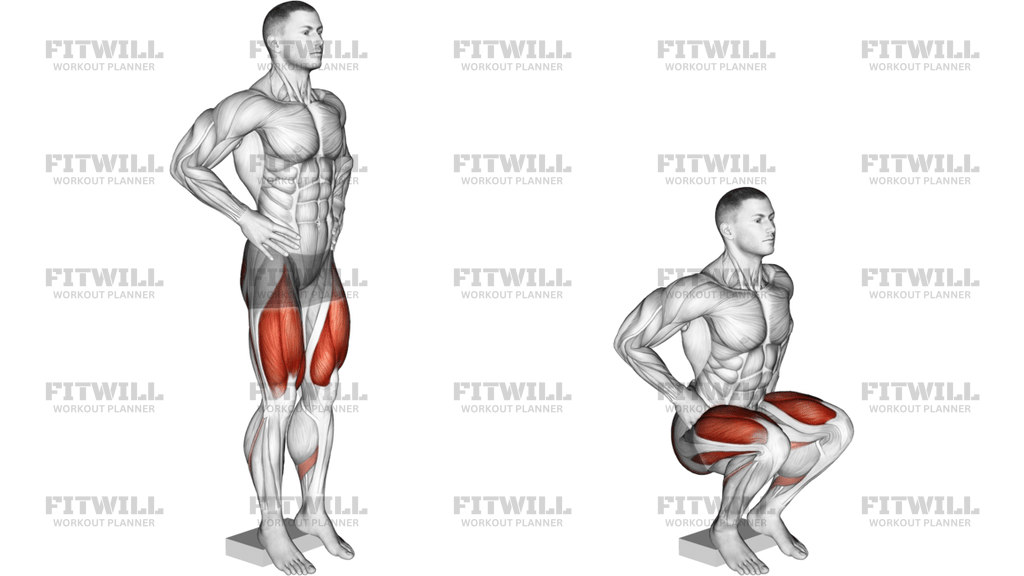
Instructions
- Stand on a low platform or weight plate with your feet about hip-width apart, toes slightly turned out, and your hands on your hips or held in front for balance.
- Stack your ribs over your pelvis, keep your chest tall, and brace before you start the descent.
- Sit straight down between your heels, letting your knees travel forward in line with your toes.
- Keep your heels and the balls of your feet planted on the platform as you lower into the deepest pain-free position you can control.
- Pause briefly at the bottom without bouncing out of the deficit.
- Drive through the whole foot to stand back up, squeezing your glutes as you pass the sticking point.
- Keep your knees tracking over your second toe and your torso long as you repeat each rep.
- Exhale as you stand up, then reset your breath before the next descent.
- Step carefully off the platform when the set is finished.
Tips & Tricks
- Use the smallest deficit that still gives you a clear depth increase; a high step usually turns the squat into a balance drill.
- A narrow stance should still leave a small gap between the feet so the knees can move without rubbing together.
- If your heels want to pop up, lower the platform height instead of forcing extra depth.
- Think about sitting straight down rather than hinging far back; that keeps the torso more upright and the quads working.
- Do not bounce off the bottom of the deficit; the pause makes the movement cleaner and safer for the knees.
- Slow the lowering phase to two or three seconds if you lose control as you approach the platform edge.
- Keep your weight centered over the midfoot instead of drifting onto the toes during the descent.
- If your lower back tucks under at the bottom, cut the depth slightly and rebuild control before adding more range.
- Use a wall, rack upright, or light support only for balance if the narrow stance feels shaky.
- Stop the set when the knees cave inward or the torso folds forward, because those are the first signs the deficit is too much.
Frequently Asked Questions
What muscles does Narrow Squat From Deficit work?
It emphasizes the quads and glutes, with the calves, adductors, and core helping you stay balanced through the deeper squat.
Why do I stand on a deficit for Narrow Squat From Deficit?
The raised platform increases squat depth and makes the bottom position harder to control, which adds a strong lower-body challenge without weights.
How narrow should my stance be?
Keep the feet about hip-width apart, not touching. That is narrow enough to change the squat pattern without making the knees collapse inward.
Should my heels stay on the platform the whole time?
Yes. Your heels should stay planted, and if they lift, the deficit is probably too high or your ankle mobility is not ready for that depth yet.
Is Narrow Squat From Deficit more of a quad or glute exercise?
It is usually felt most in the quads because of the narrow stance and forward knee travel, but the glutes still drive the stand-up phase.
Can beginners do Narrow Squat From Deficit?
Yes, if the platform is low and the movement stays smooth. Beginners should start with a shallow deficit and own the bottom position before going deeper.
What is the most common mistake with Narrow Squat From Deficit?
The biggest mistake is using too much height and bouncing out of the bottom, which usually turns into knee cave, heel lift, or a rounded lower back.
Can I hold onto something during Narrow Squat From Deficit?
Yes. A light fingertip hold on a rack or support can help if balance is the limiter, but it should not pull you out of the squat path.
How deep should I go in Narrow Squat From Deficit?
Go only as deep as you can keep the heels down, the knees tracking over the toes, and the pelvis from tucking under at the bottom.
How can I make Narrow Squat From Deficit harder without adding weight?
Use a slower descent, a longer pause at the bottom, or a slightly lower support so the bottom range demands more control.