Swimmer Kicks Version 2
Swimmer Kicks Version 2 is a prone bodyweight drill that combines long-reaching upper-body tension with alternating lower-body kicks. It is useful when you want a floor exercise that builds control through the back line, hips, and trunk without loading the spine with external weight. The position looks simple, but the quality of the rep depends on how well you keep the chest, ribs, and neck organized while the limbs keep moving.
This version is especially good for training endurance in the lats, upper back, glutes, hamstrings, and deep core. Because the body is stretched out on the floor, the exercise rewards small, precise motion more than big effort. If you turn it into a hard arch or a frantic kick, the work shifts away from the target muscles and into the lower back and neck.
The setup matters because the swimmer position needs a long, clean line from fingertips to toes. Lie face down with the arms reaching overhead, legs long, and the head in line with the spine. From there, lift only enough to clear the floor and create tension through the torso, then keep the reach active as the opposite arm and leg alternate in a smooth pattern.
Swimmer Kicks Version 2 works well as a warmup drill, a core-accessory exercise, or a light conditioning interval at the end of a session. It is also useful for beginners who need a low-load way to learn trunk control and posterior-chain engagement before moving to more demanding back extensions or loaded hip work. The goal is not speed; the goal is a steady rhythm that lets you keep the body long and the movement quiet.
When it is done well, Swimmer Kicks Version 2 teaches you to create tension without bracing so hard that you freeze. The chest stays slightly lifted, the shoulders stay away from the ears, and the kicks stay small enough to control the pelvis. That makes it a practical drill for posture, coordination, and endurance, especially when you want your back and hips to work together instead of fighting each other. It also works well as a gentle finisher when you want low-load posterior-chain volume.
Fitwill
Log Workouts, Track Progress & Build Strength.
Achieve more with Fitwill: explore over 9600 exercises with images and videos, access built-in and custom workouts, perfect for both gym and home sessions, and see real results.
Start your journey. Download today!




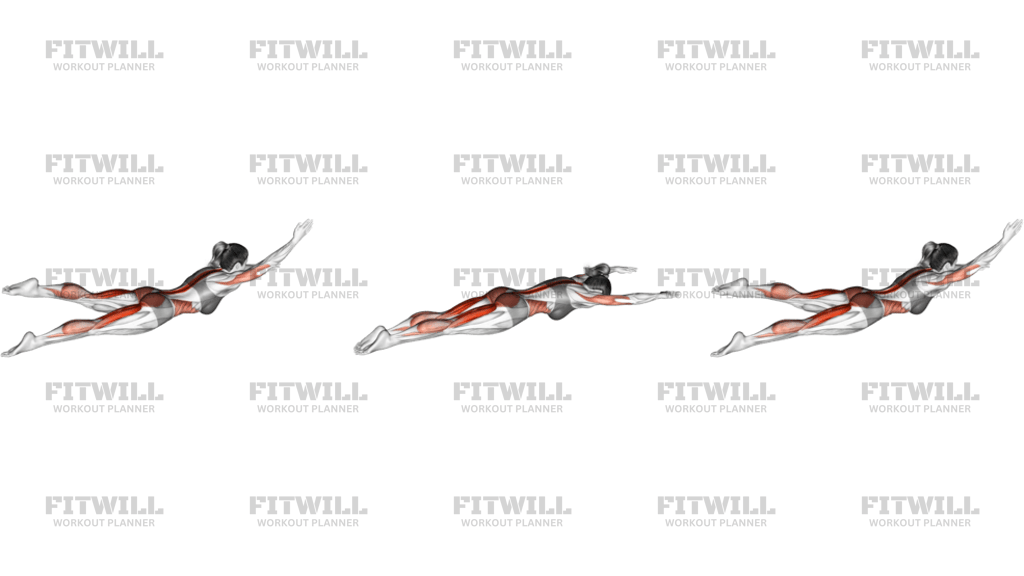
Instructions
- Lie face down on a mat with your arms reaching overhead, your legs straight behind you, and your toes pointed or relaxed.
- Keep your forehead just above the floor, lengthen the back of your neck, and look down instead of forward.
- Reach both hands long and squeeze your legs together so your body starts in one long line.
- Brace your abs lightly and lift your chest and thighs just enough to clear the mat without cranking your lower back.
- Start alternating the opposite arm and leg in a small swimming pattern, keeping the motion smooth and close to the floor.
- Keep the moving leg nearly straight and let the kick come from the hip instead of bending the knee hard.
- Maintain a steady breath while you keep the reach long through the fingertips and the toes.
- Lower your chest and legs back to the mat with control, then reset your neck and ribs before the next set.
Tips & Tricks
- Think about length, not height. A small lift with long reaches keeps more tension on the back line than an exaggerated arch.
- If your lower back starts to pinch, shorten the kick and lower the chest a little instead of forcing a bigger range.
- Keep the shoulders away from the ears so the lats and upper back can do the work instead of the neck.
- Let the kick start from the hip with a nearly straight knee; big knee bends turn the drill into a sloppy flutter.
- Pointing the toes lightly can help you keep the legs long, but do not let the ankles or feet lead the movement.
- Exhale steadily as the limbs alternate if you tend to flare the ribs or lose trunk control.
- Use a slow, even rhythm rather than a fast scissor pattern; rushing usually makes the pelvis rock side to side.
- Stop the set when the chest drops, the head cranes up, or the arms start losing their reach overhead.
Frequently Asked Questions
What does Swimmer Kicks Version 2 work most?
It mainly trains the lats, upper back, glutes, hamstrings, and deep core while also challenging shoulder endurance.
Is Swimmer Kicks Version 2 beginner-friendly?
Yes, as long as you keep the lift low and the kicks small. Beginners should focus on staying long and controlled instead of trying to move quickly.
How high should my chest come off the floor?
Only a few inches is enough. If the chest has to rise high to keep the movement going, the exercise usually turns into a lower-back extension instead of a swimmer drill.
Should my knees bend during Swimmer Kicks Version 2?
Keep them mostly straight. A slight softness is fine, but heavy knee bending usually shifts the work away from the hips and makes the kicks look choppy.
Why does my neck get tired during this exercise?
That usually means you are looking forward or lifting the chest too high. Keep the neck long and the gaze down so the upper back, not the neck, supports the position.
What if my lower back takes over?
Reduce the range, slow the rhythm down, and keep the ribs from flaring. The exercise should feel like a long, controlled hover, not a hard arch.
Can I make Swimmer Kicks Version 2 easier?
Yes. Keep one side down for a few reps at a time, or practice only the arm reach before adding the alternating leg action.
Is Swimmer Kicks Version 2 more of a core or back exercise?
It is a combined posterior-chain drill. The core stabilizes the torso while the back, glutes, and hamstrings create the lifting and reaching tension.