Resistance Band Bird Dog
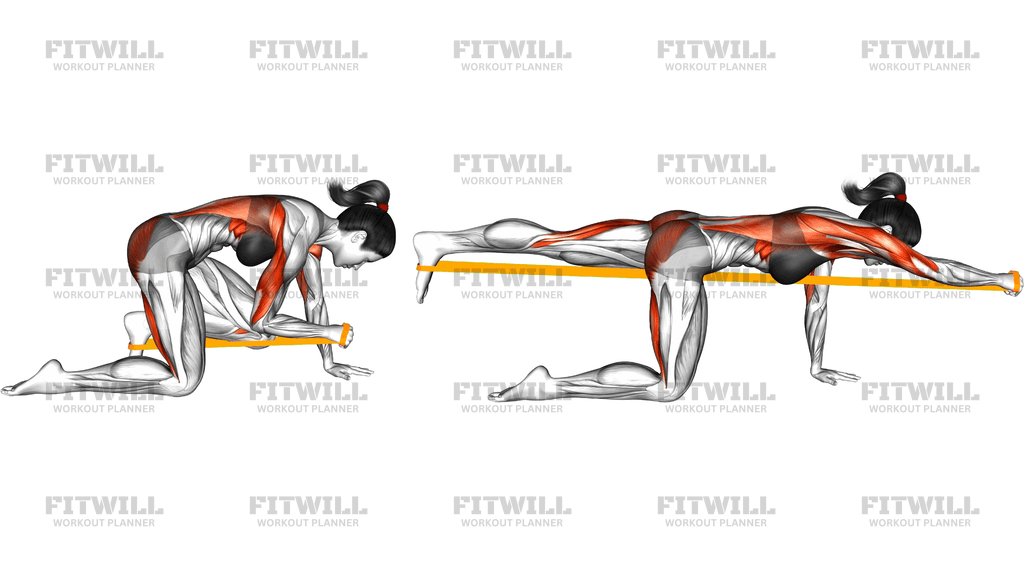
Resistance Band Bird Dog is a quadruped anti-rotation exercise that challenges your ability to keep the torso quiet while one arm and the opposite leg reach away from each other. The band adds a diagonal pull that makes the drill more demanding than a bodyweight bird dog, so the goal is not a bigger reach but a cleaner, more stable one.
This movement is useful when you want to train coordination, trunk control, and low-back-friendly strength without heavy loading. The glutes, deep core, and spinal stabilizers do most of the work, while the shoulder of the reaching arm and the lat on that side help control the line of pull from the band. When it is done well, the hips stay level and the ribs stay stacked instead of flaring open.
The setup matters because the band should challenge your balance without pulling you out of position immediately. Start on hands and knees with the wrists under the shoulders and the knees under the hips, then loop the band around one foot and hold the other end in the opposite hand. Keep enough tension in the band that you can feel the load before the first rep, but not so much that the torso twists as soon as you leave the floor.
Each repetition should feel long and deliberate. Reach the banded hand forward as the opposite leg drives straight back, finishing with both limbs extended in line with the body rather than kicked higher than the torso. The support hand and knee stay rooted, the neck stays neutral, and the exhale helps keep the ribs from popping up as the limbs extend. Return slowly, reset your base, and make the next rep look identical to the first.
Resistance Band Bird Dog fits well in a warm-up, core block, rehab-style accessory sequence, or lower-intensity strength session where you want control more than fatigue. It is especially useful for people who need better pelvic control during running, squatting, hinging, or overhead work. Use a light band first, because the drill should expose loss of control, not force you to brace so hard that you turn it into a static hold.
If the low back arches or the hips drift, shorten the reach and reduce band tension before adding volume. The movement should feel smooth and coordinated, with the moving side working against the band while the supporting side stays quiet. That combination makes Resistance Band Bird Dog a practical way to build cleaner movement patterns without needing much equipment or setup time.
[ Workout Log & Planner ]
Put your next workout in Fitwill
Keep your plan and training log ready when you are.


Instructions
- Start on a mat on your hands and knees with your wrists under your shoulders and your knees under your hips.
- Loop a light resistance band around one foot and hold the other end in the opposite hand so the band has gentle tension before you move.
- Square your hips to the floor, press the support hand and knee into the mat, and lengthen the back of your neck.
- Brace your abdomen and keep your ribs stacked over your pelvis before the reach begins.
- Reach the banded hand straight forward as the opposite leg drives straight back through the heel.
- Keep both limbs long and stop the leg when it is in line with your torso instead of lifting it higher.
- Pause for a beat at full extension while keeping the hips level and the lower back quiet.
- Exhale as you return the hand and knee under control, then reset without rocking side to side.
- Complete the planned reps on one side, then switch sides and repeat with the same tempo.
Tips & Tricks
- Choose the lightest band that still makes you fight the reach; if it twists your torso, the band is too heavy.
- Think about reaching the heel and fingertips long rather than lifting the leg higher off the floor.
- Keep the support shoulder stacked over the wrist so the chest does not sink as the opposite arm moves.
- Press the floor away with the support hand to help keep the ribs from flaring.
- A brief pause at full extension is more useful here than extra range of motion.
- If your low back takes over, shorten the leg reach and tighten the glute of the moving side first.
- Keep the pelvis level like headlights pointed at the floor; side-to-side rocking means the band is winning.
- Return slowly against the band instead of letting the arm and leg snap back to the start.
- Reset the knees and hands between sides so the next rep starts from the same stable position.
Frequently Asked Questions
What muscle does Resistance Band Bird Dog target most?
It mainly trains the core and glutes, with the shoulder stabilizers, lats, and upper back helping the reaching side stay controlled.
Can beginners perform this exercise?
Yes. Start with a very light band or bodyweight only, and keep the reach small until you can hold the hips square.
How do I set up the band for Resistance Band Bird Dog?
Loop the band around one foot and hold the other end in the opposite hand so the diagonal tension is present before each rep.
Should my leg go higher than my hips in Resistance Band Bird Dog?
No. Keep the leg in line with your torso; lifting higher usually means the low back is arching instead of the glute working.
Why do my hips twist during Resistance Band Bird Dog?
The band is probably too heavy, or you are reaching too far. Shorten the reach and lower the resistance until the pelvis stays level.
Can I do Resistance Band Bird Dog without a band first?
Yes. A bodyweight bird dog is a good starting point for learning the knee, hand, and pelvis position before adding diagonal tension.
Where should I feel Resistance Band Bird Dog working?
You should feel the glute of the moving leg, the abdominal wall, and some work in the shoulder and lat of the reaching arm.
Is Resistance Band Bird Dog more of a strength or stability exercise?
It is mostly a stability drill with a strength component, since the main challenge is resisting rotation while moving the limbs.