Glute Bridge Two Legs On Bench
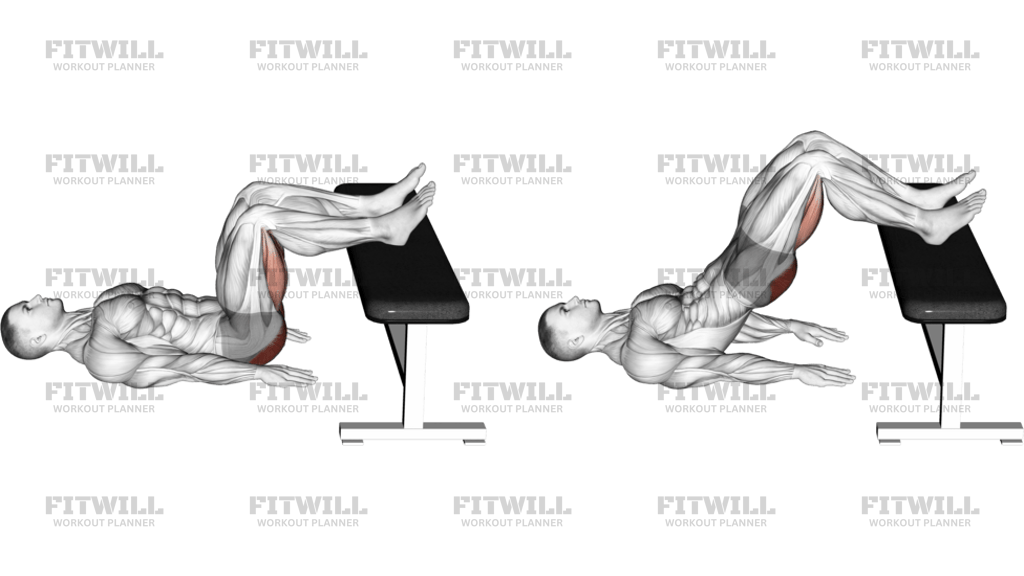
Glute Bridge Two Legs On Bench is a body-weight bridge variation that puts both feet on a bench while your upper back and shoulders stay on the floor. That setup changes the leverage of the movement and makes the glutes work hard through hip extension, while the hamstrings and core help stabilize the pelvis and keep the trunk from arching. It is a simple-looking exercise, but the bench position makes setup and control matter more than speed.
The main training goal is to drive the hips up without losing alignment. In anatomy terms, the primary work comes from the Gluteus maximus, with help from the Biceps femoris, Rectus abdominis, and Erector spinae. When the heels stay planted on the bench and the ribs stay down, the glutes can take over the top of the rep instead of the lower back doing the job.
The starting position should be precise. Lie on the floor with your upper back and shoulders grounded, place both heels on the bench, and bend the knees enough that the shins are roughly angled toward vertical. Keep your feet about hip-width apart, let your arms rest by your sides, and set your chin so the neck stays long. From there, brace lightly before you move so the torso stays quiet when the hips start to rise.
Each rep should feel like a controlled hip bridge rather than a kick or a backbend. Press through the heels, lift the hips until the torso and thighs form a straight line, and stop as soon as the glutes are fully contracted. The top position should feel like a strong squeeze through the buttocks, not a pinch in the lower back. Lower under control until the hips are close to the floor again, then repeat with the same foot pressure and body position.
This exercise is useful when you want glute-focused work without needing a machine or external load. It fits well in warm-ups, accessory work, and lower-body sessions where you want posterior-chain activation with minimal equipment. It can also be a good regression before loaded hip thrusts or a cleaner alternative when a bench-supported setup helps you feel the glutes more clearly.
Keep the movement honest. If the hamstrings cramp, the lower back arches, or the feet slide around on the bench, the setup is off and the set should be adjusted. A shorter range of motion with better pelvic control is more useful than chasing height. Done well, Glute Bridge Two Legs On Bench teaches you how to extend the hips forcefully while keeping the trunk stable and the movement smooth.
[ Workout Log & Planner ]
Put your next workout in Fitwill
Keep your plan and training log ready when you are.


Instructions
- Lie on the floor with your upper back and shoulders grounded and both heels resting on the bench.
- Set your feet about hip-width apart, bend the knees, and keep your arms long by your sides for balance.
- Tuck your chin slightly and brace your ribs so the lower back stays neutral before you lift.
- Press through both heels and drive your hips up until your torso and thighs form a straight line.
- Squeeze the glutes hard at the top without overextending the lower back.
- Pause briefly at the top while keeping both feet flat on the bench and the knees steady.
- Lower the hips slowly until they are just above the floor, keeping tension in the glutes and hamstrings.
- Reset your breath and repeat for the planned number of reps with the same heel pressure and pelvis position.
Tips & Tricks
- Set the bench height so your heels stay planted and your knees are bent enough to let the glutes drive the lift.
- Think about pushing the bench away with your heels, not curling onto your toes.
- If your hamstrings cramp, bring your feet a little closer together or reduce the range before the next set.
- Keep your ribs stacked over your pelvis; the top position should look like hip extension, not a lower-back arch.
- Let the shoulders stay heavy on the floor so the bench-supported feet do most of the work.
- A short pause at the top helps you feel the glutes finish the rep instead of bouncing through it.
- If the feet slide on the bench, slow the descent and check that your shoes or bench surface are stable.
- Use a smaller range of motion if you cannot keep both knees tracking in the same direction as your feet.
- Look straight up and keep the neck relaxed so you do not turn the bridge into a chin-driven movement.
- Stop the set when you can no longer keep the hips level and the pelvis controlled on the way up.
Frequently Asked Questions
What does Glute Bridge Two Legs On Bench work most?
It primarily targets the glutes, with the hamstrings and core helping to stabilize the lift.
How is Glute Bridge Two Legs On Bench different from a floor glute bridge?
Putting both feet on the bench changes the leverage and usually makes the top of the rep feel more demanding on the glutes and hamstrings.
Where should my feet be on the bench?
Place both heels on the bench about hip-width apart and adjust until you can press straight through the heels without sliding.
What should my upper body do during Glute Bridge Two Legs On Bench?
Your shoulders and upper back stay on the floor while your arms help balance the body without driving the movement.
Why do I feel this in my hamstrings instead of my glutes?
If the feet are too far away or the hips are not reaching full extension, the hamstrings can take over. Bring the heels a little closer and focus on a stronger glute squeeze at the top.
Is Glute Bridge Two Legs On Bench good for beginners?
Yes, as long as the range stays controlled and the pelvis does not arch when the hips rise.
What is the biggest mistake in this exercise?
The most common mistake is turning the bridge into a lower-back arch by lifting too high instead of finishing with the glutes.
Can I load Glute Bridge Two Legs On Bench later?
Yes, but only after you can keep both heels planted and the hips level through every rep with body weight.