Weighted Standing Curl
Weighted Standing Curl in this image is a standing plate curl: you hold a weight plate in front of your thighs and curl it upward with both arms at the same time. The movement is simple, but the setup matters because the plate is awkward compared with a dumbbell or barbell, so the wrists, elbows, and shoulders have to stay organized to keep the rep clean.
The main muscular demand is on the biceps, with the brachialis, brachioradialis, and forearm flexors helping to bend the elbows and control the plate. The shoulders and upper back mostly act as stabilizers so the plate can travel in a straight line instead of drifting forward. That makes this exercise useful when you want arm work with extra grip and forearm involvement, not just a pure curl pattern.
Start with your feet about hip width apart, stand tall, and hold the plate at arm’s length in front of your thighs. Keep your chest open, ribs stacked over your pelvis, and elbows close to your sides. The plate should stay centered in front of your body, not hanging off one side or swinging between the legs. A small knee bend is fine, but the torso should stay quiet from the first rep to the last.
Curl the plate by bending the elbows and lifting the plate toward the lower chest or upper abdomen. The upper arms should stay almost still while the forearms do the work. Pause briefly near the top, then lower the plate under control until the arms are nearly straight again. The lowering phase should feel deliberate, because that is where the biceps and forearms stay under the most useful tension.
This is a good accessory movement for arm development, home workouts, and sessions where you want a straightforward curl with a strong forearm component. Choose a plate you can control without leaning back, shrugging, or turning the rep into a front raise. If the plate starts to dig into the wrists, the shoulders begin to shrug, or the torso sways to help the lift, the load is too heavy. Beginners can use it with a light plate and a short, controlled range of motion until the position feels stable.
Fitwill
Log Workouts, Track Progress & Build Strength.
Achieve more with Fitwill: explore over 9600 exercises with images and videos, access built-in and custom workouts, perfect for both gym and home sessions, and see real results.
Start your journey. Download today!




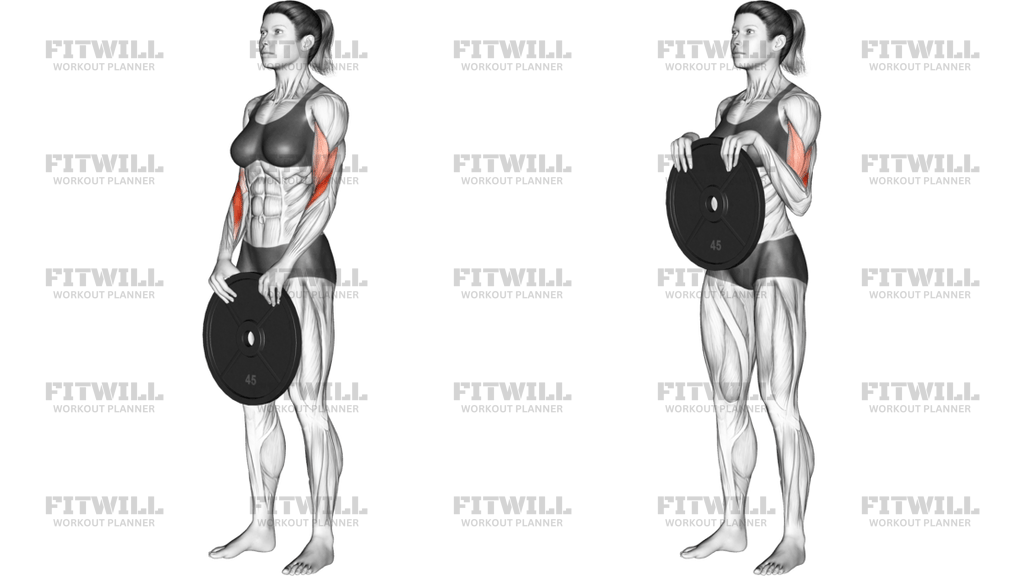
Instructions
- Stand with your feet about hip width apart and hold the weight plate vertically in front of your thighs with both hands on the outer rim or hand holes.
- Keep your chest lifted, ribs stacked over your pelvis, and shoulders down away from your ears before the first rep.
- Set your elbows close to your sides and keep your wrists straight so the plate starts in a stable position.
- Brace your midsection and keep your torso upright as you begin the curl.
- Bend your elbows to raise the plate toward your lower chest or upper abdomen without swinging your body.
- Pause for a brief squeeze at the top while keeping the elbows tucked and the shoulders quiet.
- Lower the plate slowly until your arms are almost straight again and the plate returns to the starting position in front of your thighs.
- Inhale on the way down and exhale as you curl the plate upward.
- Repeat for the planned number of reps while keeping every repetition smooth and controlled.
Tips & Tricks
- Choose a plate that fits your hands securely; a slick or overly thick plate makes the curl harder to control.
- Keep the elbows pinned near the ribs instead of letting them drift forward into a front-raise pattern.
- Hold the wrists in a neutral line with the forearms so the plate does not fold the hands backward at the top.
- If the shoulders shrug before the elbows finish bending, the plate is too heavy or the range is too ambitious.
- Lower the plate slowly; the eccentric phase is where the biceps and forearms stay under the most tension.
- Stop the curl around the lower chest or upper abdomen rather than forcing the plate all the way to the chin.
- Use a smooth grip through the rim or hand holes so the plate does not shift and pull one side of the body forward.
- If your torso rocks backward to finish the rep, reduce the load and keep the movement strict.
Frequently Asked Questions
What muscle does Weighted Standing Curl target most?
The biceps do most of the work, with the brachialis, brachioradialis, and forearm flexors helping to bend and control the plate.
Can beginners perform this exercise?
Yes. Beginners should use a light plate, keep the elbows tucked, and shorten the range until the curl stays smooth.
How should I hold the plate during the curl?
Hold the plate at the outer rim or through the hand holes with both hands so it stays centered in front of your body.
How high should I lift the plate?
Lift it to the lower chest or upper abdomen. If you have to shrug or lean back to go higher, stop the rep sooner.
Why do my wrists feel stressed on this movement?
The plate may be too heavy or your wrists may be bending back. Keep them stacked with the forearms and reduce the load if needed.
What is the most common mistake with a standing plate curl?
Using body swing or shrugging the shoulders to finish the rep instead of letting the elbows do the work.
Is this the same as a dumbbell curl?
It uses the same elbow-flexion pattern, but the plate grip adds more forearm and grip demand than a regular dumbbell curl.
Where does this exercise fit in a workout?
It works well as accessory arm work, a home-workout substitute, or a controlled finisher after bigger pulling movements.