Power Point Plank
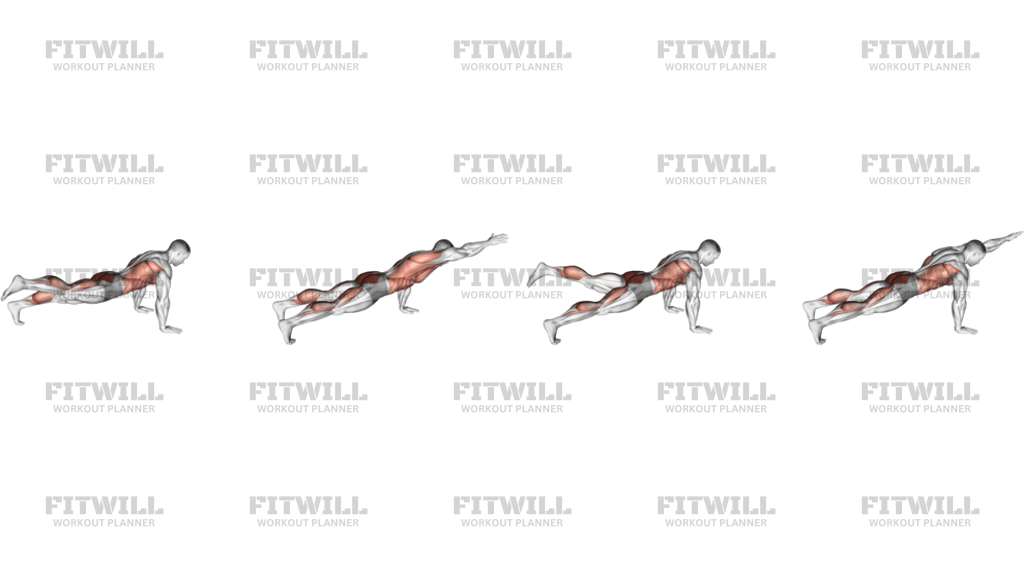
Power Point Plank is a dynamic plank variation that combines a strong high-plank position with a controlled forward reach. Instead of holding still, you shift just enough to lift one hand, point the arm straight out in front of you, and then return it without letting the torso twist. That small change makes the exercise much more demanding on trunk control than a standard plank.
The main emphasis is on the abs, with the obliques, hip flexors, and deeper core muscles helping keep the pelvis level and the ribs stacked. The thighs stay active too, especially the quads and inner thighs, because the legs have to stay rigid while the opposite arm moves. In anatomy terms, the main work centers on the Rectus Abdominis, with support from the External Obliques, Iliopsoas, and Transversus Abdominis.
The setup matters more here than in many other core drills. Start in a high plank with your hands under your shoulders, arms straight, feet set slightly apart for balance, and your body in one long line from head to heels. Press the floor away, squeeze your glutes and quads, and keep your neck long so the movement comes from the shoulder and trunk instead of from sagging through the lower back.
During each rep, reach one arm forward only as far as you can without shifting your hips or shrugging the working shoulder toward your ear. Pause for a moment in the extended position, then place the hand back under the shoulder under control and switch sides. Breathe out during the reach, breathe in as you return, and keep the rib cage from flaring as the arm leaves the floor.
Power Point Plank is useful in core blocks, warmups, and circuits where you want bracing strength and anti-rotation control rather than heavy loading. It can also be a good regression or progression tool depending on how far you reach and how wide you place your feet. If the lower back starts to arch, shorten the reach or widen the stance before the set turns into a fight for survival instead of a clean core drill.
[ Workout Log & Planner ]
Put your next workout in Fitwill
Keep your plan and training log ready when you are.


Instructions
- Start in a high plank with your hands under your shoulders, legs straight, and feet set slightly apart so you can resist rotation.
- Spread your fingers, lock in a straight line from head to heels, and press the floor away so your shoulder blades stay active.
- Brace your abs, squeeze your glutes and quads, and keep your ribs from flaring before you lift either hand.
- Shift your weight into one support hand and the opposite foot, then reach the free arm straight forward at shoulder height.
- Keep the reaching arm long without shrugging the shoulder, and hold your hips as square as possible to the floor.
- Pause briefly with the arm fully extended, keeping your neck neutral and your lower back from sagging.
- Bring the hand back under the shoulder under control without rocking side to side or bouncing through the hips.
- Repeat on the other side and continue alternating for the planned time or number of reps.
- Lower your knees to the floor or step out of the plank when the set is complete.
Tips & Tricks
- A slightly wider foot stance makes it easier to keep the hips level when one arm leaves the floor.
- Reach forward from the shoulder, not by letting the whole torso slide toward the front hand.
- If your lower back arches, shorten the reach and squeeze the glutes harder before the next rep.
- Keep the supporting hand planted firmly through the heel of the palm and the base of the index finger.
- Do not let the working shoulder creep up toward the ear; keep it packed as the arm reaches.
- Move slowly enough that the returning hand lands quietly under the shoulder instead of slapping the floor.
- Exhale as the arm reaches forward so the ribs stay down and the torso stays braced.
- If your hips twist, reduce the reach distance before you try to increase the hold time.
- Stop the set when your feet start drifting or your trunk starts wobbling instead of staying square.
Frequently Asked Questions
What does Power Point Plank train the most?
It mainly trains the abs and other anti-rotation core muscles while the thighs and shoulders work hard to keep the plank stable.
How is Power Point Plank different from a regular plank?
A regular plank is mostly an isometric hold. Power Point Plank adds an alternating forward reach, which makes the core work harder to stop the hips from twisting.
How far should I reach with the arm in Power Point Plank?
Reach only as far as you can without shifting the hips or shrugging the shoulder. A shorter, cleaner reach is better than forcing extra range.
Why do my hips rotate during Power Point Plank?
Usually the feet are too close together or the reach is too long. Widen your stance slightly and shorten the arm reach until the pelvis stays square.
Can beginners do Power Point Plank?
Yes, if they start with short holds, a smaller reach, and a slightly wider foot position. Once the trunk stays steady, they can lengthen the lever.
Should I do Power Point Plank on hands or forearms?
This version is meant to be done on straight arms in a high plank. If you drop to the forearms, you change the exercise and lose the arm-reach challenge.
What should I do if my lower back feels it more than my abs?
Tighten your glutes, shorten the reach, and keep your ribs pulled down. If the back still takes over, end the set and reset with a cleaner plank.
What makes the supporting hand important in Power Point Plank?
The planted hand has to push the floor away hard so the shoulder stays stacked and the torso does not collapse toward that side.