Alternate Punching
Alternate Punching is a standing cardio drill built around alternating straight punches while you stay light, balanced, and coordinated. It is commonly used as a shadowboxing or warm-up pattern, but it can also serve as a conditioning finisher when you want fast arm turnover without losing posture. The main training value comes from repeating clean punches with the shoulders, trunk, and hips working together instead of letting the arms fling forward on their own.
The image shows a boxing-style stance with one hand guarding the face while the other arm reaches straight ahead. That setup matters because it keeps the torso stable, the head protected, and the punch path efficient. Each rep should travel on a straight line from the guard position, extend only as far as you can control, then return sharply to the cheek or jawline before the next punch starts. The exercise is simple on paper, but the quality depends on how well you keep your ribcage stacked over your pelvis and your weight centered between both feet.
Alternate Punching trains conditioning, shoulder endurance, trunk control, and coordination. A small amount of rotation through the shoulders and hips is normal, but the movement should stay crisp rather than exaggerated. Keep the rear heel light, the knees soft, and the elbows close on the way back so the guard never opens up. If you let the punches drift outward or cross your centerline, the set turns into sloppy arm swinging instead of useful striking mechanics.
This exercise is useful in general warm-ups, boxing circuits, athletic conditioning, and anytime you want upper-body work with a high heart-rate response. Because it is bodyweight-based, it can be scaled easily by changing speed, adding rounds, or pairing it with footwork. Beginners can use it safely if they keep the punches controlled and avoid locking the elbows at full extension. More advanced trainees can increase pace, improve rhythm, and add sharper torso rotation without losing the straight punch path.
The safest version is the one that stays smooth from the first punch to the last. Your wrists should stay straight, your chin slightly tucked, and your shoulders relaxed enough that the hands can snap out and back without tension. If the neck tightens, the low back arches, or the fists stop returning to guard, the set is too fast. Treat the drill like a technical striking pattern first and a conditioning tool second.
[ Workout Log & Planner ]
Put your next workout in Fitwill
Keep your plan and training log ready when you are.


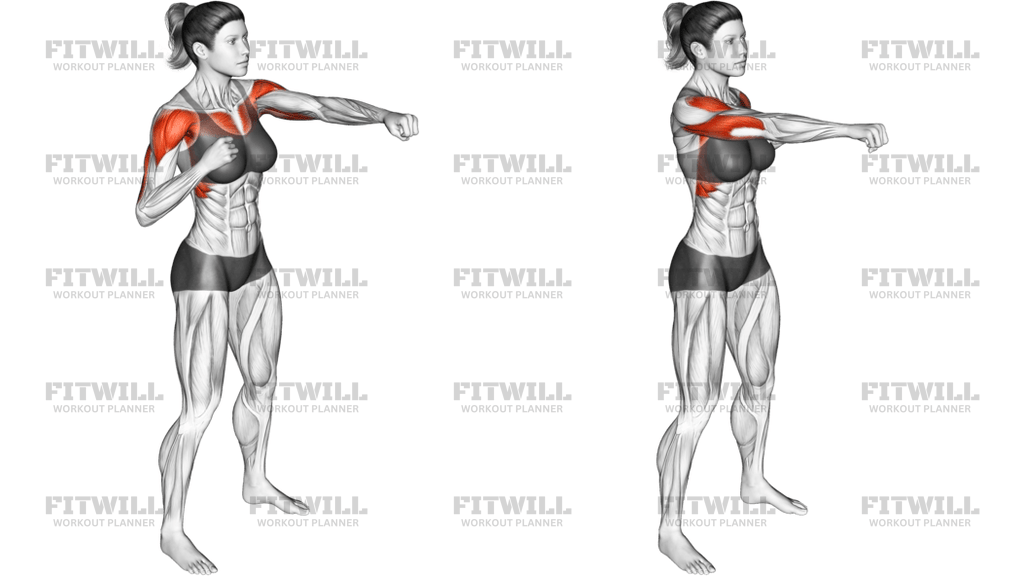
Instructions
- Stand in a light boxing stance with one foot slightly forward, knees soft, and your weight centered between both feet.
- Raise both hands to your face so one fist guards the chin and the other is ready to punch.
- Keep your chin tucked slightly and your ribs stacked over your pelvis before the first rep starts.
- Drive one fist straight forward from the guard position until the arm is almost fully extended.
- Turn the punch over just enough to keep the wrist straight and the knuckles aligned with the target line.
- Snap the punching hand back to guard before sending the other hand forward.
- Alternate left and right punches at a controlled rhythm while staying tall through the torso.
- Exhale sharply on each punch and keep the shoulders relaxed as the hands return.
- Finish the set by bringing both hands back to guard and re-centering your stance.
Tips & Tricks
- Keep the punches straight; if your fists start arcing wide, the set becomes arm swinging instead of clean striking.
- Return each hand to the cheek or jawline quickly so the guard never disappears between reps.
- Do not lock the elbow hard at full extension; stop just short of a jammed-out joint.
- Let the shoulders rotate naturally, but do not twist so far that the hips lose their stacked position.
- Stay light on the feet with a soft knee bend so the torso can move without bouncing.
- Exhale on every punch to help the trunk brace and keep the rhythm steady.
- Keep the wrists straight and the knuckles lined up with the forearm to avoid collapsing the wrist on contact.
- If the neck starts shrugging up toward the ears, slow the pace and reset the guard.
Frequently Asked Questions
What does Alternate Punching train most?
It mainly trains cardio conditioning, shoulder endurance, and coordination while your core helps keep the torso steady.
Do I need equipment for Alternate Punching?
No. It is usually performed as shadowboxing with just your bodyweight and a controlled fighting stance.
How should my hands move on each rep?
One hand should punch straight out while the other stays near your face in guard, then they switch cleanly on the next rep.
Should I rotate my hips during Alternate Punching?
A little torso and hip rotation is normal, but the movement should stay compact so you do not overtwist or lose balance.
Can beginners do this exercise safely?
Yes, as long as they keep the punches slow enough to return to guard and avoid snapping the elbows or wrists.
What is the most common form mistake?
The biggest mistake is punching without bringing the hand back to guard, which makes the shoulders tense and the stance sloppy.
How should I breathe during the drill?
Exhale briefly on each punch and keep the breathing rhythmic so the pace stays smooth.
How can I make Alternate Punching harder?
Increase the round length, tighten the rhythm, add footwork, or work at a faster pace without letting the guard and punch line break down.