Glute Bridge March
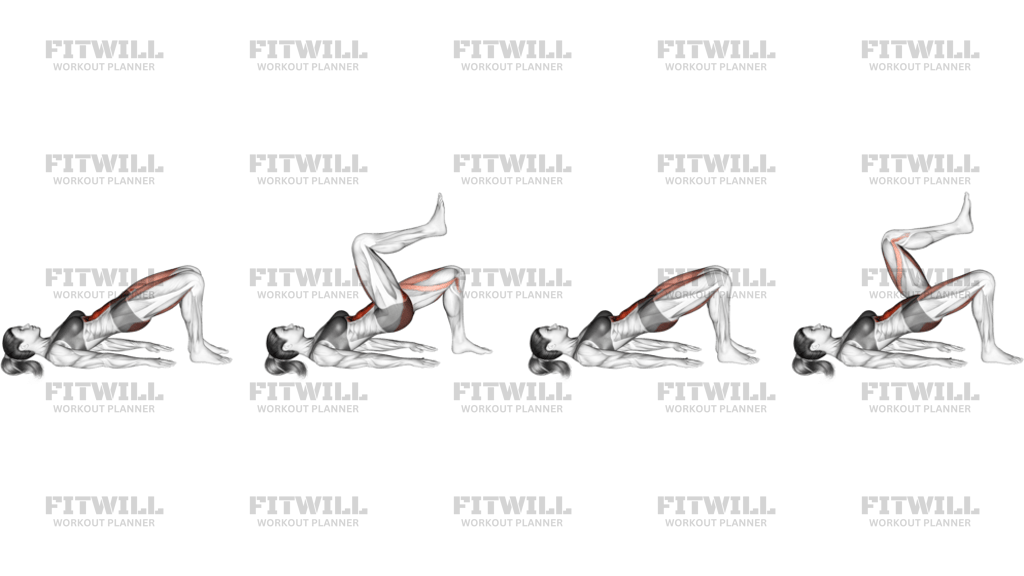
Glute Bridge March is a floor exercise that combines a held glute bridge with alternating knee lifts. You lie on your back, lift the hips into bridge position, then keep the pelvis steady as one foot leaves the floor at a time. The movement trains hip extension, pelvic control, and trunk stability at the same time, which makes it useful when you want glutes and core work without heavy loading.
The visible pattern in this exercise matters: one leg stays planted while the other knee comes toward the chest, then the sides alternate. That repeated shift of support challenges the glute on the planted side to keep the hips level and the lower back quiet. The main muscular demand sits on the gluteus maximus, with the hamstrings, rectus abdominis, and erector spinae helping hold the bridge and prevent rotation.
Good reps start before the first march. Set the feet far enough from the hips that you can press through the heels, then lift until the torso and thighs form a strong line without over-arching the spine. From there, the working leg should come up slowly while the opposite side stays tall. If the hips twist, drop, or drift forward, the set is too fast or the bridge is too high for the control you have that day.
Because this is a body-weight stability drill, the best use is often warm-up work, accessory glute training, core conditioning, or rehab-style control work. It can be scaled by slowing the march, shortening the lever, or keeping the knee lift smaller. It should feel challenging through the planted glute and abs, but not like a cramp, low-back pinch, or hamstring-dominant hip thrust.
Treat the march as a quality test rather than a speed test. Smooth alternation, even hip height, and steady breathing are the main goals. When those stay consistent, the exercise builds the kind of control that carries over to squats, lunges, running, and other single-leg lower-body work.
[ Workout Log & Planner ]
Put your next workout in Fitwill
Keep your plan and training log ready when you are.


Instructions
- Lie on your back with your knees bent, feet flat on the floor, and arms resting long by your sides.
- Set your heels close enough to press firmly through them, then brace your ribs down so your lower back stays neutral.
- Squeeze your glutes and lift your hips until your torso and thighs make a straight line from shoulders to knees.
- Keep both knees pointing forward and avoid flaring the ribs or over-arching at the top.
- From the bridge, lift one knee toward your chest without letting the pelvis drop or rotate.
- Place that foot back down under control, then lift the other knee in the same way.
- March back and forth with slow, even steps while keeping the hips level and high.
- Breathe out during each knee lift and inhale as the foot returns to the floor.
- Lower your hips to the floor when the bridge position starts to sag or you lose control.
Tips & Tricks
- Press through the planted heel, not the toes, so the glutes stay in charge of the bridge.
- Keep the marching knee lift small if your hips twist when you bring the leg up.
- Hold the bridge height that lets your pelvis stay level; a lower bridge is better than a shaky higher one.
- Think about pulling the ribs toward the pelvis to stop the lower back from taking over.
- Move the lifted thigh only as far as you can without shifting weight into the opposite shoulder or foot.
- If the hamstrings cramp, walk the feet slightly farther away and reduce the bridge height.
- Use slow cadence instead of quick alternating steps so each side has to stabilize the pelvis.
- Keep the chin softly tucked and your neck relaxed instead of looking around during the march.
- Stop the set as soon as one hip starts to sink, because that is usually the first sign the core is losing control.
Frequently Asked Questions
What does the Glute Bridge March primarily train?
It mainly trains the glutes, with extra work for the core and hamstrings as you keep the hips level while marching.
How high should my hips be in the bridge before I start marching?
Lift until your torso and thighs form a strong line, but stop before your lower back arches or your ribs flare.
Should both feet stay on the floor during the march?
No. One foot stays planted while the other knee lifts toward the chest, then you alternate sides.
What is the biggest form mistake in this exercise?
The most common problem is letting the hips twist or sink when the knee lifts, which turns the march into a sloppy bridge hold.
Why do my hamstrings feel this more than my glutes?
If your feet are too far from your hips or you are lifting too high, the hamstrings can take over. Bring the feet a little closer and keep the bridge controlled.
Can I do the Glute Bridge March if I have a sensitive lower back?
Often yes, because it is a low-load floor exercise, but only if you can keep the ribs down and avoid lumbar arching.
How can I make the march harder without adding weight?
Slow the tempo, pause for a second on each lifted knee, or keep the bridge steady for longer between sides.
What should I feel working during a good rep?
You should feel the planted-side glute, the lower abdominals, and some hamstring support, while the hips stay quiet and level.