Forward To Side To Rear Lunge
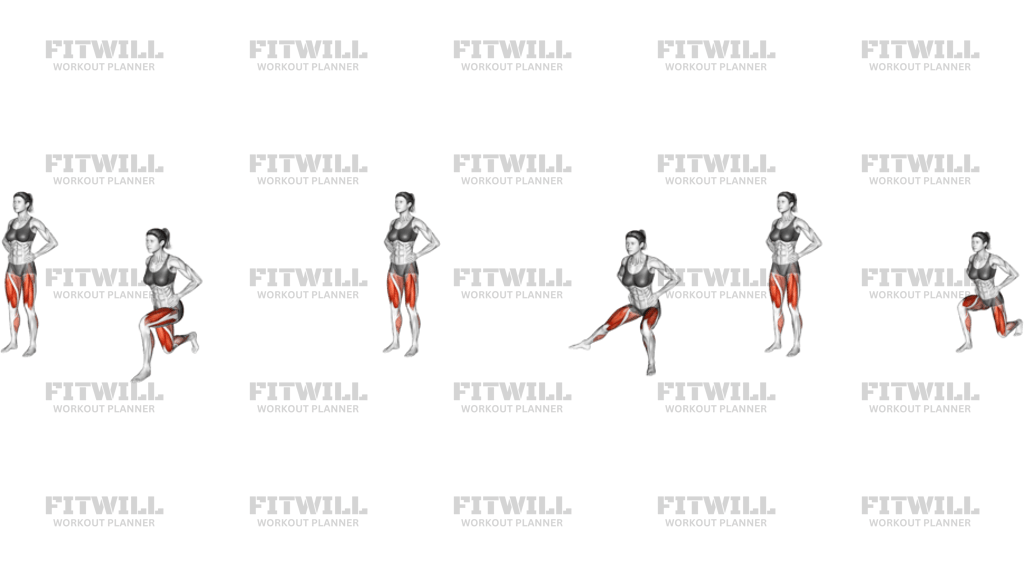
Forward To Side To Rear Lunge is a bodyweight lower-body drill that combines three common lunge patterns into one controlled sequence: forward, lateral, and reverse. It challenges the glutes, hips, quads, hamstrings, adductors, and trunk while also training balance and body awareness in different planes of motion. Because each step changes the loading angle, the exercise is useful for building more complete single-leg control than a straight-line lunge alone.
The movement is especially valuable when you want the hips to stay organized while the legs move in different directions. The primary emphasis is the glutes, with the hamstrings, core, and lower back helping stabilize the pelvis and torso. In anatomy terms, the main work centers on the Gluteus maximus, with assistance from Biceps femoris, Rectus abdominis, and Erector spinae. That makes this a good choice for warm-ups, accessory circuits, movement prep, and beginner strength work where clean mechanics matter more than external load.
Setup matters because the exercise changes direction quickly. Stand tall with your feet about hip-width apart, keep your chest stacked over your pelvis, and square your hips before each step. Hands on the hips, at the chest, or relaxed by the sides all work as long as they do not throw off balance. Before you move, think about soft knees, a braced midsection, and a clear landing path so each lunge can be controlled instead of rushed.
Each repetition should feel like a deliberate three-part pattern rather than a series of random steps. Step forward into a lunge, drive back to standing, step out to the side and sit into the hip, return to center, then step back into a reverse lunge and stand tall again. Keep the torso upright, let the front knee track in line with the toes, and control every descent so the working leg does the work instead of momentum. If the sequence starts to look sloppy, shorten the step or reduce the depth before adding volume.
This exercise fits well in lower-body warm-ups, athletic prep, or light-to-moderate conditioning blocks because it exposes side-to-side differences and helps build stable knees and hips. Beginners can use it with body weight only, while more advanced lifters can slow the lowering phase, pause at the bottom, or add a reach or light load once the pattern is clean. The main rule is simple: move in all three directions with the same control, then switch sides and keep the reps symmetrical.
[ Workout Log & Planner ]
Put your next workout in Fitwill
Keep your plan and training log ready when you are.


Instructions
- Stand tall with your feet hip-width apart and place your hands on your hips or in front of your chest.
- Brace your midsection, keep your ribs stacked over your pelvis, and pick one leg to lead the sequence.
- Step forward with the lead leg, land softly, and lower into a forward lunge with the front heel planted and the back knee bending toward the floor.
- Push through the front heel and midfoot to return to standing without leaning forward or bouncing.
- Step out to the same side for a side lunge, sit the hips back toward that leg, and keep the opposite leg straighter as the other foot stays flat.
- Drive off the bent leg to return to the middle and keep your hips facing forward as you reset.
- Step back into a reverse lunge with the same lead leg, lower under control, and keep the torso tall as the rear knee drops.
- Press through the front foot to stand up, then complete the same forward, side, and rear pattern on the other leg.
- Breathe in on each descent and exhale as you drive back to standing, stopping the set if balance or knee tracking starts to break down.
Tips & Tricks
- Use the same step length each time so the forward, side, and reverse lunges feel like one repeatable pattern.
- Keep the front foot tripod grounded on the forward and reverse lunges so the heel does not peel up as you drop.
- On the side lunge, let the moving hip travel back while the straight leg stays long enough to load the inner thigh of the opposite side.
- Keep your chest from drifting toward the floor; the torso should stay stacked even when the hips move back.
- Let the knee of the working leg track over the second or third toe instead of caving inward on the push back up.
- If the side lunge feels tight in the groin, shorten the step before forcing depth.
- Move slowly enough that each direction has its own clear landing and push-off, not one rushed hop between positions.
- This is a bodyweight drill first, so add tempo, pause, or reach before you add external load.
Frequently Asked Questions
What does Forward To Side To Rear Lunge train?
It trains the glutes and hips through forward, side, and backward stepping patterns while also challenging the quads, hamstrings, adductors, and core.
Do I do all three lunges on one side before switching?
Yes. Complete the forward, side, and reverse lunge on one lead leg, then repeat the same sequence on the other side.
Where should I feel this exercise most?
You should feel the working glute, thigh, and hip of the lead leg, with the side lunge adding more inner-thigh and hip work.
How low should I go on each lunge?
Lower only as far as you can keep the torso tall, the front foot flat, and the knee tracking cleanly over the toes.
What is the most common mistake?
The biggest mistake is rushing the direction changes and collapsing the knee or torso instead of controlling each landing and push-off.
Can beginners use this movement?
Yes. Start with a shallow range of motion and body weight only, then build depth and control before adding speed or load.
Is this exercise good for warm-ups?
Yes. It is a strong warm-up drill because it opens the hips in multiple planes and wakes up single-leg balance before heavier training.
How can I make it harder without using weights?
Slow the lowering phase, pause briefly at the bottom of each lunge, or add a reach while keeping the hips level.