Alternate Leg Raises
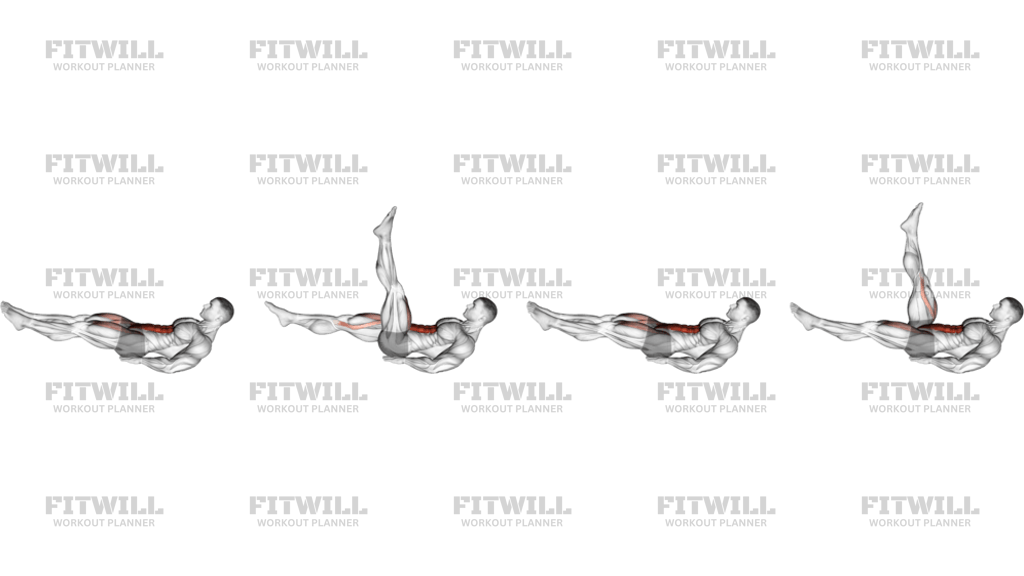
Alternate Leg Raises is a floor-based core exercise where you lie on your back and raise one straight leg at a time while the other hovers low over the mat. The image shows the torso slightly curled up, which is intentional: that small trunk hold helps keep the abs active while the legs move. The exercise is simple in appearance, but the challenge comes from keeping the pelvis steady, the lower back controlled, and the switch between legs smooth.
This movement emphasizes the abs first, with the hip flexors and obliques helping to stabilize the trunk and manage the leg change. In anatomical terms, the primary work comes from the rectus abdominis, while the external obliques, iliopsoas, and transversus abdominis contribute to control. The exercise is useful when you want direct abdominal work without spinal flexion reps or equipment, and it also makes a good accessory after bigger compound lifts or as part of a core-focused session.
The setup matters because the legs only stay honest when the trunk is fixed. Lie flat on a mat, keep the legs long, and lift the head and shoulders just enough to maintain tension without straining the neck. Press the ribs down, gently tuck the pelvis, and keep the low back from arching away from the floor. Once that position is locked in, the legs should move from the hip with the abs resisting the pull instead of the torso rocking side to side.
Each repetition should feel like a controlled exchange rather than a kick. Raise one leg to a height you can manage without losing lumbar contact, keep the opposite leg hovering low, then switch smoothly. The leg that lowers should do so under control, not drop. Breathing should stay organized through the whole set, with an exhale as the working leg rises and an inhale as the switch happens or the leg lowers. If the lower back starts to lift, shorten the range immediately.
Alternate Leg Raises works best when clean positioning matters more than speed. It is a practical option for beginners who can maintain a small range, and it also scales well for advanced lifters who want stricter tempo or longer time under tension. Keep the movement precise, stay out of momentum, and stop the set when the trunk no longer stays anchored.
[ Workout Log & Planner ]
Put your next workout in Fitwill
Keep your plan and training log ready when you are.


Instructions
- Lie on your back on a mat with both legs straight, arms by your sides, and your shoulders lightly curled off the floor.
- Press your lower back gently toward the mat, tuck your pelvis slightly, and keep your chin neutral so your neck stays long.
- Brace your abs before the first rep and keep your ribs down instead of letting your chest flare.
- Lift one straight leg toward the ceiling while the other leg hovers a few inches above the floor.
- Keep both knees extended and your hips square as the raised leg moves and the other leg stays long.
- Lower the raised leg under control until it is hovering low, then switch legs without bouncing or swinging.
- Exhale as one leg lifts and inhale as you lower and alternate to the other side.
- Continue for the planned reps, then lower both legs and your shoulders to the floor with control.
Tips & Tricks
- Keep the raised leg long but do not chase vertical height if it pulls your low back off the mat.
- The lower leg should hover, not crash into the floor, or the set turns into momentum work.
- A small shoulder curl is enough; if your neck feels tight, lower your head and keep the same leg action.
- Think about holding the pelvis still while the hips move, not about swinging the whole body.
- If the hip flexors burn before the abs, shorten the range and slow the switch between legs.
- Pointing or lightly dorsiflexing the toes is fine, but keep the legs visibly straight and active.
- A slower cadence makes the exercise harder; use tempo to keep the abs loaded instead of adding speed.
- Stop the set as soon as your lower back starts arching or your legs start to scissor wildly.
Frequently Asked Questions
What muscles do Alternate Leg Raises work most?
They mainly train the rectus abdominis, with the hip flexors and obliques helping to control the leg switch and keep the pelvis steady.
Why is my lower back arching during the raise?
The legs are probably lowering too far for your current control. Shorten the range and keep the ribs pulled down so the low back stays close to the floor.
Should my shoulders stay on the floor?
In this version, a slight shoulder curl is useful because it keeps tension on the abs, but you should not be straining your neck or yanking the head up.
How high should the raised leg go?
High enough to keep the pelvis still and the low back controlled. For many people that is near vertical, but the right height is whatever you can maintain without arching.
Is this the same as flutter kicks?
Not exactly. Flutter kicks are usually faster and smaller, while Alternate Leg Raises are typically slower, straighter, and more deliberate through each switch.
Can beginners do Alternate Leg Raises?
Yes, but many beginners need a smaller range or a bent-knee version first so they can keep the low back down and avoid swinging.
What is the biggest form mistake to avoid?
Letting the non-working leg drop hard and using body swing to change sides. The switch should stay smooth and controlled.
How can I make the exercise harder without weights?
Slow the lowering phase, keep the hovering leg lower, or pause briefly before each switch while maintaining a flat, controlled torso.