Cable Half Kneeling Adductor Pallof Press
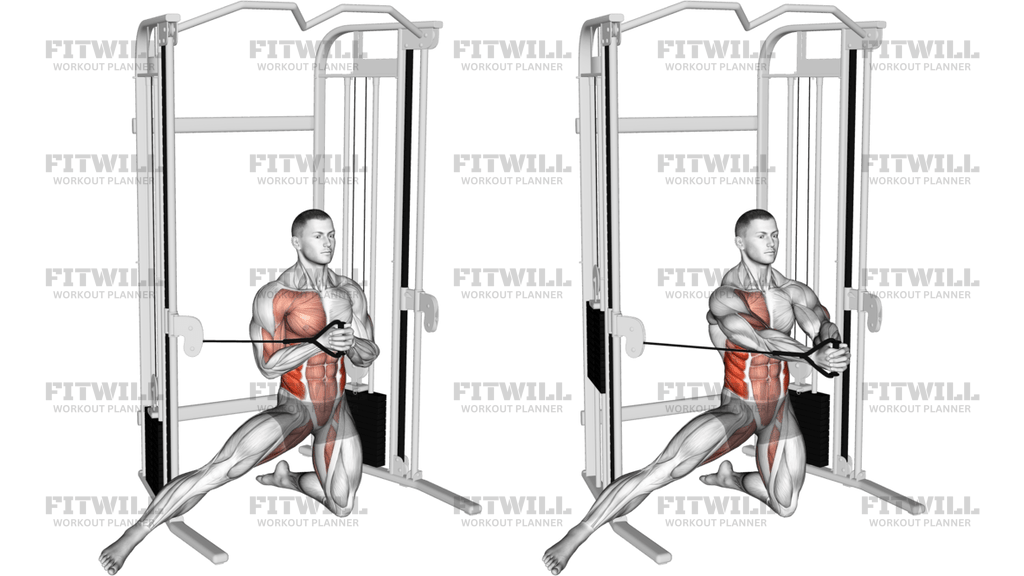
Cable Half Kneeling Adductor Pallof Press is a half-kneeling anti-rotation press that combines core control with a strong adductor and glute demand on the long leg. It is useful when you want to train the torso to stay square while the lower body has to hold an asymmetrical stance. The cable line creates constant side pull, so the exercise rewards patience and clean positioning more than heavy loading.
The half-kneeling base changes the feel of the press. One knee stays down for support while the other leg reaches out to the side, which puts extra work into the inner thigh and hip of the extended leg as well as the glute of the kneeling side. The upper body still has to press straight ahead without twisting, so the exercise ties together shoulders, chest, abs, and hip stability in one controlled pattern.
Setup matters more here than in a standard press. The pulley should sit around chest height, the handle should start close to the sternum, and the torso should face straight ahead rather than drifting toward the stack. If the pelvis tilts or the ribcage flares, the cable will pull you off line immediately, which is why a short, deliberate stance and a square chest are the right starting point.
Each rep should look like a clean press away from the body, a brief hold, and a smooth return against the cable's pull. The goal is not to reach farther every rep; it is to keep the shoulders level, the hips steady, and the extended leg active without collapsing into the floor or rotating through the trunk. That makes the movement especially useful for athletes and lifters who need better anti-rotation strength and frontal-plane hip control.
Use Cable Half Kneeling Adductor Pallof Press as an accessory drill, warm-up pattern, or core-focused strength exercise when you want a low-to-moderate load that still exposes weak links fast. Beginners can learn it well if they keep the stance short, press in a straight line, and reduce the load before the cable starts turning the torso. Treat it as a precision exercise: if the setup is off, the rep quality drops immediately.
[ Workout Log & Planner ]
Put your next workout in Fitwill
Keep your plan and training log ready when you are.


Instructions
- Set the cable handle at chest height and stand side-on to the stack, then lower into a half-kneeling position with the inside knee on the floor and the outside leg extended to the side.
- Plant the extended foot firmly and keep that leg long so the inner thigh stays active instead of letting the hip collapse inward.
- Hold the handle at your sternum with both hands, stack your wrists over your elbows, and square your shoulders and hips toward the front.
- Brace your midsection and set your ribs down before you press so the cable cannot twist your torso open.
- Press the handle straight out from your chest until your arms are almost straight, keeping the movement level rather than reaching upward or across your body.
- Pause for a second with the arms extended while the cable tries to rotate you, and keep the pelvis and sternum facing forward.
- Bring the handle back to your chest under control, letting the cable pull you only as far as you can resist without leaning or rotating.
- Reset your posture at the bottom of each rep, then repeat for the planned number of repetitions before carefully returning the handle to the stack.
Tips & Tricks
- If the cable line is too high or too low, the press will turn into a shoulder angle change instead of a true Pallof press.
- Keep the extended leg active by pressing the heel down and feeling the inner thigh work; if that leg relaxes, the stance stops doing its job.
- Do not let the kneeling hip drift forward or the pelvis rotate toward the stack when you press out.
- A shorter stance usually makes the anti-rotation demand clearer than reaching the straight leg too far away from the body.
- Press in a straight line from sternum to full reach; any diagonal path usually means the torso is following the cable.
- Use a load light enough that you can pause at full reach without the front shoulder hiking up or the ribs flaring.
- Keep the hands centered at chest height instead of pressing from the chin or collarbones.
- The return phase should feel slower than the press-out phase because the cable is trying to drag you back toward the stack.
- If the inner thigh or kneeling hip cramps, shorten the set and reset the stance before the next rep.
Frequently Asked Questions
What does Cable Half Kneeling Adductor Pallof Press train most?
It trains anti-rotation strength through the core while the extended leg's adductors and the kneeling side's glute help keep the pelvis level.
Why is one leg extended out to the side in Cable Half Kneeling Adductor Pallof Press?
The side leg adds a strong adductor challenge and makes it harder for the hips to drift or rotate while you press.
Where should the handle start in Cable Half Kneeling Adductor Pallof Press?
Start with the handle at the center of your chest, elbows tucked slightly in front of the ribs, and the cable pulling straight from your side.
Should my torso rotate during Cable Half Kneeling Adductor Pallof Press?
No. The whole point is to resist rotation, so the chest, ribs, and pelvis should stay square as you press and return.
What muscles should I feel most in this variation?
You should feel the core working hard, along with the inner thigh of the extended leg and the glute on the kneeling side.
Is Cable Half Kneeling Adductor Pallof Press beginner friendly?
Yes, if you start light and keep the stance compact. Beginners usually do best when they focus on staying square rather than pressing far away from the body.
Can I use a band instead of a cable for Cable Half Kneeling Adductor Pallof Press?
Yes. A band works if you anchor it at chest height and keep enough tension that the press still tries to pull you into rotation.
What is the biggest mistake to avoid in Cable Half Kneeling Adductor Pallof Press?
Letting the torso twist toward the cable or flaring the ribs at lockout. If that happens, reduce the load or shorten the reach.
How many reps work well for Cable Half Kneeling Adductor Pallof Press?
Controlled sets of about 8-12 reps per side usually work well, because the exercise is about position and tension more than chasing fatigue.