Climbing Monkey Bars
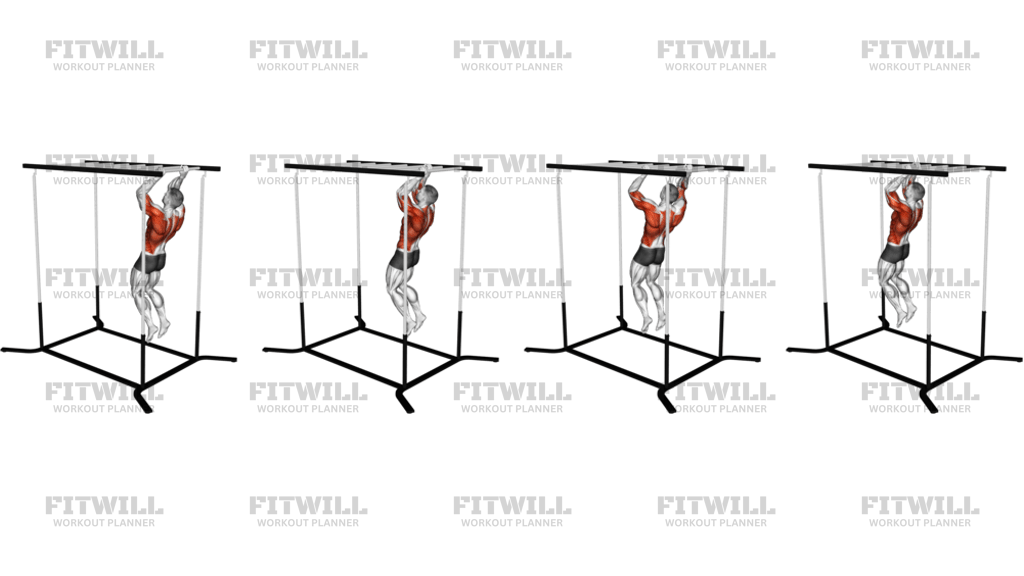
Climbing Monkey Bars is a body-weight hanging traverse that trains grip endurance, upper-back pulling strength, shoulder stability, and trunk control. The image shows a person suspended under overhead bars and moving hand-over-hand across the structure, so the exercise is best understood as a controlled locomotion drill rather than a simple static hang. The quality of the set depends on how well you keep the body organized while each hand releases, reaches, and regrips the next rung.
Because the movement is overhead and unsupported, the shoulders, lats, forearms, and core all have to contribute at the same time. The grip keeps you attached to the bars, the scapular muscles help hold the shoulders in a safe position, and the trunk prevents excessive swinging or twisting. That makes Climbing Monkey Bars useful for obstacle-course prep, calisthenics conditioning, and general upper-body resilience when you want work capacity as much as strength.
Good reps start before the first reach. Grip a bar firmly, hang with active shoulders, and keep the ribs stacked over the pelvis so the swing stays small. From there, move one hand at a time to the next bar, letting the free hand search forward only as far as you can control. The goal is a smooth transfer with minimal wasted motion, not a wild leap from rung to rung. If the course is high, dismount deliberately at the end instead of letting go early.
Use a pace that lets you keep the elbows controlled and the neck relaxed. A little leg motion can help you travel, but the movement should come from the hands and shoulders, not from kicking or yanking your torso forward. Exhale during each reach or hand transfer, then reset your brace before the next one. If your grip opens early, your shoulders shrug hard, or your body starts swinging uncontrollably, the set is too long or too fast for the current level.
This exercise fits best as a skill-and-conditioning movement in a warmup, circuit, or obstacle-focused session. Beginners can shorten the distance, use lower bars, or keep feet lightly assisted until they can hang and transfer safely. Advanced users can increase distance, speed, or total time under tension, but the same standard applies: clean hand placements, controlled trunk position, and a safe finish at the dismount point.
Fitwill
Log Workouts, Track Progress & Build Strength.
Achieve more with Fitwill: explore over 9600 exercises with images and videos, access built-in and custom workouts, perfect for both gym and home sessions, and see real results.
Start your journey. Download today!




Instructions
- Stand under the first rung, jump or step up to grab the bar with both hands, and hang with active shoulders instead of sinking into a loose dead hang.
- Set your ribs down, squeeze your glutes lightly, and keep your legs together so the body stays quiet before you move.
- Shift your weight into one hand and reach the other hand to the next bar, keeping the torso long and the swing small.
- Regrip the next bar securely before you let the trailing hand fully release.
- Repeat the hand-over-hand pattern across the bars, moving one hand at a time in a controlled rhythm.
- Keep the elbows slightly bent and the shoulders packed enough to avoid shrugging hard at each transfer.
- Breathe out as you reach or transfer, then reset your brace before the next hand placement.
- Finish with a deliberate dismount when you reach the end rather than dropping early.
- If you are traversing back and forth, reverse the pattern only after you are settled and stable on the next rung.
Tips & Tricks
- A strong grip matters more than speed; keep the handle deep in the palm and squeeze through the last two fingers as you move.
- Small swings are fine, but large kipping motions turn the drill into momentum practice instead of a controlled climb.
- Keep the shoulder blades active so the shoulders do not collapse toward your ears on every reach.
- If your forearms pump out before your back does, shorten the distance or slow the pace instead of forcing more rungs.
- Keep the legs quiet and slightly in front of you; wild bicycle kicks usually make the hand transfer harder.
- Look toward the next rung, not straight up, so the reach stays accurate and your neck stays relaxed.
- Lower bars or a foot-assisted setup are good regressions when a full hanging traverse is too hard to control.
- Treat each hand transfer like a separate rep: secure the new grip first, then move the other hand.
- Stop when the grip opens, the body starts twisting hard, or the next reach becomes a blind lunge.
Frequently Asked Questions
What muscles do Climbing Monkey Bars work?
They heavily involve the forearms and grip, plus the lats, upper back, shoulders, and core that keep you hanging and moving cleanly.
Is this more of a strength or conditioning exercise?
It is usually both: the hanging and hand-over-hand transfers build pulling endurance, grip capacity, and body-control conditioning.
Should I keep my arms straight or bent while moving?
Use a controlled slight bend rather than locking out aggressively or curling up hard; that helps the shoulders stay organized during each transfer.
How do I stop swinging too much on the bars?
Brace your trunk, keep the legs together, and move one hand at a time only after the next grip is secure.
Can beginners do Climbing Monkey Bars?
Yes, if they use lower bars, shorter distances, or light foot assistance until they can hang and transfer without losing control.
What is the most common mistake with monkey bars?
Rushing the reach and letting the body lunge forward is the biggest problem because it turns the move into a swing instead of a controlled traverse.
Do I need to touch every bar with both hands?
Not necessarily; the key is secure, deliberate hand placement. Some versions use a one-hand-at-a-time traverse, while others may require both hands on each rung briefly for stability.
What should I do if my grip gives out early?
End the set, or shorten the course so the last successful rung still looks clean; grip failure usually shows up before the rest of the body is ready.
How should I breathe during the movement?
Use short exhalations during each reach or transfer, then reset your brace before the next hand move.