Resistance Band Push-Up
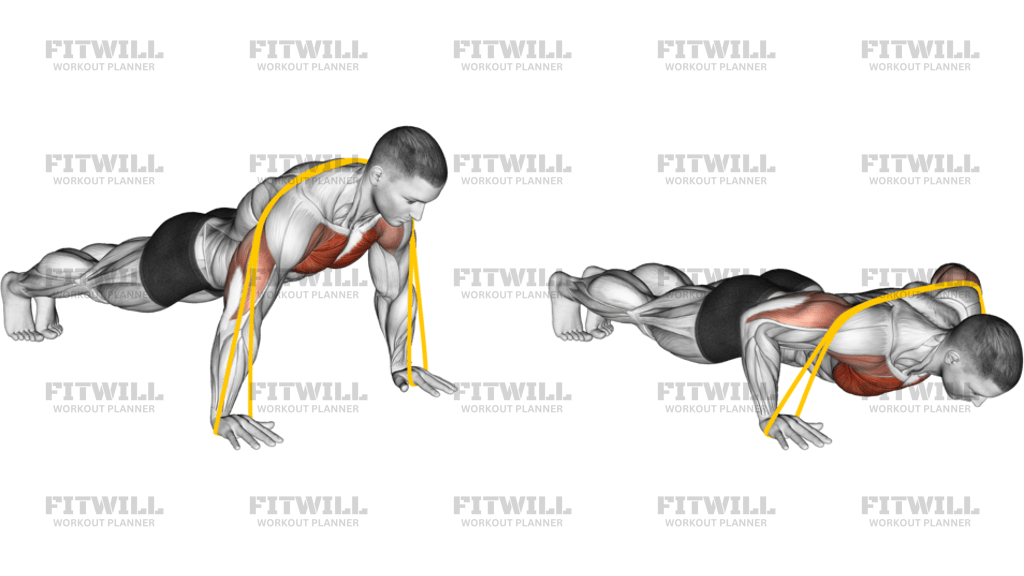
Resistance Band Push-Up is a band-resisted floor push-up that builds pressing strength with extra load as you approach the top of each rep. The band in the image is looped across the upper back and pinned under the hands, which means the press gets hardest when the elbows are extending and the chest is moving away from the floor. That makes it useful for developing stronger lockout strength without changing the basic push-up pattern.
The exercise mainly targets the chest, with the front shoulders, triceps, and core helping to stabilize and finish the press. In anatomy terms, the main work centers on the Pectoralis major, assisted by the Anterior deltoid, Triceps brachii, and Rectus abdominis. Because the band is trying to pull your torso down harder as you rise, you have to keep the body rigid and the hands planted so the load stays on the pressing muscles instead of on shoulder shrugging or low-back extension.
The setup matters. Place the band across the upper back, set your palms on the floor under or slightly wider than the shoulders, and step into a solid high plank before the first rep. Your body should form a straight line from head to heels, with the ribs down and glutes lightly engaged. If the band sits too high on the neck or too low near the waist, the tension path changes and the movement feels awkward or unstable.
Each repetition should start under control, descend to a chest-near-floor position you can own, then press the floor away while keeping the elbows from flaring excessively. The band adds more resistance as the arms straighten, so the top half of the rep should feel deliberate rather than rushed. Exhale through the press, lower with a steady tempo, and reset your plank before the next rep so every repetition begins from the same clean position.
Use Resistance Band Push-Up when you want a simple bodyweight press with a stronger finish, such as in chest-focused strength work, upper-body accessory training, or a home workout where external loading options are limited. It is a good progression for lifters who already own a solid push-up and want more challenge without moving to a barbell or machine. Keep the range pain-free, choose a band that lets you maintain alignment, and stop the set once the hips sag, the shoulders collapse forward, or the band starts sliding off the back.
[ Workout Log & Planner ]
Put your next workout in Fitwill
Keep your plan and training log ready when you are.


Instructions
- Loop a resistance band across your upper back and hold the ends under your palms on the floor.
- Set your hands slightly wider than shoulder width and walk your feet back into a straight high plank.
- Stack your shoulders over your hands, squeeze your glutes, and keep your ribs from flaring.
- Lower your chest toward the floor with your elbows angled about 30 to 45 degrees from your torso.
- Keep the band centered across your back as you descend so it does not roll toward your neck or waist.
- Pause briefly near the bottom if you can hold position without losing tension.
- Press the floor away and drive back to a strong plank, finishing by fully extending the elbows.
- Exhale as you press up and inhale as you lower under control.
- Reset your plank after each rep before starting the next repetition.
Tips & Tricks
- Choose a band that makes the top third of the push-up challenging without forcing you to arch your lower back.
- Keep the band flat across the upper back; if it slides toward the neck, the setup is too loose.
- Press through the whole palm, not just the heel of the hand, so the wrists stay stacked and stable.
- Let the elbows travel naturally, but do not flare them straight out to the sides.
- Hold the torso rigid from shoulders to ankles so the band load stays on the press instead of the spine.
- Use a controlled 2 to 3 second lowering phase to keep tension on the chest and triceps.
- If the bottom position collapses, elevate your hands on a bench or box before adding more band tension.
- Stop the set when your hips pike up, your chest stops touching the same depth, or the band slips.
- Keep your head in line with your spine instead of craning forward toward the floor.
Frequently Asked Questions
What does the resistance band change in a push-up?
The band makes the rep harder as you press up, so the top half of the push-up has more resistance than a normal bodyweight version.
Where should the band sit during this exercise?
It should lie across the upper back and be trapped under the palms so it stays in place during the full push-up.
What muscles work hardest in a resistance band push-up?
The chest is the main mover, with the triceps, front delts, and core helping to stabilize and finish the press.
Can beginners use a banded push-up?
Yes, but only with a light band and a push-up depth they can control. An incline surface is often a better starting point if regular floor reps are too hard.
Why do my shoulders feel like they do more work than my chest?
That usually means the elbows are flaring too much, the chest is not lowering under control, or the band tension is too heavy for your current push-up strength.
How deep should I lower on each rep?
Lower until your chest gets close to the floor without losing plank alignment. Stop the descent earlier if your hips sag or your shoulders roll forward.
What is the most common setup mistake with the band?
Letting the band sit too high on the neck or too loose across the back. It should stay centered on the upper back and feel secure under both hands.
How can I make this exercise easier?
Use a lighter band, raise your hands on a bench, or shorten the range of motion until you can keep the torso rigid.
How should I breathe during the rep?
Inhale on the way down and exhale as you press back to the top, finishing the breath before you start the next rep.