Resistance Band Assisted Push-Up
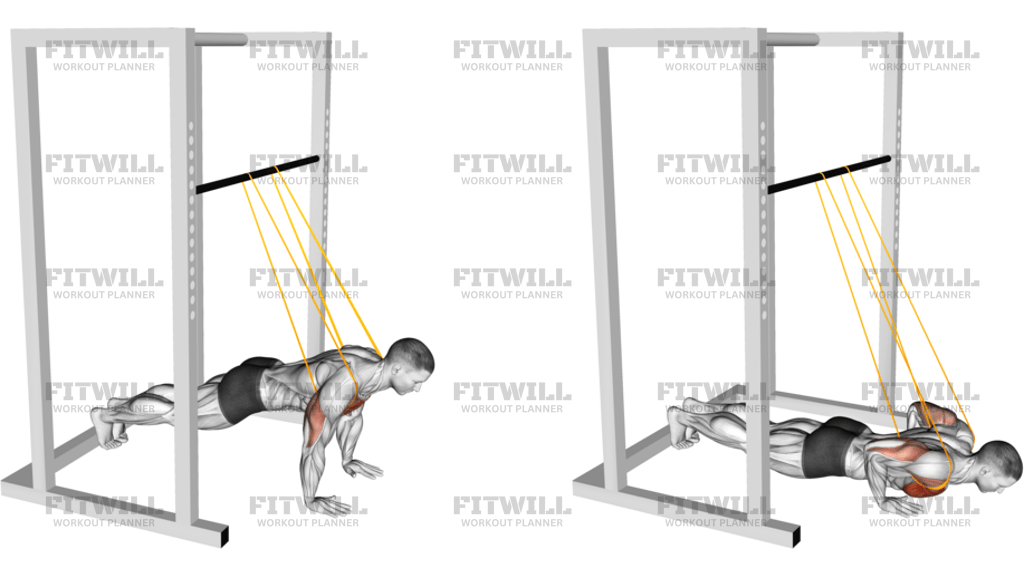
Resistance Band Assisted Push-Up is a band-supported pressing exercise that helps you practice a full push-up while reducing how much bodyweight you have to press. The band is anchored high and supports the torso as you lower and press, which makes the movement useful for beginners learning push-up mechanics, for lifters building extra volume, and for anyone who wants cleaner reps than they can manage with an unassisted floor push-up.
The main training focus is the chest, with the front shoulders, triceps, and core working to keep the body rigid and the press path smooth. In anatomy terms, the primary work comes from the Pectoralis major, with help from the Anterior deltoid, Triceps brachii, and Rectus abdominis. The band changes the loading curve so you can stay in a strong plank, keep the chest engaged, and practice consistent pressing mechanics without collapsing at the bottom.
The setup matters more here than it does in a standard push-up because the band has to sit in the right place to assist instead of pulling you out of position. Position the band across the upper back and line it up with a high anchor so it supports the torso without riding up toward the neck. Set the hands slightly wider than shoulder width, place the wrists under the shoulders, and walk the feet back until the body forms a straight line from heels to head.
Once you are set, keep the ribs tucked, squeeze the glutes, and lower with control until the chest approaches the floor. The elbows should track at a moderate angle rather than flaring straight out. Press the floor away as the band helps you through the hardest part of the rep, then finish with the elbows fully extended and the shoulders still organized instead of shrugged forward.
Resistance Band Assisted Push-Up works well as a regression when regular push-ups are too hard, as an accessory movement for higher-rep chest work, or as part of a warmup when you want pressing volume without excessive fatigue. It also fits well when you want to reinforce bodyline control, because the band only helps if you keep the torso tight and the plank position honest. If the hips sag, the neck cranes, or the band shifts position, reduce the difficulty and reset before continuing.
Fitwill
Log Workouts, Track Progress & Build Strength.
Achieve more with Fitwill: explore over 9600 exercises with images and videos, access built-in and custom workouts, perfect for both gym and home sessions, and see real results.
Start your journey. Download today!




Instructions
- Loop the band over a high anchor and place it across your upper back so it supports the torso without sliding up toward the neck.
- Set your hands on the floor slightly wider than shoulder width and stack your wrists under your shoulders.
- Walk your feet back into a straight plank so your heels, hips, ribs, and head form one line.
- Screw your hands into the floor, brace your abs, and squeeze your glutes before the first rep.
- Inhale as you lower your chest toward the floor with your elbows tracking about 30 to 45 degrees from your sides.
- Keep the band centered on your upper back as you descend and pause briefly near the bottom without relaxing your trunk.
- Press the floor away and exhale as you drive back up until your elbows are straight and your chest is lifted.
- Reset the plank after each rep, then lower again with the same body line and band position.
- Step your knees down or ease out of the band carefully after the set is complete.
Tips & Tricks
- If the band creeps toward your neck, lower it to the upper back before each set; a high-riding band changes the assist and can irritate the shoulders.
- Keep the hands just outside shoulder width so the chest can drive the press without forcing the elbows too far out.
- Let the band help you out of the bottom, not at the top; if the top feels weightless, the band is probably too strong.
- Use a slow 2 to 3 second descent so the band stays centered and the torso does not bounce off the floor.
- Keep the ribs down and the glutes squeezed so the lower back does not take over when the band shortens.
- If your wrists bend back sharply, use push-up handles or hold dumbbells to keep the wrist angle cleaner.
- Stop the set when your hips start sagging or your head reaches forward to chase the floor.
- Choose a band that lets you touch close to the floor without losing the plank; too much assistance turns the rep into a shrug-and-bounce.
- For more chest bias, think about bringing the biceps slightly inward on the way up instead of flaring the elbows wider.
Frequently Asked Questions
What muscles does Resistance Band Assisted Push-Up train most?
It primarily targets the chest, with the front shoulders, triceps, and core helping you keep the press stable.
Is Resistance Band Assisted Push-Up good for beginners?
Yes. It is a practical way to learn the floor push-up pattern before you can handle your full bodyweight unassisted.
Where should the band sit during Resistance Band Assisted Push-Up?
The band should sit across the upper back and stay centered as you lower and press, not ride up toward the neck.
How wide should my hands be on Resistance Band Assisted Push-Up?
Slightly wider than shoulder width is usually best. That position gives the chest room to work without forcing the elbows to flare hard.
What is the biggest mistake people make with this exercise?
The most common error is letting the hips sag while the band does the work. Keep a straight plank and lower with control.
Can I use this instead of incline push-ups?
Yes. If you need more help than a band can give, incline push-ups are another solid regression for building pressing strength.
How do I make Resistance Band Assisted Push-Up harder?
Use a thinner band or reduce the amount of assistance so you have to press a larger share of your bodyweight.
Should my elbows flare out on Resistance Band Assisted Push-Up?
No. Let them travel at a moderate angle from your sides so the shoulders stay happier and the chest can drive the press.