Boxing Block
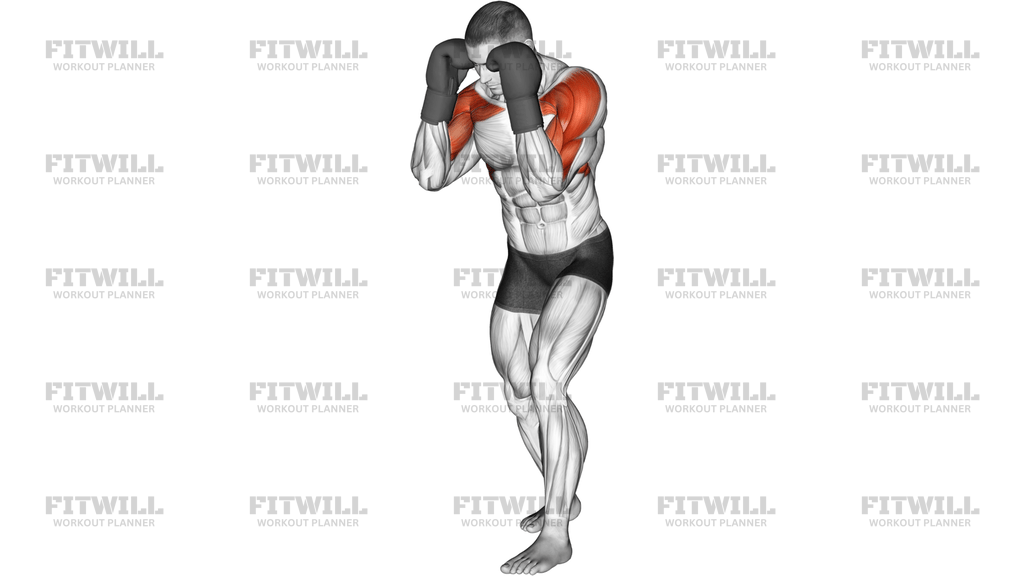
Boxing Block is a defensive boxing drill built around a tight guard, quick arm positioning, and stable lower-body balance. It teaches you how to keep your hands high, elbows close, chin tucked, and trunk braced while the upper body stays ready to absorb or redirect incoming punches. The image shows a compact fighting stance with the forearms protecting the face and the shoulders raised enough to support the guard.
Even though this is a bodyweight drill, it challenges the shoulders, upper back, arms, and trunk because they have to stay organized instead of collapsing forward. The purpose is not to swing hard or reach for a big range. It is to hold a solid boxing frame, move only as much as needed to block, and return to a protected position without losing balance or opening the ribs.
A good Boxing Block starts from the feet. Set one foot slightly ahead of the other, soften the knees, and stay on the balls of the feet so you can react quickly. Bring the gloves or fists to eyebrow height, angle the forearms in front of the cheeks, and keep the elbows tucked enough to shield the body. The head should stay behind the guard instead of poking forward into the strike line.
When you execute the block, use a short, sharp motion rather than a sweeping arm movement. Meet the punch with the forearm or glove, keep the torso quiet, and let the shoulders and trunk absorb the contact. After each rep or cue, snap the hands back to the same guard so you are ready for the next shot. Exhale on the block and reset your stance before the next repetition.
This drill is useful in boxing warmups, conditioning circuits, shadowboxing rounds, and beginner skill work because it reinforces safe defensive habits. It also helps people learn how to keep their upper body organized under pressure. If your shoulders rise too high, your elbows flare, or your stance gets too narrow, the block becomes sloppy and tiring. Clean, compact reps matter more than speed.
Fitwill
Log Workouts, Track Progress & Build Strength.
Achieve more with Fitwill: explore over 9600 exercises with images and videos, access built-in and custom workouts, perfect for both gym and home sessions, and see real results.
Start your journey. Download today!




Instructions
- Stand in a staggered boxing stance with one foot slightly in front of the other, knees soft, and your weight balanced on the balls of your feet.
- Raise both hands to cheek or eyebrow height, with the fists or gloves framing the face and the elbows tucked in front of the ribs.
- Tuck your chin slightly and let the shoulders stay high enough to protect the neck without rounding the upper back hard.
- Brace your midsection so the chest and ribs stay stacked over the hips instead of leaning forward into the block.
- For each rep, make a short block by lifting or turning the forearm into the punch line, keeping the motion tight and compact.
- Keep the nonworking hand at guard while the blocking side does the work, so the face never opens up.
- Return the blocking arm straight back to the same guard position before the next rep or punch cue.
- Breathe out as the block lands, then reset your feet and posture before the next repetition.
Tips & Tricks
- Keep the fists close enough to the face that you could cover the temples without reaching.
- Do not let the elbows drift wide; a wide guard leaves the ribs and jaw exposed.
- The block should be short and snappy, not a big shoulder swing across the body.
- Stay light on the feet so you can reset your stance after every defensive action.
- If you feel the neck working too hard, lower the shoulders slightly while keeping the chin tucked.
- Use a mirror or coach feedback to check that the forearms stay between the face and the imagined strike line.
- Exhale sharply on contact to keep the trunk braced without holding your breath.
- Slow the pace down if your hands start dropping below cheek level between reps.
Frequently Asked Questions
What is Boxing Block training?
It is a defensive boxing drill that teaches a tight guard, quick arm blocks, and stable balance under pressure.
Do I need equipment for Boxing Block?
No equipment is required, although boxing gloves or wraps can help if you are practicing with punches or partner cues.
Where should my hands be in the guard?
Keep both hands near cheek or eyebrow height so the forearms can protect the face without the shoulders drifting forward.
What are the main mistakes in this drill?
Common errors are flaring the elbows, dropping the hands between reps, and making the block too large instead of keeping it compact.
Is Boxing Block a beginner-friendly exercise?
Yes. Beginners can start with slow shadowboxing blocks and a stable stance before adding speed or partner cues.
Should my shoulders stay relaxed during the block?
They should stay active enough to protect the head, but not so tense that you lose the ability to move quickly or breathe.
Can this be used in shadowboxing rounds?
Yes. It fits well inside shadowboxing, especially when you want to practice defense and guard recovery between punches.
How do I know if my stance is too narrow or too tall?
If you feel unstable after each block or your head bounces forward, widen the stance slightly and keep the knees softly bent.